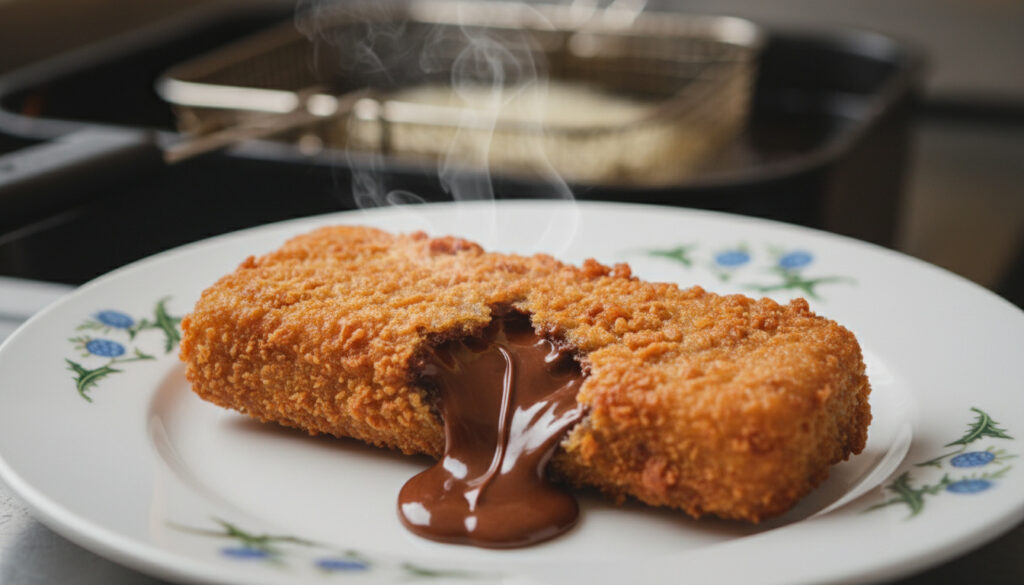
Deep Fried Mars Bar – Recipe, Calories, Scottish Origins
The deep-fried Mars bar remains one of Scotland’s most controversial culinary exports. This battered chocolate confection, originating from chip shops in Stonehaven during the late twentieth century, has sparked global fascination and medical concern in equal measure.
Despite its reputation as a nutritional outlier—packaging estimates suggest caloric loads exceeding 1,000 kilocalories per serving—the dish persists as a cultural curiosity. Tourists visiting Edinburgh and Glasgow continue to seek out the experience, while social media platforms circulate preparation methods for home cooking.
How Do You Make a Deep Fried Mars Bar?
Scottish chip shop novelty
~640–1,200 per bar (battered)
Frozen Mars bar in batter
Scotland, tourist spots, global fairs
- Emerged from Stonehaven chip shops as a novelty item
- Caloric density rivals complete meals, with specific preparations reaching 1,200 calories
- Mars Incorporated publicly disavowed the preparation citing health implications
- Requires freezing the chocolate bar prior to battering to prevent melting
- Standard preparation utilizes fish-and-chip shop batter techniques
- Media reports have linked consumption to acute blood sugar spikes and cardiovascular concerns
- Availability now extends beyond Scotland to fair vendors and select restaurants in North America
| Attribute | Detail |
|---|---|
| Origin | Stonehaven, Scotland (1980s–1990s) |
| Base Ingredient | Standard Mars bar (nougat, caramel, chocolate) |
| Coating | Flour-based batter with cornstarch or baking powder |
| Frying Temperature | 375°F (190°C) |
| Calories (Kelsey’s) | 640 per 210g serving |
| Calories (Sunset Foods) | 690 per serving |
| Calories (High estimate) | Up to 1,200 |
| Total Fat | 28g (Kelsey’s/Fat Bastards) |
| Saturated Fat | 12g (Kelsey’s) |
| Carbohydrates | 96g (Kelsey’s/Fat Bastards) |
| Protein | 9g |
| Sodium | 530mg (Kelsey’s) |
Preparation begins with freezing the chocolate bar solid. According to the method documented by Carnival Eats, the frozen bar is skewered for handling, then dipped into a thick batter comprising all-purpose flour, cornstarch, baking soda, and milk. The battered bar is submerged in 375°F oil until golden, then drained on paper towels. Alternative recipes, such as that published by Thanis Lim, incorporate vinegar and oil into the batter mixture.
Freezing the Mars bar solid before battering is essential. Without this step, the chocolate interior melts instantly upon contact with hot oil, causing the coating to slide off and the filling to leak into the fryer.
What Is the Nutritional Impact of a Deep Fried Mars Bar?
Nutritional data reveals significant variation depending on preparation standards and additional accompaniments. Kelsey’s Restaurant reports approximately 640 calories for a 210-gram serving that includes ice cream, containing 28 grams of total fat and 12 grams of saturated fat. Fat Bastards lists identical caloric values, while Sunset Foods calculates 690 calories per serving with 15.3 grams of fat.
Caloric Variations Across Preparations
The discrepancy between commercial preparations and general estimates is substantial. While standardized restaurant portions hover between 640 and 690 calories, unregulated fair preparations may exceed 1,200 calories per bar. This variation stems from batter thickness, oil absorption rates, and whether the dish is served with ancillary items like ice cream or syrup. Nutritional databases indicate that even conservative estimates position the item as a high-calorie indulgence.
Macronutrient Composition
The macronutrient profile emphasizes carbohydrate density, with Kelsey’s preparation containing 96 grams of carbohydrates representing 57 percent of caloric content. Protein remains minimal at 9 grams, while sodium reaches 530 milligrams. The Fat Bastards nutritional analysis corroborates these ratios, indicating minimal variation in commercial preparations.
Health Concerns and Manufacturer Stance
Medical discussions surrounding the dish have cited risks of extreme blood sugar elevations and potential stroke associations. Research documenting the phenomenon notes that Mars Incorporated formally disassociated itself from the preparation, requesting that Scottish chip shops stop using the Mars trade name for the fried product.
Mars Incorporated has publicly disowned the deep-fried preparation of its product, citing significant health concerns including risks of cardiovascular events and requesting that retailers refrain from selling the item under the Mars brand name.
Nutritional values vary dramatically based on batter thickness, frying duration, and portion size. While some commercial vendors list 640 calories, unregulated fair preparations and homemade versions may exceed 1,200 calories or contain higher saturated fat content.
Where Can You Find Deep Fried Mars Bars?
Locating this specialty item requires targeting specific geographic regions and venue types. The dish maintains strongest availability within its native Scotland, particularly in Edinburgh and the original Stonehaven chip shops, though accessibility in London remains limited primarily to seasonal fairs.
Scotland and the Original Chip Shops
Stonehaven, located on Scotland’s east coast, retains its status as the spiritual home of the dish. Edinburgh chip shops continue to offer the item to tourists, capitalizing on its reputation as a Scottish novelty. Historical documentation confirms the preparation emerged from this region during the 1980s and 1990s.
London and Global Availability
Specific London vendors remain unidentified in current directories, though UK fair vendors occasionally offer the item during seasonal events. The preparation has migrated to North American markets, appearing on menus at Canadian-linked chains such as Kelsey’s and Fat Bastards. Carnival and fair vendors across various regions also sporadically feature the dish. For home cooks seeking to replicate the experience, Air Fry Chicken Breast – Juicy Times and Temperatures provides alternative preparation guidance.
How Did the Deep Fried Mars Bar Phenomenon Begin?
-
Origination in Stonehaven chip shops as a novelty item for local customers and tourists.
-
Mainstream media coverage highlighting extreme health risks, including reports citing potential stroke associations and blood sugar spikes.
-
Food blogger Thanis Lim publishes home preparation methods, documenting batter recipes for Mars and Snickers bars.
-
Roads & Kingdoms publishes experiential narrative documenting the cultural phenomenon and caloric impact.
-
Commercial frying guidelines emerge from equipment manufacturers; social media platforms see increased viral recipe sharing including Carnival Ets demonstration videos.
What Do We Know for Certain About Deep Fried Mars Bars?
| Established Information | Information Remaining Unclear |
|---|---|
| Scottish origin in Stonehaven chip shops | Specific inventor or original chip shop name |
| Batter-dipped and deep-fried preparation method | Precise nutritional consistency across all vendors |
| Extreme caloric density (600–1,200+ range) | Long-term health impact studies specific to this dish |
| Mars Incorporated corporate disownment | Exact date of first preparation |
| Risk of acute blood sugar spikes | Standardized serving size regulations |
Why Did a Scottish Chip Shop Snack Become a Global Curiosity?
The migration of the deep-fried Mars bar from local oddity to international curiosity stems from its function as a symbol of culinary excess. Media coverage during the early 2000s positioned the dish as a shorthand for Scotland’s relationship with fried foods, triggering global fascination.
Social media algorithms and fair food culture sustained momentum decades after its creation. Visual documentation of the battering and frying process generates viral engagement, while the dish’s defiance of conventional nutritional wisdom renders it a novelty experience for tourists.
What Do Primary Sources Reveal About This Controversial Dish?
Mars Incorporated has publicly disowned the deep-fried Mars bar due to health concerns, with reports citing risks of blood sugar spikes, strokes, or even death from one serving.
— Art Chocolat Portfolio Documentation
The deep-fried Mars contains at least 400 calories before you even add the batter and oil. It is a massive calorie bomb.
— Thanis Lim, 2006 Culinary Documentation
What Are the Key Facts About Deep Fried Mars Bars?
The deep-fried Mars bar represents a high-calorie Scottish novelty requiring frozen chocolate bars dipped in batter and fried at 375°F. With caloric loads ranging from 640 to over 1,200 calories depending on preparation, the dish carries documented health warnings from its original manufacturer. Those interested in alternative home frying techniques might consider exploring Air Fry Chicken Breast – Juicy Times and Temperatures for comparative methods.
Frequently Asked Questions
Is it safe to eat a deep fried Mars bar?
Consuming a deep-fried Mars bar poses acute metabolic risks including blood sugar spikes. Medical warnings have cited stroke risks. Mars Incorporated disavows the product. Moderation is essential.
Can you deep fry a Mars bar at home?
Yes. Freeze the bar solid first. Prepare batter with flour, cornstarch or baking powder, and milk. Fry at 375°F until golden. Drain on paper towels before serving.
Why did Mars Incorporated disown the dish?
Mars Incorporated publicly disowned the preparation due to extreme health concerns, including risks of cardiovascular events and blood sugar spikes associated with consumption.
How many calories are in a deep fried Mars bar?
Estimates vary significantly. Kelsey’s and Fat Bastards versions contain approximately 640 calories. Sunset Foods recipes indicate 690 calories. Some preparations may exceed 1,200 calories.
Where was the deep fried Mars bar invented?
The dish originated in Stonehaven, Scotland, emerging from local chip shops during the late twentieth century as a novelty item for tourists and locals.
Is this dish available outside Scotland?
Availability extends to Edinburgh, London fair vendors, and North American restaurants including Kelsey’s and Fat Bastards. Carnival vendors in various regions also offer the item.
What type of oil works best for frying?
Use high smoke-point oils suitable for deep frying. Standard vegetable, canola, or peanut oils heated to 375°F provide optimal results for the batter coating.
More related posts
 Van Gogh Death: Cause, Facts, and Tragic Story
 Touker Suleyman Net Worth, Businesses & Dragons’ Den Exit
 Simon Jordan: Net Worth, Illness, Wife, and Full Biography
 Ryan Searle: His Rare Eye Condition, Career & Net Worth
 Leon Kennedy: Age, Marriage, Love Interest & Power Comparison
 Mo Gilligan: Biography, Net Worth, Kids & Allegations
 Tom Brady: Career, Family, Ireland Trip, and Life After Football
 Club Brugge vs Aston Villa Lineups: Predicted XI & Preview
