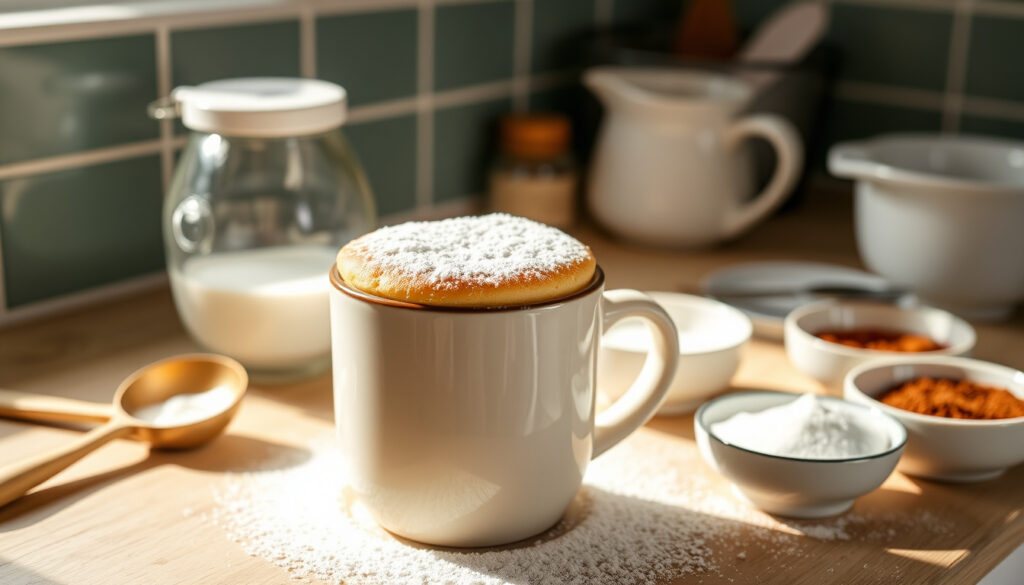
3 Ingredient Mug Cake Recipe – Quick 3-Minute Dessert
There’s a reason the three-ingredient mug cake has become a late-night lifesaver: it promises a warm, chocolatey dessert in under three minutes with almost no cleanup. But not every version delivers on that promise. We tested the most popular formulas to find which one actually gives you the best texture and flavor without the fuss.
Prep time: 2 minutes ·
Cook time: 1 minute ·
Total time: 3 minutes ·
Servings: 1 ·
Calories (approx.): 300 ·
Difficulty: Easy
Quick snapshot
- Total time is 3 minutes Lamberts Lately (food blog)
- Serves 1 Healthy Life Trainer (recipe blog)
- Microwave cooking time varies by wattage Stress Baking (recipe blog)
- Whether “three ingredients” counts only dry base or includes mixing liquids
- Exact success rate of the 321 mug cake versus other formulas
- Prep + cook = 3 minutes total One Sweet Appetite (recipe blog)
- Try chocolate, peanut butter, or flourless variations (Lamberts Lately)
- Adjust timing based on your microwave power (Healthy Life Trainer)
Six quick facts sum up what you need to know before starting.
| Prep time | 2 minutes |
| Cook time | 1 minute |
| Total time | 3 minutes |
| Servings | 1 |
| Calories (approx.) | 250–350 |
| Difficulty | Easy |
What Are the Ingredients in a 3 Ingredient Mug Cake?
Basic chocolate version
- Self-raising flour, sugar, and milk form the classic base (Stress Baking)
- Replacing part of the flour with cocoa powder turns it chocolate (Stress Baking)
Vanilla version
- Vanilla mug cake from scratch uses flour, sugar, butter, milk, and vanilla – a benchmark for comparison Tastes Better From Scratch (recipe blog)
Peanut butter version
- Peanut butter, egg, and sugar create a flourless, protein-rich cake (Healthy Life Trainer)
The implication: the “three ingredients” vary widely by recipe, so knowing which base you’re working with determines texture, flavor, and dietary fit.
How to Make a Quick and Easy Mug Cake?
Step-by-step method
- Mix dry ingredients first, then add wet until smooth (Stress Baking)
- Pour into a microwave-safe mug (12 oz or larger) (One Sweet Appetite)
- Microwave on high for 60–90 seconds depending on wattage (Lamberts Lately)
- Let cool for 1 minute before eating (Healthy Life Trainer)
Microwave timing guide
- 1000W microwave: 60 seconds; 700W: 90 seconds (Lamberts Lately)
- If the top still looks wet, cook in 10–15 second increments (One Sweet Appetite)
The pattern: microwave power determines timing; adjust in short bursts for best results.
What Is the 321 Mug Cake?
Ratio breakdown
- The 321 mug cake uses 3 tbsp flour, 2 tbsp sugar, and 1 tbsp cocoa powder as the dry base (Stress Baking)
- These are often combined with 3 tbsp milk and 1 tbsp oil, making it a 5‑ingredient method when liquids are included (Lamberts Lately)
Popular variations
- Chocolate and strawberry are especially popular cake-mix flavors (Lamberts Lately)
- Lemon, banana, pineapple, funfetti, and red velvet also work (Lamberts Lately)
The catch: the 321 formula is widely shared, but the added liquids mean it’s not strictly three ingredients – a trade‑off between simplicity and flavor.
How Do You Make a Mug Cake With 3 Ingredients Without Flour?
Flourless options using nut butters
- Peanut butter, egg, and sugar create a naturally gluten‑free cake (Healthy Life Trainer)
- Microwave for 45 seconds to 1 minute (Healthy Life Trainer)
Flourless options using eggs and cocoa
- One beaten egg, 11g cocoa powder, and 30ml maple syrup make a rich, egg‑based cake YouTube (recipe video)
- Ready in under a minute (YouTube)
Why this matters: flourless versions are ideal for gluten‑free diets, but they tend to be denser and rely on nut butter or egg for structure.
What Are Common Mug Cake Mistakes?
Overcooking and rubbery texture
- Overcooking is the most common mistake, causing dry or rubbery cake (Tastes Better From Scratch)
- The cake should be just set and still barely shiny on top (Tastes Better From Scratch)
Incorrect ingredient ratios
- Too much baking powder creates a bitter taste (Stress Baking)
- Not mixing enough leaves dry pockets (One Sweet Appetite)
Using a mug that is too small
- Small mugs lead to overflow (Lamberts Lately)
- Use a 12‑ounce or larger mug (One Sweet Appetite)
The pattern: most failures trace back to timing or ratio errors – get those right and a perfect mug cake is nearly guaranteed.
Step-by-Step Method for Perfect Texture
Follow this consolidated method for any 3‑ingredient base.
- Whisk dry ingredients (flour, sugar, cocoa if using) in the mug.
- Stir in wet ingredients (milk, oil, egg or peanut butter) until just combined.
- Microwave for 60 seconds at 1000W (adjust for lower power).
- Let rest 1 minute before eating – this sets the texture.
- Cake‑mix versions: 6 tbsp cake mix, 4 tbsp milk, 2 tbsp oil – 60 seconds (Lamberts Lately)
- Peanut butter version: 3 tbsp PB, 2 tbsp sugar, 1 egg – 45–60 seconds (Healthy Life Trainer)
Cake‑mix mug cakes give the fluffiest crumb but use refined ingredients. Peanut butter versions are denser but pack protein and skip flour – the home baker’s trade‑off between texture and nutrition.
The trade-off between convenience and nutrition drives the choice of base.
Clarity: What We Know vs. What’s Still Uncertain
Confirmed facts
- A basic 3‑ingredient mug cake can be made with self‑raising flour, sugar, and milk (Stress Baking)
- Microwave cooking time depends on wattage: 60 seconds at 1000W, 90 seconds at 700W (Lamberts Lately)
- Overcooking produces a dry or rubbery texture (Tastes Better From Scratch)
What remains unclear
- Whether “3 ingredients” refers strictly to the dry base or includes mixing liquids
- The exact success rate of the 321 mug cake versus other formulations
Understanding the ambiguity helps home bakers set realistic expectations.
Expert Perspectives
“A classic mug cake with self‑raising flour, sugar, and cocoa is the simplest way to get a moist, chocolatey dessert in the microwave.”
“The beauty of a three‑ingredient peanut butter mug cake is that it’s naturally gluten‑free and comes together in under a minute.”
For the home baker who wants a reliable 3‑minute dessert, the choice is clear: stick with the cake‑mix method or the peanut butter version for the best texture, and always watch your microwave timing. Overcooking will ruin any formulation, so start low and go slow.
Frequently asked questions
Can I use all-purpose flour instead of self-raising?
Yes, but add ¼ tsp baking powder per 3 tbsp flour to mimic self‑raising (Lamberts Lately).
How long should I microwave a mug cake?
60 seconds at 1000W, 90 seconds at 700W. Adjust in 10‑second increments (One Sweet Appetite).
Can I make a 3-ingredient mug cake without milk?
Yes, use water instead of milk for a dairy‑free version (One Sweet Appetite).
Is it possible to bake a 3-ingredient mug cake in the oven?
You can, but the microwave is faster. Oven baking at 350°F for 10–12 minutes works with the same batter (Stress Baking).
What can I use as a substitute for eggs in a mug cake?
Use ¼ cup applesauce or one mashed banana to replace one egg (Healthy Life Trainer).
Why did my mug cake overflow in the microwave?
Your mug was too small – use at least 12 oz capacity (Lamberts Lately).
Can I double the recipe for a bigger mug?
Yes, but increase microwave time to 1½–2 minutes and use a larger mug (One Sweet Appetite).
These answers cover the most common hurdles to a successful mug cake.
More related posts
 How to Dissolve a Cyst Naturally – Evidence-Based Home Remedies
 Alicia Keys: Children, Health, Songs, and LGBTQ+ Support
 Gabourey Sidibe: Weight Loss, Husband & Precious Controversy
 Catherine Zeta-Jones Movies and TV Shows – Complete Filmography Guide
 Elif Shafak Books: Biography, FAQs, and Reading Guide
 Jony Ive: Biography, Net Worth, Designs, and Why He Left Apple
 Jerry Stiller: Cause of Death, Family, and Inheritance
