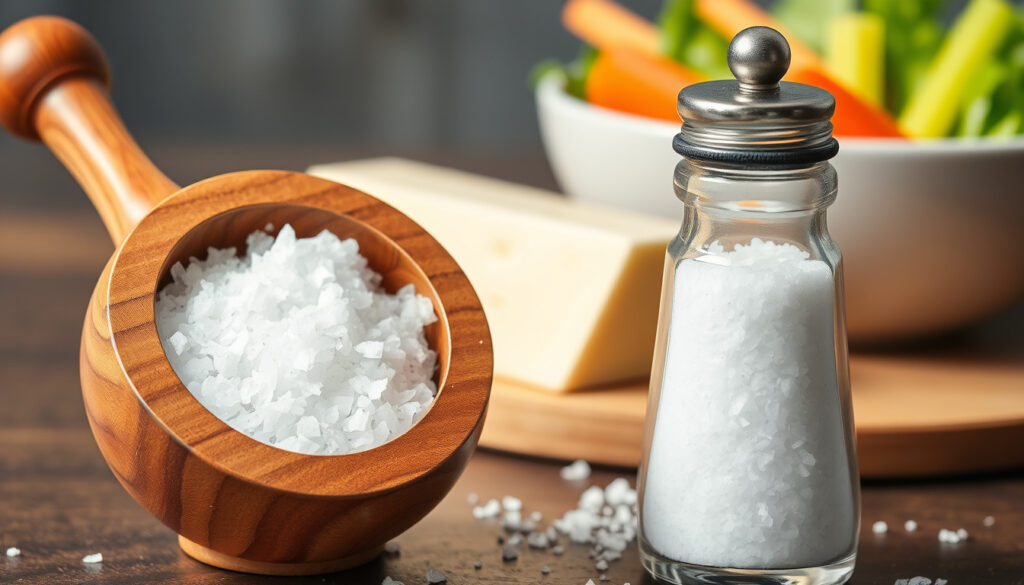
Sea Salt Benefits vs Table Salt: Facts for Your Health
Few kitchen staples spark as much quiet debate as sea salt. For years it has been sold as the more natural, mineral-rich alternative to everyday table salt, yet the basic chemistry of both is nearly identical. This guide separates the evidence from the marketing, comparing sea salt to table salt on nutrition, iodine, and the claims that actually matter for your health.
Sodium per teaspoon (sea salt): ~2,300 mg ·
Trace minerals present: Magnesium, calcium, potassium, zinc ·
Production method: Evaporation of seawater ·
Global annual production: ~250 million metric tons ·
Historical use: Over 4,000 years
Quick snapshot
- Sea salt is produced by evaporating seawater (Illinois Extension)
- Both sea salt and table salt contain about 40% sodium by weight (Mayo Clinic Health System)
- Table salt is typically iodized; sea salt rarely is (Mayo Clinic Health System)
- Whether trace minerals in sea salt provide meaningful health benefits (Mayo Clinic Health System)
- Whether Dead Sea salt baths are effective for arthritis (limited evidence) (Mayo Clinic Health System)
- Whether coarser sea salt crystals lead to lower sodium intake in practice (Mayo Clinic Health System)
- WHO targets a 30% reduction in population sodium intake by 2025–2030 (PAHO/WHO)
- Artisan and gourmet sea salt markets are growing, but a 2023 review found lead exceeded maximum levels in all sampled gourmet salts (PubMed Central)
- Consumer interest in “natural” salts continues to rise despite nutritional equivalence (PAHO/WHO)
- Expect more public-health campaigns emphasizing sodium reduction from all salt types (World Health Organization)
- Regulatory scrutiny of heavy-metal content in artisan salts may increase (World Health Organization)
- Clearer labeling requirements for iodine content could emerge (World Health Organization)
| Attribute | Detail |
|---|---|
| Sodium per teaspoon | 2,300 mg |
| Minerals | Trace amounts of Mg, K, Ca (Michigan State University Extension) |
| Production | Evaporation of seawater |
| Forms | Fine, coarse, flaky |
| Iodine | Typically none (Illinois Extension) |
| Anti-caking agents | Rarely added (table salt usually contains them) |
| Processing level | Minimal |
| Primary use | Cooking, cosmetics, preservation |
| Heavy-metal risk | Potential lead content in less-refined varieties (PubMed Central) |
What are the benefits of sea salt?
What makes sea salt special?
- Sea salt is produced by evaporating seawater, a process that preserves trace minerals such as magnesium, calcium, potassium, and zinc (Michigan State University Extension).
- It undergoes minimal processing compared to table salt, which is typically refined and stripped of minerals (Mayo Clinic Health System).
- The crystals are larger and coarser, giving sea salt a distinct texture and crunch that many chefs and home cooks prefer.
- Artisan varieties — from Irish brands like Achill Island and Salt of Kinsale to French fleur de sel — are valued for their terroir and flavor complexity.
Is sea salt healthy for you?
- Sea salt and table salt both contain roughly 40% sodium by weight, so the basic impact on blood pressure is identical (Mayo Clinic Health System).
- The World Health Organization identifies sodium reduction as one of the most cost-effective ways to reduce noncommunicable disease burden globally (World Health Organization).
- Sea salt may contain trace minerals, but the amounts are nutritionally minor compared with the rest of your diet (Mayo Clinic Health System).
- Because sea salt is less refined, it may contain impurities — including potentially toxic elements like lead — depending on the source water and processing (Michigan State University Extension).
Sea salt’s “natural” label is its biggest marketing advantage — and its biggest scientific weakness. The same minimal processing that preserves trace minerals also leaves behind whatever contaminants were in the source water. A 2023 review found that lead exceeded the maximum level in every sampled gourmet salt (PubMed Central). Natural doesn’t automatically mean safer.
The implication: For the average person, switching from table salt to sea salt will not improve health outcomes. The sodium content is the same, the mineral benefit is negligible, and the iodine you lose from skipping iodized salt is a real trade-off — especially in regions where iodine deficiency remains a concern (World Health Organization).
Sea salt vs. table salt: What’s the difference?
Is sea salt healthier than table salt?
- Sea salt is made from evaporated seawater or salty lake water; table salt is mined from underground salt deposits (Illinois Extension).
- Table salt is processed to remove minerals and typically contains anti-caking agents to prevent clumping (Mayo Clinic Health System).
- Table salt is fortified with iodine, a key public-health measure that prevents thyroid enlargement (goiter) and iodine deficiency disorders (Mayo Clinic Health System).
- Sea salt can have slightly less sodium by volume — not by weight — because its larger crystals pack less tightly into a spoon (Illinois Extension).
The catch: The lower-sodium-by-volume effect is real but misleading. If you measure by weight — which is how nutrition works — both salts deliver the same sodium punch. A teaspoon of fine sea salt weighs less than a teaspoon of table salt, so you get slightly less sodium per spoonful. But if you weigh them on a scale, gram for gram, they’re identical (Michigan State University Extension).
What is the healthiest salt?
- From a sodium perspective, no salt is healthier than another — all are roughly 40% sodium by weight.
- Iodized table salt has the advantage of preventing iodine deficiency, which sea salt does not provide.
- Specialty salts like Himalayan pink salt, Celtic sea salt, and fleur de sel vary in trace mineral content, but the differences are not clinically significant (Mayo Clinic Health System).
- The healthiest choice is the one that helps you control your total sodium intake — regardless of color, origin, or grain size.
Is salt good for skin infections?
What kills a bacterial skin infection?
- Salt water can help cleanse minor wounds through osmotic action — the salt draws fluid out of tissues, which can flush out bacteria (PubMed Central).
- Salt has documented antibacterial properties, but it is not a substitute for medical treatment of bacterial skin infections (Mayo Clinic Health System).
- Sea salt baths may soothe symptoms of eczema or psoriasis due to the anti-inflammatory effect of magnesium absorbed through the skin.
- Risks include skin irritation, dehydration of healthy tissue, and delayed healing if used improperly.
What is the salt trick for aging skin?
- Some social-media trends suggest using sea salt as a natural exfoliant to reduce signs of aging by sloughing off dead skin cells.
- There is no clinical evidence that sea salt reverses aging or stimulates collagen production.
- Over-scrubbing with coarse salt crystals can damage the skin barrier, leading to redness, irritation, and increased sensitivity.
- Dead Sea salt is sometimes marketed for anti-aging, but studies are limited and mostly focus on its mineral content rather than any anti-aging mechanism (Mayo Clinic Health System).
The trade-off: Exfoliation can temporarily make skin look smoother, but the effect is mechanical, not regenerative. A salt scrub is no substitute for sunscreen, hydration, and proven skincare ingredients like retinoids or vitamin C.
Is sea salt good for arthritis?
- No strong scientific evidence supports the claim that sea salt improves arthritis symptoms or disease progression.
- Sea salt baths — particularly those using Dead Sea salt — are marketed for arthritis relief, with the theory that magnesium absorbed through the skin can reduce inflammation and joint pain.
- A small number of studies suggest that bathing in mineral-rich salt water may provide temporary relief from joint stiffness and pain, but the evidence is limited and not conclusive.
- The relaxation and warmth of a bath alone can reduce perceived pain, making it difficult to isolate the effect of the salt itself.
Is sea salt the same as Epsom salt?
- No — they are chemically different compounds. Sea salt is primarily sodium chloride (NaCl), while Epsom salt is magnesium sulfate (MgSO₄).
- Epsom salt is not intended for cooking; it is used in baths to soothe sore muscles and promote relaxation.
- Sea salt can be used for both cooking and bathing, while Epsom salt has a bitter taste and is not food-grade.
- The confusion arises because both are marketed as “wellness” salts and are often sold in similar packaging.
Five products, one pattern: Sea salt, table salt, Epsom salt, Himalayan salt, and Dead Sea salt are all marketed as distinct health products, but they share more similarities than differences in their core chemistry. The real distinction is between edible salts (sodium chloride) and therapeutic salts (magnesium sulfate), not between “natural” and “processed.”
The comparison table below lays out the key differences.
| Feature | Sea Salt | Table Salt | Epsom Salt |
|---|---|---|---|
| Chemical composition | Sodium chloride (NaCl) | Sodium chloride (NaCl) | Magnesium sulfate (MgSO₄) |
| Source | Evaporated seawater | Mined underground deposits | Mined magnesium sulfate |
| Iodine content | Typically none (Illinois Extension) | Usually iodized | None |
| Grain size | Coarse to fine | Fine, uniform | Coarse crystals |
| Primary use | Cooking, cosmetics, preservation | Cooking, seasoning | Baths, muscle relaxation |
| Edible | Yes | Yes | No (bitter, laxative effect) |
| Sodium content | ~40% by weight | ~40% by weight | None |
| Anti-caking agents | Rarely | Commonly added | No |
Upsides
- Sea salt offers a more complex flavor and texture than table salt
- Minimal processing preserves trace minerals and natural crystal structure
- Can be used in cooking, cosmetics, and bath products
- Artisan varieties support local producers and traditional methods
- No anti-caking agents or additives
Downsides
- Same sodium content as table salt — no health advantage for blood pressure
- Lacks iodine, a critical nutrient for thyroid health
- May contain heavy metals like lead in less-refined varieties (PubMed Central)
- Higher cost than table salt, often with no nutritional benefit
- Coarser grains can be harder to measure accurately in recipes
What we know and what remains unclear
Confirmed facts
- Sea salt and table salt have the same basic nutritional value — both are ~40% sodium by weight (Mayo Clinic Health System)
- Sea salt is not a cure for skin infections and should not replace medical treatment
- Epsom salt is chemically different from sea salt (magnesium sulfate vs. sodium chloride)
- Table salt is the primary dietary source of iodine in many countries, and sea salt does not provide it (Illinois Extension)
- WHO recommends reducing total sodium intake to under 2,000 mg per day from all sources (World Health Organization)
What’s unclear
- Whether the trace minerals in sea salt provide any measurable health benefit beyond what a normal diet already supplies
- Whether Dead Sea salt baths are effective for arthritis — the evidence is limited and mixed
- Whether the lower sodium-by-volume effect of coarse sea salt actually translates to reduced sodium intake in real-world use
- Whether the higher cost of artisan sea salt is justified by any health benefit
- Whether the heavy-metal content in gourmet salts poses a long-term health risk at typical consumption levels (PubMed Central)
Expert perspectives
Sea salt and table salt have the same basic nutritional value.
— Mayo Clinic Health System (leading U.S. medical research center)
Dead Sea salt may help with some skin conditions, but the evidence is limited.
Salt water can help cleanse wounds due to osmotic effect, but it is not a substitute for medical treatment.
— National Institutes of Health (U.S. medical research agency)
What the evidence tells us is that sea salt’s reputation as a health food rests more on marketing than on science. The real choice for consumers isn’t about which salt is “healthier” — it’s about whether you prioritize flavor and texture over iodine fortification, and whether you’re willing to pay a premium for a product that, gram for gram, delivers the same sodium as the cheapest table salt. For anyone concerned about blood pressure, heart health, or iodine intake, the most important step is simply to use less salt, regardless of the type. For the cook who values crunch and mineral complexity, sea salt has a place in the kitchen — just not as a health supplement. For the Irish consumer looking at local artisan brands from Achill Island or the Salt of Kinsale, the choice is clear: enjoy the flavor and the craft, but don’t expect it to transform your health.
lifebridgehealth.org, en.wikipedia.org, who.int, webmd.com, centralvirginiachiro.com, goodrx.com, oddssider.net
For a detailed comparison of sodium content and health implications, see this analysis of sea salt vs table salt.
Frequently asked questions
Is sea salt lower in sodium?
No. By weight, sea salt and table salt both contain about 40% sodium. Sea salt may have slightly less sodium by volume because its larger crystals take up more space in a spoon, but the difference is negligible when measured by weight (Mayo Clinic Health System).
Can sea salt be used for cooking?
Yes, sea salt is widely used in cooking. Its coarse texture makes it ideal for finishing dishes, and it can be used in any recipe that calls for salt. Keep in mind that fine sea salt measures differently than coarse sea salt by volume.
What is the best sea salt for health?
No sea salt is meaningfully healthier than another. All varieties are primarily sodium chloride with trace amounts of other minerals. The healthiest choice is the one that helps you manage your total sodium intake (World Health Organization).
Does sea salt expire?
Sea salt does not expire in the sense that it spoils, but it can absorb moisture from the air and clump over time. Stored in an airtight container in a dry place, it will last indefinitely. Flavored or infused sea salts may lose potency over time.
How is sea salt made?
Sea salt is produced by evaporating seawater or salty lake water. The water is collected in shallow ponds, and the sun and wind gradually evaporate the water, leaving behind salt crystals that are then harvested and sometimes washed or dried (Illinois Extension).
Is sea salt good for high blood pressure?
No. Sea salt has the same sodium content as table salt, so it has the same effect on blood pressure. Reducing sodium intake from all sources is what matters for managing hypertension (Mayo Clinic Health System).
Can sea salt help with weight loss?
There is no evidence that sea salt aids weight loss. It contains no calories, but it also has no metabolism-boosting properties. Any weight loss associated with a low-salt diet is typically due to reduced water retention, not fat loss.
What is Celtic sea salt?
Celtic sea salt is a type of sea salt harvested from the coastal regions of France, particularly the Guérande area. It is typically gray in color due to the clay and sand in the salt flats, and it retains more moisture and trace minerals than standard sea salt. Its nutritional profile is still predominantly sodium chloride.
More related posts
 Anthony Elanga: Newcastle Record Signing Profile
 Laura Haddock Biography: Net Worth, Children, and Divorce
 Chuck Norris Death: Life, Legacy, and $70M Estate
 Mick McCarthy: Career, Net Worth, Saipan Incident, Current Role
 Secure Dog Field Near Me – Private UK Paddocks for Safe Off-Lead Play
 Alan Cumming Movies and TV Shows – Complete Filmography Guide
 Tom Welling: Smallville Star’s Life Now & Net Worth
 Clara Amfo: Radio 1 Exit, Strictly, and What’s Next
