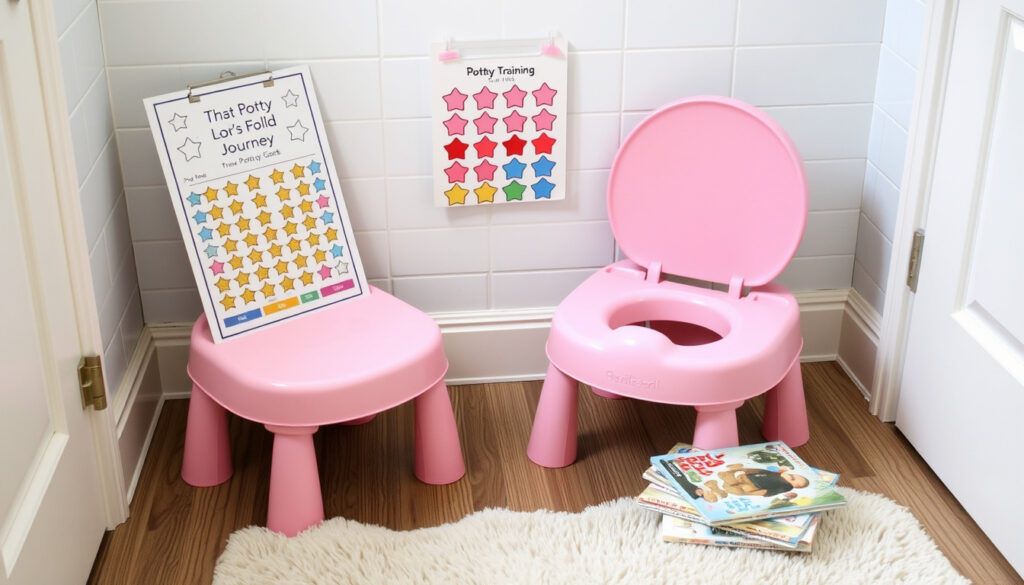
Potty Train a Girl: Ages, Methods, and a Day 1 Plan
There’s a reason the potty-training phase sits somewhere near the top of every parent’s mental mountain: it’s messy, it’s emotional, and it never follows a strict script. The NHS (UK public health service) points to a window between 2 and 2.5 years as the sweet spot, and the guidance is refreshingly calm about accidents and refusals—an evidence-based frame that shapes day one, poop stand-offs, and choosing the right method.
Recommended start window: 18 months to 3 years ·
NHS sweet spot: 2 to 2.5 years ·
Popular fast-track: 3 days ·
Potty placement tip: Accessible play area and regular sit times
Quick snapshot
- The NHS (UK public health service) flags 2 to 2.5 years as the ideal window to start.
- Fidgeting or going quiet can signal a need to go (Cambridgeshire Children’s Health, NHS trust).
- Daily practice such as nappy-free time helps build the routine (NHS). (NHS (UK public health service))
- Whether the 10-10-10 rule improves outcomes remains anecdotal.
- Whether girls reliably train faster than boys is not settled.
- Whether intelligence directly affects difficulty is unsupported by evidence.
- Most children show readiness between 18 months and 3 years (NHS).
- The NHS advises starting between 2 and 2.5 years, if no big disruptions (NHS 111 Wales).
- Bowel control often takes longer than urine control (Cambridgeshire Children’s Health, NHS trust).
- Choose a method: gradual, 3-day intensive, or elimination communication. (NHS Tayside, Scottish health board)
- Set up day 1 with the potty visible and accessible (NHS Tayside, Scottish health board).
- Plan for the hardest day (usually day 2 or 3, when novelty fades). (NHS Tayside, Scottish health board)
Four numbers capture most of the planning: the age window, the ideal start, the method menu, and the reason poop lags behind.
| Factor | What the guidance says |
|---|---|
| Typical age window | 18 months to 3 years |
| Ideal start per NHS | 2 to 2.5 years, if no big disruptions (NHS, UK public health service) |
| Common methods | Child-oriented, 3-day intensive, scheduled, elimination communication |
| Poop training | Often slower than urine training; use seated routine and foot support |
What is the new guidance on potty training?
Potty train NHS: what parents should know
- Read books about the potty, model with dolls or toys, and practise sitting (Sheffield Children’s Hospital, NHS specialist care).
- Change nappies in the bathroom and involve your child in flushing and handwashing (NHS Tayside, Scottish health board).
- Give up to 30 minutes of nappy-free time after a wee or poo.
The modern consensus is clear: pressure is counterproductive. NHS 111 Wales states that potty training must proceed slowly and at the child’s pace, and that a child cannot be forced to use a potty. The same guidance advises avoiding major disruptions or changes in family routine before starting.
What this means: the goal is to build a low-anxiety routine around the potty, not to hit a developmental deadline.
Why child-led timing matters
Starting too early turns a learning skill into a power struggle. NHS guidance consistently links success to readiness rather than a birthday.
NHS guidance encourages practising sits without nappies and watching for the child’s own signals. Fidgeting, suddenly going quiet, or moving to a specific spot are listed by Cambridgeshire and Peterborough Children’s Health as recognisable signs that a child needs the toilet (Cambridgeshire Children’s Health, NHS trust).
The pattern: children who are guided gently when they show signs pick it up faster than children who are marched to the potty on an adult schedule.
What age should you be potty trained at?
Is age 3 too late to potty train?
- Most children show readiness between 18 months and 3 years.
- The 2-to-2.5-year sweet spot is widely repeated in NHS guidance.
- Age 3 is not too late; readiness signals matter more than the exact birthday.
If a 3-year-old is dry for longer stretches, shows interest in the toilet, and can pull clothes down, the window is wide open. NHS guidance focuses on the child’s pace and physical readiness, not a strict calendar deadline.
The trade-off: starting later can shorten the training period, but can also meet more resistance.
Potty training a 2-year-old girl
- NHS Tayside recommends clothing that is easy for a child to pull down, encouraging independence.
- Sitting for both wees and poos works best for girls at this age.
- A potty or seat adapter that lets her feet rest flat makes it easier to relax and push.
At 2, a girl often has the physical and communication skills to start: she can walk to the potty, pull at her clothes, and understand simple instructions. The NHS advises avoiding overly frequent prompting and instead directing the child gently when they are likely to need the toilet.
The implication: setting up the environment (easy clothing, flat feet, visible potty) does more work than constant reminders.
What are the different potty training methods?
What is the 10-10-10 rule for potty training?
- The 10-10-10 rule is a structured practice technique circulating in parenting groups.
- It is not presented as universal NHS guidance.
- The NHS advice is broader: guide the child as part of an everyday routine rather than pressuring them constantly.
The exact details of the 10-10-10 rule vary, and parents should be wary of any method that claims a single fix. The evidence-based frame from the NHS focuses on consistency and calm.
What is the fastest way to potty train?
- Three-day potty training is the most common fast track.
- It requires close adult supervision and frequent bathroom trips.
- Speed does not override readiness; a child cannot be forced to use a potty (NHS 111 Wales, Welsh health service).
A 3-day method can work for a child who is already showing readiness. If she isn’t ready, it becomes a battle. The NHS approach is to watch for the child’s signals and adjust.
How do Chinese potty train babies?
Traditional Chinese infant toilet training is closer to elimination communication: early cue-based sits, often with split pants, rather than reward-based toddler training.
This approach maps neatly to the NHS advice in one key respect: it treats the child’s timing and signals as the starting point. The difference is that elimination communication starts much earlier, while the NHS advises waiting for the 2-to-2.5-year window for the main training push.
How to potty train a girl in 3 days
- Set up the potty in the play area where she spends most of her time.
- Use regular sits: first thing in the morning, after meals, and before bath time.
- Keep the same routine on days 2 and 3 even when the novelty fades.
- Handle accidents calmly; anxiety can make toileting more difficult.
The catch: the 3-day method is intense, but the NHS reminds parents that a child picks this up at her own pace. If day 3 is still accident-heavy, that’s a signal to slow down, not to push harder.
The implication: no single method is universally right; the one that fits the family’s daily rhythm will succeed.
Do boys or girls potty train quicker?
Are intelligent children harder to potty train?
- There is no credible evidence that intelligence makes potty training harder.
- Temperament, attention, and physical readiness are the real variables.
- Parents often perceive girls as slightly earlier, but the difference is small.
NHS guidance does not stratify readiness by gender or IQ. It points to observable skills and signals, which is the safer measure for any child.
Temperament and readiness signs that matter more
Watch her signals, not the neighbor’s kid. Fidgeting, going quiet, or moving to a particular place are the cues that matter.
Physical skills matter too: walking to the potty, pulling clothes down, and sitting steadily. Cambridgeshire and Peterborough Children’s Health lists these clear signals and advises directing the child gently to the potty when they appear (Cambridgeshire Children’s Health, NHS trust).
What this means: consistency with one method matters more than switching approaches based on gender or perceived ability.
What should I do on day 1 of potty training?
What is the hardest day of potty training?
Many parents find day 2 or 3 harder than day 1. The novelty fades, and the child starts testing the routine. Keep the same structure and stay calm.
Day 1 is a familiarization run. The potty is new and interesting. By day 2, the child realizes this is permanent. NHS Wales says consistency is key and warns against starting during major disruptions or changes in family routine (NHS 111 Wales, Welsh health service).
A simple day 1 schedule
- Keep the potty in the room where she plays.
- Praise every attempt, even if nothing happens.
- Use quick-don pants or clothing that is easy to pull down.
Below is the routine that NHS-aligned guidance supports. It combines structured sits with the calm-response principle from Cambridgeshire.
- Put the potty in the play area.
- Sit her on it first thing in the morning, after meals, and before bath.
- Give about 30 minutes of nappy-free time after a wee or poo (NHS Tayside, Scottish health board).
- If she produces anything, involve her in emptying and flushing, then wash hands together.
- For accidents, change her calmly and say no more than “We do wees and poos in the potty.”
The pattern: day 1 is about repetition, not perfection. If you stay calm and consistent, you’re already past the biggest hurdle.
How to get a toddler girl to poop in potty?
Bowel training vs. urine training
Poop training often takes longer than urine training. A later bowel-training win is normal; the underlying fear is usually the sensation of letting go.
For a child reluctant to poo in the potty, the NHS suggests a progressive approach: begin with a loose nappy, then loosen it a little more each day until the poo falls into the toilet. This eases the fear of falling.
Why this matters: withholding poop turns into constipation, which turns into pain, which makes the next attempt harder. Breaking that loop is the real job.
How to help your child stop withholding poop
- Set a routine: sit after meals, support her feet firmly, and keep the position relaxed.
- Stay close without forcing; Sheffield Children’s Hospital advises never forcing a child to sit.
- Explain what the potty is for in simple words and involve her in flushing the poo away.
Sheffield Children’s Hospital also recommends limiting a potty sit to about two minutes (Sheffield Children’s Hospital, NHS specialist care). A short, calm sit beats a long, forced one. If she is clamping down or crying, end the sit and try again later.
The trade-off: pushing too hard in the moment can extend the standoff for weeks. Patience is the fastest strategy.
The pattern: reducing the child’s fear around bowel movements is the single most effective strategy.
Potty training methods compared
Three approaches dominate the advice, and they differ mainly in pacing and how closely you follow the child’s cues.
| Method | How it works | What the evidence says |
|---|---|---|
| Child-oriented / gradual | Potty stays visible; sits happen naturally after meals or before bath | Aligned with NHS guidance; low pressure, works with child’s readiness |
| 3-day intensive | Block off a long weekend, remove nappies, prompt every 30–60 minutes | Popular, but speed should not override readiness (NHS 111 Wales, Welsh health service) |
| Elimination communication / infant | Cue-based sits from early infancy, often with split pants | Traditional in some cultures; relies on reading the baby’s timing closely |
The implication: there’s no single “best” method. The one you can execute calmly and consistently is the one that will work.
The upsides and downsides
Upsides
- Starting at the NHS-recommended 2-to-2.5-year window means most children have the physical and language skills to succeed.
- Following the child’s cues builds confidence and avoids power struggles.
- A calm, low-pressure routine keeps anxiety down, which makes toileting easier.
Downsides
- Waiting too long can lead to social pressure from nursery or family.
- Fast-track methods demand intense supervision and can backfire if readiness isn’t there.
- Poop training can lag for weeks, testing parental patience (and laundry supplies).
The trade-off: a slightly earlier start may mean a longer training period; a later start may mean more resistance. The NHS’ child-led middle path avoids both extremes.
A step-by-step day 1 plan
Here is the day-1 sequence that puts the NHS and NHS Tayside advice into practice.
- Place the potty in the play area. She needs to see it and touch it before she uses it.
- Prompt at anchor points: first thing in the morning, after meals, and before bath time.
- Use easy-to-pull-down clothing so she can manage independently (NHS Tayside, Scottish health board).
- Offer 30 minutes of nappy-free time after a wee or poo to connect the sensation with the potty.
- Praise every attempt, even if nothing happens.
- Keep accidents calm. Change her, reassure her, and move on.
The catch: adult consistency matters more than the child’s performance on any given day.
What’s clear and what’s not
Confirmed facts
- A calm response to accidents is essential because anxiety makes toileting harder (Cambridgeshire Children’s Health, NHS trust).
- The NHS recommends a start window of 2 to 2.5 years, assuming no big disruptions (NHS, UK public health service).
- Never force a child to sit on the potty; a sit should last about two minutes (Sheffield Children’s Hospital, NHS specialist care).
What’s unclear
- Whether the 10-10-10 rule improves outcomes compared to simpler routines.
- Whether girls reliably train faster than boys once age and readiness are controlled.
- Whether intelligence plays any direct role in potty-training difficulty.
The pattern: the NHS guidance is confident on environment and adult behavior, and silent on trendy rules and gender comparisons. That silence is itself a signal.
What the experts say
“Potty training should be guided, not pressured. Regular nappy-free time and a consistent routine help children learn at their own pace.”
— NHS, UK public health service
“A calm response to accidents is essential because anxiety can make toileting more difficult.”
— Cambridgeshire and Peterborough Children’s Health, NHS trust
“A child cannot be forced to use a potty. Training must go slowly, at the child’s pace, and without major changes in family routine.”
— NHS 111 Wales, Welsh health service
For the parent staring at a cupboard full of nappies, the choice is clear: anchor your plan to the NHS’s 2-to-2.5-year window, pick a method you can repeat calmly, and treat day 1 as a low-pressure introduction rather than a test. The alternative—rushing the calendar or forcing the potty—turns a normal developmental milestone into a battle of wills.
Related reading
These resources extend the evidence-based framework into other practical parenting challenges.
oxfordhealth.nhs.uk, shropscommunityhealth.nhs.uk, leicspart.nhs.uk
Frequently asked questions
How long does potty training usually take?
It varies widely. The NHS advises going at the child’s pace and keeping the routine consistent, and notes that poop training often takes longer than urine training.
What are the signs of potty training readiness?
Look for longer dry stretches, interest in the toilet, the ability to pull clothes down, and physical cues like fidgeting, going quiet, or moving to a particular place, as noted by Cambridgeshire and Peterborough Children’s Health.
Should I use a potty chair or a toilet seat adapter?
Use whichever lets your child’s feet rest flat, so she can relax and push. NHS Tayside recommends clothing that is easy to pull down, which makes either choice simpler for the child.
How do I handle potty training regression?
Stay calm and consistent. The NHS advises avoiding major disruptions and maintaining the same routine. A calm response prevents anxiety from making the regression worse.
Can I start potty training before 2 years old?
Some families do, but the NHS points to 2 to 2.5 years as the general sweet spot. Starting earlier is fine if your child shows clear readiness signals and you keep the pressure off.
What should I do if my child refuses to sit on the potty?
Never force it. Sheffield Children’s Hospital advises limiting a potty sit to about two minutes and ending it calmly if she is upset. Try again later, and involve her in flushing or handwashing to build curiosity.
More related posts
 Jessica Ennis-Hill: Biography, Family, Career, and Current Life
 3 Ingredient Mug Cake Recipe – Quick 3-Minute Dessert
 Sabrina Carpenter Rumors: Facts vs. Speculation
 Paul Walker Death: Crash Cause, Speed, and Aftermath
 Quinta Brunson: Husband, Divorce, Net Worth, Age & More
 Dining Tables Ireland: Complete Buying Guide (2025)
 Mark Bonnar: Biography, Career, and Personal Life
 Scottish School Holidays 2025: Guide for Every Council
