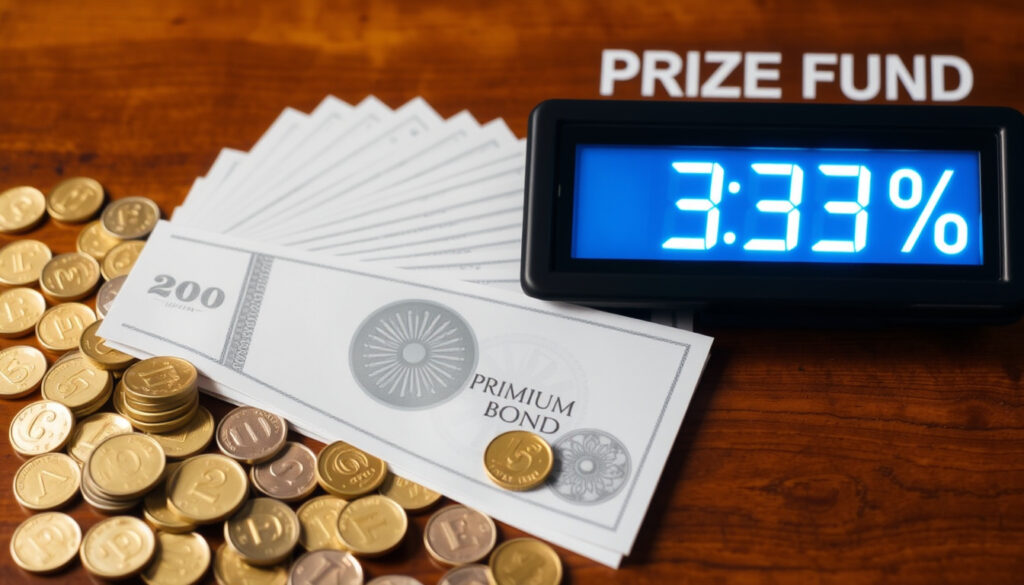
Premium Bonds Interest Rate: 3.3% Prize Fund Explained
Premium Bonds are a UK government-backed savings product where your money enters a monthly tax-free prize draw instead of earning interest. NS&I has cut the prize fund rate to 3.30% from April 2026, worsening the odds to 23,000 to 1 — making it harder to justify holding large sums compared to guaranteed alternatives.
Current Prize Fund Rate: 3.30% variable (tax-free) ·
Odds per £1 Bond: 23,000 to 1 ·
Maximum Holding: £50,000 ·
Government Fund Rate (Dec 2024): 4.15% (decreasing to 4% Jan 2025) ·
Prizes Monthly: Tax-free lottery draw
Quick snapshot
- Current prize fund rate sits at 3.30% (NS&I Official)
- Odds per £1 bond are 23,000 to 1 (Moneyfactscompare)
- Maximum holding capped at £50,000 (NS&I Official)
- All prizes are tax-free (NS&I Official)
- Whether further cuts follow in 2026
- Your personal odds depend on total bonds in issue
- Exact impact of inflation on real returns
- Prize fund peaked at 4.65% in September 2023 (Moneyweek)
- Rate cut to 3.30% effective April 2026 draw (Moneyfactscompare)
- Sixth cut since September 2023 (Moneyweek)
- April 2026 draw: ~5.94m prizes worth £375m (Moneyfactscompare)
- Average payout drops to £330 per £10,000 held (Moneyfactscompare)
- Competition from market savings rates intensifies (Moneyfactscompare)
| Metric | Value | Source |
|---|---|---|
| Prize Fund Rate | 3.30% (Nov 2024) | NS&I Official |
| Odds | 23,000 to 1 per £1 | NS&I Official |
| Max Investment | £50,000 | NS&I Official |
| Tax Status | Tax-free prizes | NS&I Official |
| Backing | UK Government | NS&I Official |
| Direct ISA Rate | 3.50% tax-free/AER | NS&I Official |
| Bond Fund Interest (Dec 2024) | 4.15% | Wikipedia (Reference) |
| Non-winners (FOI 2025) | 63% of all holders | Moneyweek |
What is the average return on Premium Bonds?
The concept of “interest” doesn’t strictly apply to Premium Bonds — NS&I calls it a prize fund rate instead, and that distinction matters. Rather than paying guaranteed interest, the scheme uses your money to fund a monthly lottery. Prizes range from £25 to £1 million, and the size of the prize pool depends on the current prize fund rate.
Prize fund rate explained
The prize fund rate currently sits at 3.30% — this isn’t interest you’ll receive, but rather the annual percentage used to calculate the total prize pool distributed each month (NS&I Official). For every £10,000 you hold, the fund theoretically allocates £330 per year in prizes — though whether you personally see that depends entirely on luck. NS&I uses ERNIE (Electronic Random Number Indicator Equipment) to generate completely random numbers each month, making predictions impossible (Wikipedia Reference).
Historical rates
The prize fund rate has fluctuated significantly over recent years. It stood at 1.40% in December 2017, dropped to 1.00% during the pandemic-era lows of December 2020, then surged during the rate-hike cycle — reaching 2.2% in October 2022, 3% in January 2023, and a peak of 3.6% by August 2025 (Moneyfactscompare). The rate then fell to the current 3.30% for the April 2026 draw, marking the sixth cut since the September 2023 high of 4.65% (Moneyweek).
Effective return vs interest
Comparing Premium Bonds to a standard savings account requires a mental shift. Easy-access accounts now offer around 4–5% AER, while fixed-rate bonds frequently exceed 5%. If you hold £10,000 in Premium Bonds and receive the average payout of £330, that’s a 3.30% return — but it’s taxable on ordinary savings. The Premium Bonds prize is tax-free, which means the gross comparison isn’t straightforward. For basic-rate taxpayers at 20%, the tax-free nature effectively boosts the 3.30% to roughly the equivalent of a 4.125% gross return.
Is 50k in Premium Bonds worth it?
Holding the maximum £50,000 in Premium Bonds means you have 50,000 individual entries in each monthly draw. The mathematics become more interesting at this scale, but not necessarily more favourable.
Odds with maximum holding
At current odds of 23,000 to 1 per £1 bond, your £50,000 holding gives you 50,000 chances per draw. Statistically, this improves your probability of winning something, but “improves” in lottery terms still means the vast majority of draws yield nothing. A Freedom of Information request by AJ Bell in April 2025 revealed that 63% of all Premium Bonds holders have never won a single prize (Moneyweek). The odds are calculated on a per-bond basis, and the total pool of eligible bonds affects every participant equally.
Comparison to savings rates
With £50,000 in a best-buy easy-access account at 4.75% AER, you’d earn approximately £2,375 in a year — guaranteed. In Premium Bonds at the 3.30% average rate, your expected return is £1,650, but this is purely statistical. You could win nothing, or you could win multiple prizes. The guaranteed alternative delivers certainty; Premium Bonds deliver variance.
Risk of no return
The lottery structure means there’s a genuine possibility — mathematically small per draw, but cumulative over years — that a large holding never wins a penny. For investors relying on their money to work hard, the absence of guaranteed returns is a meaningful risk. Inflation compounds this concern: even if you win prizes, inflation erodes the real purchasing power of those gains over time (NS&I Official).
The paradox of Premium Bonds: the more you hold, the more the guaranteed-returns gap widens against competing savings products. For £50,000, you’re looking at roughly £725 in foregone annual interest at current market rates.
Is there a downside to Premium Bonds?
Beyond the obvious lottery risk, Premium Bonds carry structural disadvantages that savvy investors should weigh carefully before committing large sums.
No guaranteed income
Unlike certificates of deposit or fixed-rate bonds, Premium Bonds provide no predictable income stream. The prize fund rate represents an average — the luck of the draw determines your actual return. For investors who need reliable interest payments to cover living expenses or meet income targets, this structure fails basic requirements.
Prize draw risks
The probability of winning any prize in a single month is low. While £25 prizes are relatively common (the April 2026 draw is expected to include 2,806,003 of them (Moneyweek)), larger prizes are extraordinarily rare. The two £1 million prizes per draw remain constant regardless of total prize pool size (Moneyweek).
Opportunity cost vs fixed rates
NS&I’s own Guaranteed Income Bonds offer 4.41% gross (4.50% AER) for a 1-year fixed term (NS&I Official). That’s a guaranteed return exceeding the average expected payout from Premium Bonds. For investors who aren’t primarily motivated by lottery-style excitement, the opportunity cost is measurable.
Premium Bonds reward those who enjoy gambling on their savings. For everyone else — particularly those seeking growth or income — comparable or superior returns exist in fixed-rate products with full certainty.
Premium Bonds rate cut: should you keep them or cash out?
The August 2025 prize fund rate cut from 3.60% to 3.30% — combined with worsening odds — has prompted serious re-evaluation among bondholders. The mathematics that once seemed reasonable are shifting.
Recent rate changes
NS&I slashed the prize fund rate by 0.30 percentage points while simultaneously worsening the odds from 22,000 to 1 to 23,000 to 1 (Moneyfactscompare). For a £10,000 holding, average expected payout drops from £360 to £330 annually. The total prize pool for the April 2026 draw falls to £375 million from £408 million in February 2026 (Moneyweek).
When to hold or sell
The case for holding weakens when guaranteed alternatives offer superior returns. However, the tax-free status of Premium Bonds prizes retains value for higher-rate taxpayers — a 40% taxpayer winning a £1,000 prize saves £400 in tax compared to equivalent interest. For those in higher tax brackets who’ve already maxed their ISA allowances, Premium Bonds retain a niche advantage.
2026 outlook
NS&I has given no indication that further cuts are imminent, but the trend since September 2023’s 4.65% peak suggests ongoing pressure. The Bank of England’s base rate decisions influence NS&I’s pricing, and further cuts could make Premium Bonds increasingly uncompetitive. For investors comfortable with a lottery element in their portfolio, holding a modest position (perhaps £5,000–£10,000) maintains excitement without excessive opportunity cost.
Cash out if you need guaranteed growth or income. Keep a small position if you’re a higher-rate taxpayer seeking tax-free speculation and you can absorb the opportunity cost.
Comparing fixed rate bonds: NS&I vs alternatives
For investors prioritizing certainty over lottery potential, the comparison between Premium Bonds and fixed-rate products is straightforward — fixed rates win on predictable returns.
Seven savings products across three issuers illustrate the competitive landscape clearly.
| Product | Rate Type | AER / Return | Tax Treatment | Source |
|---|---|---|---|---|
| Premium Bonds | Variable prize fund | 3.30% avg (not guaranteed) | Tax-free prizes | NS&I Official |
| NS&I Guaranteed Income Bonds | 1-year fixed | 4.50% AER | Gross, taxable | NS&I Official |
| NS&I Direct ISA | Variable | 3.50% AER | Tax-free | NS&I Official |
| Easy-access savings | Variable | 4.25–4.75% AER | Gross, taxable | Moneyfactscompare |
| 1-year fixed rate bond | Fixed | 4.85–5.10% AER | Gross, taxable | Moneyfactscompare |
| 2-year fixed rate bond | Fixed | 4.65–4.90% AER | Gross, taxable | Moneyweek |
| Regular saver account | Variable | 5.00–6.00% AER | Gross, taxable | Moneyweek |
Five products offer guaranteed returns exceeding Premium Bonds’ average payout, with four delivering after-tax advantages to basic-rate taxpayers. The comparison reveals Premium Bonds’ fundamental positioning challenge: the tax-free status partially compensates but doesn’t overcome the certainty gap for most investors.
NS&I fixed rates
NS&I’s Guaranteed Income Bonds for Issue 89 offer 4.41% gross or 4.50% AER for a 1-year fixed term (NS&I Official). This guaranteed return exceeds the average expected payout from Premium Bonds by 1.20 percentage points — a meaningful gap for investors who don’t need lottery-style excitement.
Premium Bonds vs fixed
Premium Bonds make sense only for investors who prioritise tax-free lottery potential over guaranteed growth. The tax-free status helps narrow the gap: for a 45% taxpayer, Premium Bonds’ 3.30% average is roughly equivalent to a 6% gross return on a standard account. But the variability — from zero to potentially much more — remains the defining characteristic.
Upsides
- UK Government-backed security
- 100% tax-free prizes withinPersonal Savings Allowance
- No risk of capital loss
- Instant access with no penalties
- Monthly draw excitement
- Potential for life-changing £1 million prizes
- Valuable for higher-rate taxpayers who’ve exhausted ISAs
Downsides
- No guaranteed returns — could win nothing indefinitely
- Average payout below market fixed rates
- 63% of holders never win a prize (FOI data)
- Odds worsen with each NS&I rate cut
- Variable rate subject to future reductions
- Large holdings face greater opportunity cost
- Inflation erodes real value of prizes over time
Timeline
| Date | Event | Source |
|---|---|---|
| September 2023 | Prize fund rate peaks at 4.65% | Moneyweek |
| January 2023 | Prize fund rate set at 3% | Wikipedia (Reference) |
| December 2024 | Odds worsen to 22,000 to 1; bond fund interest at 4.15% | Moneyweek |
| December 2024 | Bond fund interest decreases to 4%; January draw awards 5,851,240 prizes worth £429 million | Wikipedia (Reference) |
| December 2024 | FOI reveals 63% of holders never won a prize | Moneyweek |
| August 2025 | Prize fund rate reaches 3.6% | Wikipedia (Reference) |
| August 2025 | Prize fund rate cut to 3.30%; odds worsen to 23,000 to 1; ~5.94m prizes worth £375m expected | Moneyfactscompare |
What we know — and what remains unclear
Certain facts anchor the Premium Bonds debate. NS&I has confirmed the current 3.30% prize fund rate and 23,000 to 1 odds (NS&I Official). The maximum holding of £50,000 is fixed. All prizes remain tax-free. The April 2026 changes have been formally announced (Moneyfactscompare).
What remains genuinely uncertain is whether further cuts follow. NS&I has given no forward guidance on future rate changes, and the bond fund interest rate that underpins NS&I’s pricing continues to fluctuate. The impact of inflation on real returns over extended holding periods is also unclear — while prizes are tax-free, inflation progressively erodes their purchasing power.
“Millions of Premium Bondholders may be left feeling demoralised after National Savings & Investments (NS&I) today announced it’s reducing the chance of winning in its monthly draws.”
— Moneyfactscompare (Savings News)
“The nearest thing Premium Bonds have to an interest rate is their annual prize rate, which is currently 3.3%.”
“Despite this, Westhead reassured bondholders that the April 2026 draw is still expected to have close to six million tax-free prizes up for grabs, worth around £375 million in total.”
— Moneyfactscompare (NS&I Spokesperson Quote)
Summary
Premium Bonds occupy a peculiar niche: government-backed savings with lottery mechanics and tax-free prizes. The current 3.30% prize fund rate and 23,000 to 1 odds represent a further deterioration from the already-reduced levels of recent months. The chance of winning life-changing sums keeps millions invested, but the mathematics increasingly favour guaranteed alternatives for investors who don’t need lottery excitement.
The 63% of holders who have never won anything face a stark reality check: over years and decades, Premium Bonds may never deliver a penny in prizes while competitors pay reliable interest. For UK investors who can tolerate uncertainty, a modest Premium Bonds holding (under £10,000) maintains lottery access without excessive opportunity cost. For those needing growth or income, the clear choice is fixed-rate products — many offering guaranteed returns exceeding Premium Bonds’ average payout by over a percentage point.
Related reading: What Is a SIPP · Cost of Living Payment 2025 Gov UK
With the prize fund at 3.3%, savers increasingly question Premium Bonds worth it analysis against rising fixed-rate alternatives and low odds of winning big.
Frequently asked questions
What are the new NS&I interest rates?
NS&I’s Premium Bonds carry a 3.30% prize fund rate (August 2025 onwards), down from 3.60%. Their Guaranteed Income Bonds offer 4.50% AER for 1-year fixed terms, and the Direct ISA provides 3.50% tax-free. All official rates appear on the NS&I website.
What are the odds of winning Premium Bonds with £50,000?
At 23,000 to 1 per £1 bond, £50,000 gives you 50,000 entries per draw. While this sounds favourable, the odds compound against winning significant prizes. Most draws yield nothing for most large holders.
Is NS&I a 6.2% fixed rate?
No. NS&I’s highest current fixed rate is 4.50% AER on Guaranteed Income Bonds. Claims of 6.2% fixed rates are false — either misremembered historical rates or competitor products.
Where should I put my money in 2026?
For guaranteed growth: 1-year fixed rate bonds at 4.85–5.10% AER outperform Premium Bonds’ average 3.30%. For tax-free savings: ISAs max out before Premium Bonds become optimal. Reserve Premium Bonds for the excitement element and higher-rate tax situations.
Where can I get 10% return on my money?
No legitimate UK savings product offers 10% returns currently. Premium Bonds cannot guarantee any return, let alone 10%. Historical rates at that level belong to high-inflation periods. Anyone promising 10% guaranteed returns is likely operating a scam.
Is it worth putting £20k in Premium Bonds?
At the 3.30% average rate, £20,000 expects £660 in annual prizes — versus roughly £950 in a 4.75% easy-access account. The £290 difference represents your “lottery ticket premium.” Only pay it if tax-free excitement matters more than guaranteed growth.
Is it worth putting £5k into Premium Bonds?
At £5,000, the opportunity cost is smaller (approximately £72.50 annually versus market rates). Many investors find the modest Premium Bonds position worth holding for the monthly draw excitement without significant financial penalty.
Can I use a calculator to estimate my personal odds?
Yes. NS&I and MoneySavingExpert both offer calculators that estimate your personal probability of winning based on your holding amount. These tools use the official odds formula and can help you calibrate realistic expectations.
More related posts
 Beetle Juice 2024: Sequel, Cast, and Scary Rating Facts
 Rishi Sunak: Career, Resignation, and Net Worth
 Tyrese Gibson: Career, Divorce, and Financial Troubles
 Where Is Ridley Set – Fictional Town and Real Filming Locations
 Scott Disick: Net Worth, Inheritance, and Relationship
 Ray Davies Kinks: Age, Health, Relationship, Songs & More
 Gary Stevenson: Former Trader, Activist, YouTube Exit
 Tim Peake: From Military Pilot to First British ESA Astronaut on the ISS
