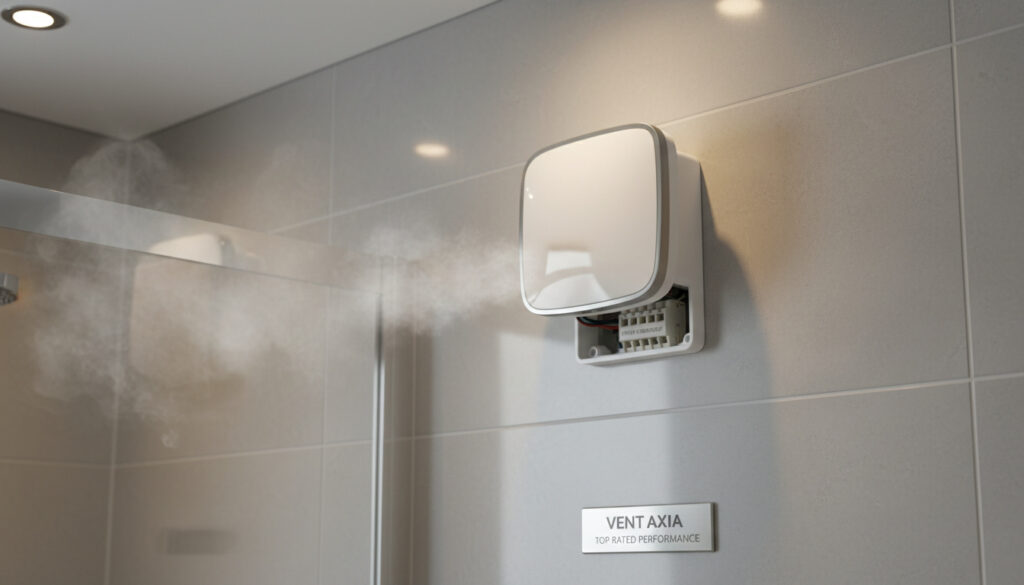
Vent Axia Extractor Fan – Best Models, Installation and Reviews
Vent-Axia stands as one of Britain’s most established ventilation manufacturers, with a history stretching back to 1935. The company’s current extractor fan range targets the growing demand for near-silent operation and energy efficiency in residential bathrooms and kitchens, balancing low-noise DC motors with smart sensor technology.
The 2024-25 product line centres on three distinct technologies: the app-controlled PureAir Sense featuring odour detection, the Bluetooth-enabled Lo-Carbon Svara, and the continuous-running Lo-Carbon DMEV series. These units compete directly with alternatives from Manrose and retail own-brands, differentiated by IP44 safety ratings and Part F building regulation compliance.
Selecting the appropriate model requires balancing airflow requirements against acoustic performance, with prices ranging from basic axial units around £25 to smart humidity-controlled systems approaching £150.
Which is the Best Vent-Axia Extractor Fan?
PureAir Sense 479460 with triple sensors
5–30 l/s configurable
12–24 dB(A) at trickle speed
£25–150 depending on specification
- The PureAir Sense combines light, humidity and odour sensing with automatic boost activation.
- Lo-Carbon Svara operates at approximately 4W, consuming minimal electricity during continuous running.
- IP44/IPX4 ratings permit installation in bathroom Zones 1 and 2 when protected by an RCD.
- The ACM inline series handles duct runs up to 10 metres, outperforming standard axial fans on complex routes.
- Continuous dMEV models help meet Part F 2021 requirements for new-build properties.
- Smart models feature Bluetooth connectivity for app-based configuration and scheduling.
- Budget options such as the Slimline 436530 provide basic extraction without humidity sensors.
| Model Series | Airflow (l/s) | Noise dB(A) | IP Rating | Typical Price |
|---|---|---|---|---|
| PureAir Sense | 10–30 | 12–24 | IP44 | £100–150 |
| Lo-Carbon Svara | Variable | Very low | IP44 | £100–130 |
| Lo-Carbon DMEV | 5–30 | <20 | IPX4 | £70–100 |
| ACM Inline | High pressure | Very low | N/A (remote) | £50–120 |
| VA100XHT | ~24 | Moderate | IPX4 | £30–50 |
| Slimline 436530 | ~20 | Standard | IPX4 | £25–35 |
How Do I Install a Vent-Axia Extractor Fan?
Positioning and Ductwork Requirements
Locate the fan as far from the air inlet as practical, ideally close to the shower or bath to capture moisture at the source. For axial wall fans, keep duct runs short and straight; rigid ducting delivers better performance and lower noise than flexible alternatives. Where ducts must exceed three metres or navigate multiple bends, the ACM inline series provides the higher pressure necessary to maintain airflow.
Electrical Safety and Building Regulations
Installation must comply with Part P of the building regulations, requiring a competent person or qualified electrician. Bathroom zones mandate RCD protection and suitable isolator switches. Always verify the IP rating on the product packaging; IPX4 serves as the minimum for areas subject to splashing.
Rigid ducting improves airflow and reduces noise compared to flexible hose. When installing inline units in lofts, ensure ducting remains insulated to prevent condensation accumulation during winter months.
Common Installation Problems
Noise complaints frequently stem from rigid mounting on lightweight plasterboard without anti-vibration mounts, or from backdraft shutters flapping in wind. Poor extraction usually indicates undersized fans for the room volume, excessive duct length, or sagging flexible ducting creating condensate traps. Smart models allow sensitivity adjustments via smartphone apps, eliminating the need to access internal potentiometers.
What Are Vent-Axia Extractor Fan Reviews and Performance?
User Experience and Noise Levels
User reviews consistently describe the PureAir Sense as “super quiet” during normal operation, with the automatic odour boost function receiving particular praise. The Lo-Carbon Svara earns similar accolades for reliability after extended use, though users note the Bluetooth-only connectivity limits control to within the home.
For those interested in competitive comparisons within UK manufacturing and sports history, the Nigel Benn vs Chris Eubank – Results, History and Key Moments provides context on British design evolution during the same period Vent-Axia expanded its domestic range.
Energy Efficiency Credentials
Lo-Carbon models utilise DC motors drawing as little as 4W during continuous operation, significantly reducing running costs compared to traditional AC motors. The dMEV range maintains trickle ventilation at 1–5W, satisfying Part F requirements without excessive energy consumption.
Laboratory noise ratings assume optimal installation. Actual acoustic performance depends on duct quality, mounting surface rigidity, and maintenance frequency. Independent video assessments demonstrate the PureAir Sense operating at whisper levels in residential settings.
Smart Control Functionality
The PureAir Sense and Svara offer app-based configuration for timer over-runs, humidity thresholds, and silent-hours scheduling. The PureAir adds odour sensing, triggering automatic boost when air quality degrades. These features reduce manual intervention while ensuring compliance with ventilation standards.
Where to Buy Vent-Axia Extractor Fans and Warranty Details
Major UK retailers including B&Q and electrical specialists such as ElectricPoint stock comprehensive Vent-Axia ranges. The ACM inline series and bathroom wall fans are widely available through trade counters and online platforms, though prices vary significantly between standard and Lo-Carbon specifications.
Standard Vent-Axia models typically carry 1–3 year warranties, while Lo-Carbon ranges often extend to 5 years. Warranty terms depend on professional installation and registration; DIY installations may void coverage. Always verify specific terms on the product packaging rather than relying on general brand policies.
While Screwfix and similar retailers offer competitive pricing on budget models, specialist electrical suppliers provide better support for smart models requiring app setup. Consider total cost including ducting accessories, as these often exceed the fan unit price on complex installations.
How Has Vent-Axia Technology Evolved?
- : Vent-Axia founded, establishing early UK ventilation manufacturing.
- : Launch of the Silenta range, pioneering acoustically dampened residential extraction.
- : Integration of humidity sensors and overrun timers across mid-range axial models.
- : Introduction of Lo-Carbon DC motor technology, reducing consumption to 1–5W.
- : Release of PureAir Sense with odour detection and Bluetooth-enabled Svara, alongside updated dMEV units for Part F 2021 compliance.
What Is Certain About Vent-Axia Performance?
| Established Specifications | Installation-Dependent Variables |
|---|---|
| PureAir Sense consumes <5–8W continuous power | Acoustic levels vary by mounting surface and ducting rigidity |
| Svara draws approximately 4W during operation | Airflow performance depends on duct length and bend count |
| IP44 rating verified for bathroom Zones 1–2 | Longevity requires maintenance frequency unknown at purchase |
| ACM inline series rated for 10m duct runs | Sensor accuracy affected by dust accumulation and placement |
| DMEV models meet Part F continuous extract requirements | Condensation risk increases with uninsulated loft ducting |
Understanding UK Building Regulations Context
Approved Document F mandates specific extraction rates: 15 l/s minimum for bathrooms with the fan in the room, rising to 30 l/s when the unit sits in an adjacent space. Kitchens require 60 l/s for cooker hoods or 30 l/s for wall/ceiling extraction. Continuous dMEV systems must provide 8–13 l/s background ventilation with boosted rates for showers.
Vent-Axia positions its Lo-Carbon DMEV and PureAir ranges specifically to satisfy these regulatory requirements while maintaining the acoustic limits required for residential comfort. Installers must calculate specific room volumes and duct resistance to ensure selected models deliver the advertised air changes per hour.
Expert and User Perspectives
After 4–5 months of use, the Svara is pretty much perfect. Reliable and easy to tune via the app.
— Mark’s Tech Blogs
Super quiet operation. The automatic boost when detecting odours works exactly as described.
— Feefo user review
Final Considerations for Selection
Vent-Axia extractor fans offer proven solutions for UK bathrooms and kitchens, with the PureAir Sense and Lo-Carbon ranges leading on noise reduction and energy efficiency. While premium models command higher initial investment, reduced running costs and extended warranties often justify the expenditure. For those exploring cultural touchstones of British design and entertainment from the same era as Vent-Axia’s expansion, the Welcome to the Jungle – Meaning, Lyrics and Origins provides additional context.
Frequently Asked Questions
How do I clean a Vent-Axia extractor fan?
Isolate power at the isolator switch. Remove the grille and vacuum dust from blades and housing. Wipe with a damp cloth, ensuring sensor windows on smart models remain unobstructed. Reassemble carefully to prevent vibration.
What is the Vent-Axia fan warranty?
Standard models carry 1–3 years, while Lo-Carbon ranges extend to 5 years. Warranty validity requires professional installation and product registration. Always verify specific terms on the packaging.
How noisy are Vent-Axia extractor fans?
PureAir and Lo-Carbon models operate between 12–24 dB(A) at low speed. Inline ACM units produce minimal audible noise in bathrooms as motors sit remotely in loft spaces.
Are Vent-Axia fans suitable for kitchens?
Yes. The ACM inline series (125–150mm) handles kitchen extraction requiring 30–60 l/s under Part F. Wall-mounted axial models suit smaller kitchenettes with short duct runs.
What IP rating do Vent-Axia bathroom fans have?
Most enclosed bathroom models including Svara and PureAir Sense carry IP44 or IPX4 ratings, permitting installation in Zones 1 and 2 when RCD-protected and correctly positioned.
How do Vent-Axia fans compare to Manrose?
Vent-Axia typically offers lower wattage DC motors, app connectivity on premium models, and longer warranties. Manrose provides competitive quiet models at lower prices but lacks equivalent smart features.
Can I install a Vent-Axia fan myself?
Installation requires a competent person or qualified electrician to comply with Part P. Bathroom zones demand RCD protection and specific isolators, making DIY electrical connections inadvisable.
More related posts
 Kieran Trippier: Biography, Stats, Wife, and Career Facts
 Loving Poetry: The Best Love Poems, Deep Poetry & Urdu Classics
 Steven Seagal: From Action Star to Russian Diplomat
 Why Djimon Hounsou Is Still Struggling Financially
 Stefon Diggs: NFL Career, Net Worth & Personal Life Rumors
 Who is Serenity Cox? Real Life, Age, Net Worth & Career
 Stephen Graham: Biography, Dyslexia, Family, and Net Worth
 Oxford Dictionary Online: Free, App, & Price (2026 Guide)
