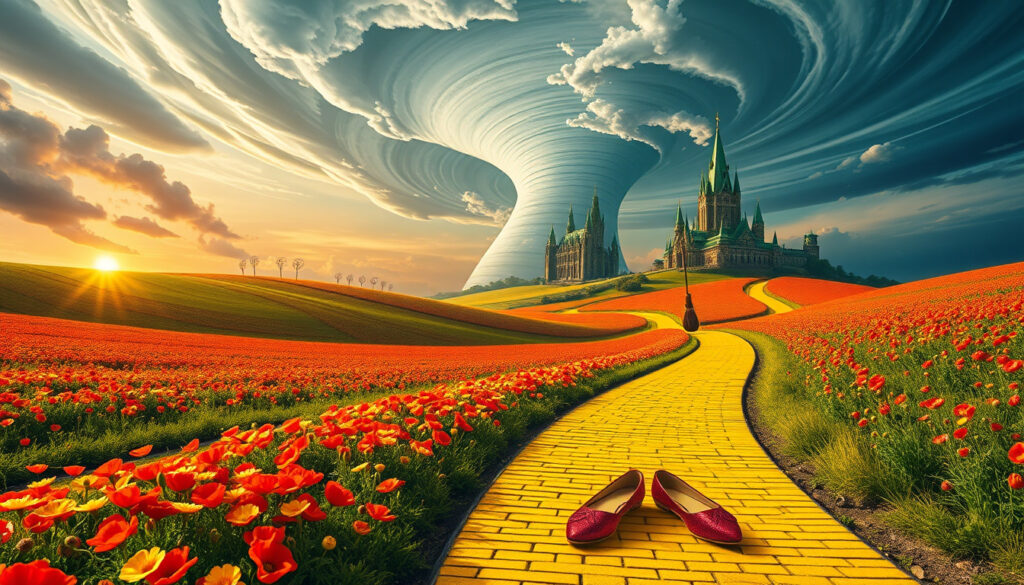
Dorothy Wizard of Oz: Story, Judy Garland & Wicked Ties
There’s a reason people still debate Dorothy’s place in Oz mythology decades after the ruby slippers first lit up the screen. She started as an ordinary Kansas farm girl in L. Frank Baum’s 1900 novel, became Judy Garland’s signature role in the 1939 MGM film, and evolved into something unexpected: a symbol embraced by generations of LGBTQ+ fans. This guide traces that journey, separating documented history from the stories fans have built around it.
First Book Appearance: The Wonderful Wizard of Oz (1900) ·
Iconic Movie Portrayal: Judy Garland in 1939 MGM film ·
Signature Item: Ruby slippers ·
Author: L. Frank Baum ·
Dog Companion: Toto
Quick snapshot
- Dorothy Gale is protagonist of Oz books starting 1900 (Autostraddle)
- Judy Garland played her in 1939 film (Autostraddle)
- Garland died aged 47 on June 22, 1969 (Irish Times)
- Exact premiere date of 1939 Wizard of Oz film (only year given in sources)
- Primary sources for WWII origin of ‘friend of Dorothy’ slang
- Divergent historian views on Stonewall-Garland link beyond legend
- ‘Friend of Dorothy’ emerged as gay code during WWII (Irish Times)
- Wicked film released 2024 with Ariana Grande and Cynthia Erivo (YouTube: The Wizard of Oz and Wicked Have Always Been Gay)
- Wicked’s sapphic Elphaba-Glinda romance continues Dorothy’s legacy in Oz storytelling
- Costume and cultural guides will define how new audiences encounter Dorothy
Key biographical and cultural details for Dorothy Gale and her Judy Garland portrayal are summarized below.
| Label | Value |
|---|---|
| Creator | L. Frank Baum |
| Debut Novel | The Wonderful Wizard of Oz, 1900 |
| Film Debut | The Wizard of Oz, 1939 |
| Actress | Judy Garland |
| Companions | Scarecrow, Tin Woodman, Cowardly Lion, Toto |
Who is Dorothy in The Wizard of Oz?
Dorothy Gale is the protagonist of L. Frank Baum’s Oz book series, first appearing in The Wonderful Wizard of Oz published in 1900. Baum created her as a young orphan girl living on a Kansas farm with her Aunt Em and Uncle Henry. Unlike the ruby slippers of the famous 1939 film, Dorothy’s magical footwear in the original novel were made of silver—a detail that MGM changed to red for Technicolor impact.
As the protagonist, Dorothy serves as the reader’s entry point into the fantastical Land of Oz. She is characterized by her practicality, kindness, and courage despite her youth. The character traits Baum established would become foundational to how audiences understand her: an ordinary girl thrust into extraordinary circumstances who relies on her wits and compassion rather than magical powers.
Origins in L. Frank Baum’s novels
Baum’s Dorothy is notably different from her cinematic counterpart. In the books, she returns to Oz multiple times across fourteen novels, developing deeper relationships with characters like Ozma, the magical ruler of the land. Scholars have noted sapphic undertones in Baum’s writing, including the Ozma-Dorothy relationship, which some modern interpretations build upon. The Carnegie Library of Pittsburgh notes that queerness in Oz traces to L. Frank Baum’s original books with elements that contemporary readers have identified as progressive for their era.
Character traits and role as protagonist
Dorothy functions as both a passive observer and active participant in her story. She asks questions, forms friendships, and makes decisions that drive the plot forward. Her role as protagonist meant that generations of readers saw themselves through her eyes—young, hopeful, and capable of greatness despite humble beginnings.
Baum designed Dorothy as a bridge between ordinary readers and fantastical possibility. That accessibility is precisely why she became such a versatile symbol, adaptable to meanings Baum himself may never have intended.
What happened to Dorothy in The Wizard of Oz?
The story most people know follows Dorothy Gale, a Kansas farm girl swept to the magical Land of Oz by a tornado. According to the narrative, she arrives at a strange world of colorful landscapes and talking creatures, with her small dog Toto the only connection to home.
Tornado journey to Oz
The tornado that transports Dorothy and Toto to Oz is the inciting incident that launches the adventure. This event separates Dorothy from everything familiar—the gray Kansas prairie becomes the vibrant colors of Munchkinland. The transition from black-and-white (in the film’s opening) to Technicolor became one of cinema’s most iconic visual metaphors, representing escape from hardship into wonder.
Adventures with Scarecrow, Tin Man, Lion
On her yellow brick road journey to the Emerald City, Dorothy befriends three companions, each lacking something they believe they need: the Scarecrow wants a brain, the Tin Woodman desires a heart, and the Cowardly Lion seeks courage. These characters became cultural shorthand for universal human desires. Notably, at a crossroads early in the story, the Scarecrow offers a line that scholars have read as queer-coded: “Of course, some people go both ways,” a phrase that has resonated with LGBTQ+ audiences for decades.
Ruby slippers and return home
After the Wizard’s reveal as an ordinary man rather than a magical ruler, Dorothy learns she can return home by clicking the heels of herruby slippers three times—a magical command revealed by Glinda, the Good Witch of the South. This ending, where Dorothy chooses to leave Oz despite its wonders, emphasizes her connection to Kansas and the people she loves. The ruby slippers themselves became one of cinema’s most recognizable objects, reproduced endlessly in costumes and merchandise.
The 1939 film’s Dorothy is not Baum’s only version, but she is the most culturally dominant. Film historians note that Garland’s portrayal shaped public perception so thoroughly that many fans are unaware the books exist with significantly different storylines and character details.
Why is Dorothy not shown in Wicked?
The musical and film Wicked tells the story of Elphaba and Glinda before Dorothy’s arrival in Oz. This prequel structure means Dorothy appears only as a distant reference—a child mentioned in the distance, never seen on screen. Fans have long wondered why the adaptation avoids the character so deliberately.
Rights and canon differences
The primary reason Dorothy doesn’t appear stems from licensing restrictions tied to the Baum estate. While Gregory Maguire’s novel Wicked and the musical it inspired exist in a separate creative space from the 1939 film, the estate controls Oz-related character usage. The Wicked creators chose to build their narrative around the time before Dorothy’s story rather than alongside it, avoiding legal complications and allowing focus on their central characters.
Focus on prequel timeline
Structurally, Wicked depends on Dorothy’s absence. The green-skinned Elphaba becomes the “Wicked Witch of the West” only in Dorothy’s story—a role that Wicked reframes as villainous propaganda spread by the Wizard’s regime. Had Dorothy appeared, the audience would struggle to see Elphaba as anything other than a villain awaiting her fate.
Face and portrayal issues in adaptations
The 2024 film with Ariana Grande as Glinda and Cynthia Erivo as Elphaba highlights the tangible romance between the two leads, building on queerness from Baum’s original books. Rather than introducing Dorothy—whose casting would invite inevitable comparisons to Garland—the production maintains focus on the sapphic relationship that has made Wicked resonate with modern audiences. The implication: Dorothy’s story continues to influence Oz narratives even when she’s not present.
Dorothy’s absence from Wicked paradoxically reinforces her importance. The prequel format acknowledges that her story is so foundational that it must come last, not first.
How much was Judy Garland paid for Dorothy?
Reports indicate that Judy Garland was paid less than some supporting actors in The Wizard of Oz despite carrying the film. At seventeen years old during production, Garland was one of MGM’s youngest contract players and lacked the negotiating leverage of established stars.
Salary compared to cast
Historical accounts suggest that Garland earned a standard MGM contract salary rather than a prominent lead’s rate. The Munchkin actors, some of whom were experienced vaudeville performers, reportedly commanded comparable fees. This disparity reflected Hollywood’s treatment of young performers at the time—valuable as rising talent but not yet powerful enough to demand top billing compensation.
Behind-the-scenes production context
Behind the magic of Oz, production was grueling. According to reporting from the Irish Times, Garland confided in co-star Margaret Hamilton (the Wicked Witch) that she couldn’t sleep or wake without studio-issued pills during eighteen-hour shoot days. She was reportedly starved and drugged on set, and faced harassment from adult Munchkin actors. These conditions exemplify the exploitation young performers faced under studio contracts of the era.
MGM fired Garland in 1950 after she attempted suicide twice. The studio’s mistreatment of its young star stands in stark contrast to the wholesome image she projected on screen.
Why is the Wizard of Oz linked to LGBTQ culture?
The connection between The Wizard of Oz and LGBTQ+ communities is layered, spanning decades of cultural adoption, code language, and personal meaning-making. It represents one of the most enduring relationships between a cultural property and a marginalized community.
Judy Garland as gay icon
Judy Garland’s status as a gay icon began solidifying during her career and intensified after her death. Richard Dyer’s influential 2004 essay “Judy Garland and Gay Men” identified androgyny, camp performance, and ordinariness as key reasons for gay identification with her persona. Garland herself had many gay friends and associates, including directors Vincente Minnelli and George Cukor, and comedian Joey Adams.
The filmmaker John Waters joked that “openly gay” sounds like running into parties screaming for Judy Garland records. The Irish Times documented how Mart Crowley’s 1968 play The Boys in the Band referenced Garland imitations, establishing her as cultural shorthand within gay communities during a period when being openly gay was criminalized.
“Friend of Dorothy” term origin
“Friend of Dorothy” originated as a discreet code term for gay men, attributed to the 1939 film. The phrase appears to have emerged during WWII, relating to the Cowardly Lion, Dorothy, and her rainbow-colored group of misfit companions. The term functioned as a coded question and answer in social situations where direct inquiry about sexuality could be dangerous.
This code became shorthand for queer identification, documented in various historical accounts of LGBTQ+ community formation. The 2022 series A League of Their Own referenced the “friend of Dorothy” connection, demonstrating how the term has entered mainstream recognition while retaining its community-specific meaning.
Themes of outsider acceptance
The narrative of outsiders finding belonging in Oz resonates deeply with LGBTQ+ audiences. Dorothy’s journey from the gray Kansas prairie to the colorful Land of Oz functions as an escape narrative for characters who don’t fit heteronormative expectations. The message—that different is not wrong, and that found family provides belonging—has made the story meaningful across generations.
Garland’s funeral on June 27, 1969, in New York City occurred with significant gay community presence. The following day, June 28, 1969, the Stonewall Uprising began. While historians debate whether this timing is coincidental or symbolic, the connection has become legend within LGBTQ+ history. Scholars note that the legend is more powerful than the confirmed facts, demonstrating how communities construct meaning from shared cultural touchstones.
Confirmed vs. Rumored
Confirmed facts
- Dorothy Gale is protagonist of Oz books starting 1900
- Judy Garland played her in 1939 film
- “Friend of Dorothy” dates to WWII era as gay code
- Garland died aged 47 on June 22, 1969
- Wicked film released 2024 with Grande and Erivo
- Richard Dyer published “Judy Garland and Gay Men” in 2004
- MGM fired Garland in 1950
What’s rumored or unclear
- Whether Garland funeral timing directly influenced Stonewall timing
- Exact premiere date of 1939 film (only year confirmed)
- Whether Garland’s Dorothy alone explains gay appeal of Oz
- Specific regional variations in how non-US communities adopted Oz
What people are saying
“Of course, some people go both ways.”
— Scarecrow, The Wizard of Oz (a line scholars cite as queer-coded)
“Openly gay,” jokes the great John Waters, “sounds like you’re running into parties screaming, ‘Got any Judy Garland records?'”
— John Waters, filmmaker (via Irish Times)
“What’s more boring than a queen doing a Judy Garland imitation?”
— Mart Crowley, playwright (The Boys in the Band, 1968)
Richard Dyer’s 2004 essay identified specific reasons for Garland’s gay male appeal: androgyny that resisted easy categorization, camp performance style, and an ordinariness that made identification possible. These academic frameworks explain what casual observations about “gay Judy fans” could not—the relationship is structural, not sentimental.
Related reading: Buffy the Vampire Slayer · X-Men Days of Future Past
thebristorian.co.uk, carnegielibrary.org, youtube.com, youtube.com, deemichel.info
Judy Garland’s timeless portrayal of Dorothy Gale propelled the 1939 film into a cornerstone of queer culture through its LGBTQ legacy.
Frequently asked questions
What color were Dorothy’s shoes in the original book?
In L. Frank Baum’s original 1900 novel, Dorothy wore silver shoes, not ruby red. MGM changed them to ruby for the 1939 film because the red color showed better in Technicolor and became iconic in its own right.
Who almost played Dorothy instead of Judy Garland?
Several young actresses were considered for the role, including Deanna Durbin. Garland won the part at age sixteen after successful earlier MGM performances, though she was reportedly not the studio’s first choice.
Is Dorothy the villain in Wizard of Oz interpretations?
Some modern reinterpretations, including Gregory Maguire’s novel Wicked, position Dorothy as an unwitting aggressor against Elphaba rather than a traditional hero. The 2024 film continues this reframing.
What breed is Toto in the Wizard of Oz movie?
Toto was played by a Cairn terrier named Terry, who was reportedly paid more per week than some human Munchkin actors. The breed became associated with Dorothy’s loyal companion as a result.
Are there cartoons featuring Dorothy from Wizard of Oz?
Animated adaptations have appeared over the decades, though none achieved the cultural impact of the 1939 live-action film. The 1974 animated film The Wizard of Oz and various television specials have featured Dorothy characters.
What is the plot of the Dorothy Wizard of Oz story?
Kansas farm girl Dorothy Gale is swept to the magical Land of Oz by tornado. Befriending a Scarecrow, Tin Man, and Cowardly Lion, she travels to the Emerald City seeking the Wizard’s help to return home. After discovering the Wizard is ordinary, Glinda tells her the ruby slippers can take her home by clicking their heels three times.
Who else is in the Wizard of Oz cast with Dorothy?
Key cast members include Judy Garland (Dorothy), Frank Morgan (the Wizard), Ray Bolger (Scarecrow), Jack Haley (Tin Man), Bert Lahr (Cowardly Lion), Billie Burke (Glinda), and Margaret Hamilton (the Wicked Witch of the West).
For audiences encountering Dorothy today, the choice is no longer between books and the 1939 film alone. Wicked offers Elphaba and Glinda’s sapphic romance; Baum’s later Oz novels provide Ozma-Dorothy dynamics; The Wiz offers a Black reimagining. Dorothy remains the reference point—present or absent—that defines how all Oz stories position themselves.
More related posts
 The City Is Ours Cast: Full Actors List & Characters
 Lauren Hemp: Profile, Height, Salary, and England Career
 Narinder Kaur: Biography, Husband, Big Brother Fame, and More
 Benson Boone Beautiful Things Lyrics: Meaning, Apology & Swift
 Jodie Marsh: Allegations, Net Worth, and Fripps Farm Updates
 Kate Hudson Kids: Facts on Her 3 Children, Partner & Adoption
 Emma Paton: Sky Sports Darts Presenter & Career
 Is My Car MOT Valid? Free Check Status & History Guide
