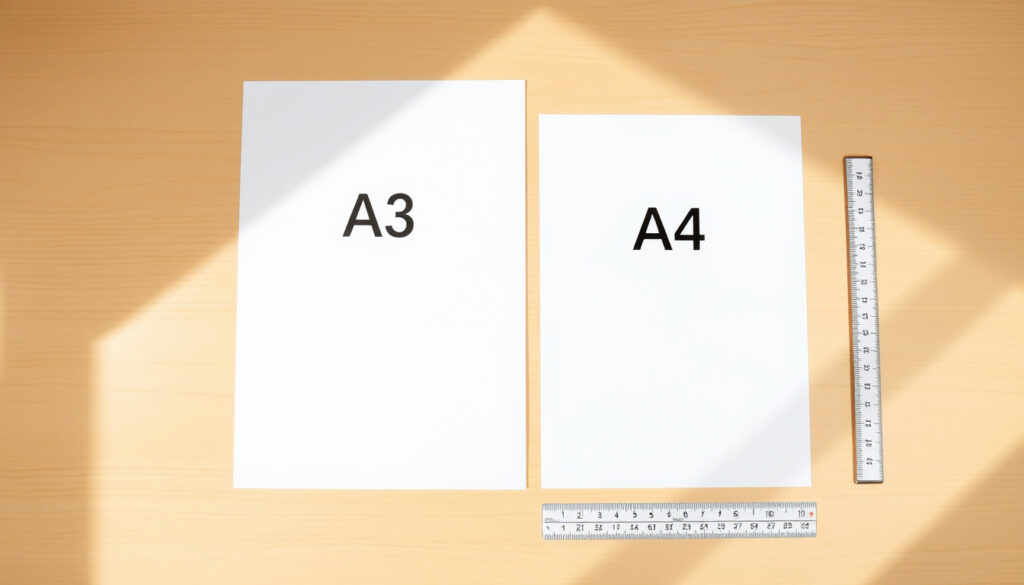
Is A3 Bigger Than A4? Paper Size Comparison Guide
A3 paper is exactly twice the size of A4 — a relationship that makes scaling designs between formats mathematically clean and eliminates the guesswork in print production. This guide breaks down the exact measurements of A3 and A4, explains how they relate within the ISO 216 family, and covers what this means for your printing options.
A3 Dimensions: 297 × 420 mm (11.7 × 16.5 inches) ·
A4 Dimensions: 210 × 297 mm (8.3 × 11.7 inches) ·
Area Ratio: A3 is 2× the size of A4 ·
Standard: ISO 216 ·
A4 Use: Letters, documents
Quick snapshot
- A3 measures 297 mm × 420 mm (GFlesch)
- A4 measures 210 mm × 297 mm (GFlesch)
- A3 is exactly twice the area of A4 (BDS Doc)
- ISO 216 governs the A-series standard (Wikipedia ISO 216)
- Regional pricing variations between A3 and A4 paper
- Exact model-by-model printer compatibility beyond size categories
- Historical adoption timelines by specific country
- The A-series system originated in German DIN 476 (1922), became ISO 216 in 1975 (Wikipedia ISO 216)
- A-series adoption spread globally through the late 20th century (Neenah Paper)
- A3+ and A4+ variants now serve commercial printing with slight oversize margins (Printerland)
- Printers increasingly support both ISO A-series and US Letter sizing natively (Printerland)
| Specification | Measurement |
|---|---|
| A3 Width × Height | 297 × 420 mm |
| A4 Width × Height | 210 × 297 mm |
| A3 in Inches | 11.7 × 16.5 |
| A4 in Inches | 8.3 × 11.7 |
| Area Ratio A3:A4 | 2:1 |
Is A3 Bigger Than A4?
Yes — A3 is unambiguously larger in every dimension. A3 measures 297 mm wide by 420 mm tall, while A4 comes in at 210 mm by 297 mm. The width difference alone is 87 mm (about 3.4 inches), and the height gap is 123 mm (roughly 4.8 inches). In imperial terms, A3 is 11.7 × 16.5 inches versus A4’s 8.3 × 11.7 inches.
Dimensions Comparison
- A3: 297 mm × 420 mm (11.69 × 16.53 inches) — GFlesch paper sizing guide
- A4: 210 mm × 297 mm (8.27 × 11.69 inches) — GFlesch paper sizing guide
- Width difference: A3 is 41% wider than A4 — Papersizes.io comparison tool
- Height difference: A3 is 41% taller than A4 — Papersizes.io comparison tool
Area and Scaling
The area difference is where the relationship gets precise: A3’s surface area is exactly double that of A4. Each step up in the A-series (A0 → A1 → A2 → A3 → A4 → A5) halves the previous size, and each step down doubles it. This halving property means cutting an A3 sheet in half by its shorter side produces two A4 sheets — a feature designers and printers rely on daily — Papersizes.io paper size reference.
Scaling a design from A4 to A3 gives exactly twice the canvas area without awkward aspect ratio distortion — the ISO standard’s 1:√2 aspect ratio makes this mathematically clean.
The implication: for any document that needs to print cleanly at both sizes, designing for A4 and scaling up to A3 works without cropping or reflowing.
Which is Bigger, an A3 or an A4?
The question answers itself once you know the numbers — A3 is the larger format. A3 is taller and wider than A4 across both metric and imperial measurements.
Metric Measurements
The table below summarizes the metric dimensions for both formats along with the exact differences in each dimension.
| Format | Millimeters | Centimeters |
|---|---|---|
| A3 | 297 × 420 | 29.7 × 42.0 |
| A4 | 210 × 297 | 21.0 × 29.7 |
| Difference | +87 width, +123 height | +8.7 wide, +12.3 tall |
Imperial Inches
- A3: 11.69 × 16.53 inches — GFlesch paper sizing guide
- A4: 8.27 × 11.69 inches — GFlesch paper sizing guide
- US Letter (for reference): 8.5 × 11.0 inches — roughly comparable to A4 but not identical — GFlesch
- US Tabloid/Ledger (for reference): 11.0 × 17.0 inches — roughly comparable to A3 but slightly taller and narrower — GFlesch
North American Letter and Tabloid sizes are close but not identical to A4 and A3. If you’re mailing printed materials internationally, always specify the ISO format to avoid last-minute trimming surprises.
The pattern: A3 and A4 are fixed by the same aspect ratio (1:√2), which means every A-series sheet has the same proportions regardless of size — Wikipedia ISO 216 reference. That consistency is why the series scales so predictably.
A3 vs A4 Paper Size: A Comparison Guide
Choosing between A3 and A4 comes down to what you’re printing and what your equipment handles. A3 dominates in visual, spatial work; A4 rules everyday office life.
Printing Applications
The table below compares typical uses and printer requirements for each format.
| Format | Typical Uses | Printer Requirement |
|---|---|---|
| A3 | Posters, architectural drawings, large diagrams, newsletters, tabloid-style layouts | A3-capable printer (handles up to 11 × 17 inch paper) |
| A4 | Business letters, reports, contracts, academic papers, standard forms | Standard office printer (handles up to 8.5 × 14 inch legal) |
Common Uses
- A3 for: Drawings, diagrams, large tables, presentation mockups, art prints — Formax Printing industry guide
- A4 for: Everyday office use — letters, invoices, reports, academic submissions — Formax Printing industry guide
- A3+ (oversized variant): 329 × 483 mm — leaves margin for bleed in commercial printing — Printerland printer resource
- A4+ (oversized variant): 250 × 337 mm — same bleed-margin logic — Printerland printer resource
A3 printers cost more to buy and run — they offer faster speeds and higher capacity to justify the investment, but for a home office printing standard letters, an A4 machine does the job without the premium price tag.
The catch: not all printers designed for A4 can mechanically handle A3 paper. If you need to scale up a design, check your machine’s maximum paper size before committing to A3 output — GFlesch.
What is A3 Size in cm?
A3 measures 29.7 cm × 42.0 cm. Converting the millimeter values to centimeters gives you the same dimensions in a more readable metric format — 297 mm becomes 29.7 cm, and 420 mm becomes 42.0 cm.
Full A-Series Overview
The table below shows how each size in the A-series relates through the halving pattern that defines ISO 216.
| Format | Dimensions (mm) | Dimensions (cm) | Approx. Inches |
|---|---|---|---|
| A0 | 841 × 1189 | 84.1 × 118.9 | 33.1 × 46.8 |
| A1 | 594 × 841 | 59.4 × 84.1 | 23.4 × 33.1 |
| A2 | 420 × 594 | 42.0 × 59.4 | 16.5 × 23.4 |
| A3 | 297 × 420 | 29.7 × 42.0 | 11.7 × 16.5 |
| A4 | 210 × 297 | 21.0 × 29.7 | 8.3 × 11.7 |
| A5 | 148 × 210 | 14.8 × 21.0 | 5.8 × 8.3 |
| A6 | 105 × 148 | 10.5 × 14.8 | 4.1 × 5.8 |
| B3 | 353 × 500 | 35.3 × 50.0 | 13.9 × 19.7 |
| C4 envelope | 229 × 324 | 22.9 × 32.4 | 9.0 × 12.8 |
The pattern: every A-series size relates to the next by halving, and the aspect ratio (1:√2) stays constant across the entire family — Wikipedia ISO 216 reference. B-series sizes fall between A-series neighbors, and C-series envelopes are sized to hold their corresponding A-format flat — Neenah Paper international guide.
How Bigger is A3 Than A4?
A3 is exactly twice the area of A4 — not approximately, but mathematically exact. The surface area of A3 is 123,744 mm² while A4 is 62,370 mm², making A3 precisely 100% larger — Papersizes.io.
Size Ratio Details
- Area ratio: A3 is 2× the area of A4 — BDS Doc paper format guide
- Width ratio: A3 is 297 mm vs A4’s 210 mm — a factor of 1.414 (√2) — Papersizes.io
- Height ratio: A3 is 420 mm vs A4’s 297 mm — also exactly √2 — Papersizes.io
- Cutting rule: Slicing A3 in half across its short side yields two A4 sheets — Papersizes.io
Folding and Scaling
The √2 aspect ratio isn’t accidental — it means that folding any A-series sheet along its longer side produces the next size down with no wasted paper. An A4 folded in half becomes A5; an A3 folded in half becomes A4. This relationship is what makes the A-series efficient for both digital design and physical printing workflows.
Scaling a design from A4 to A3 requires enlarging by exactly 141.4% — not 140% and not 150%. Getting this wrong means text reflows and margins shift. Most design software handles this automatically if you specify the target paper size.
Confirmed facts
- A3 paper measures 297 mm × 420 mm (ISO 216 standard) — Wikipedia ISO 216 reference
- A4 paper measures 210 mm × 297 mm (ISO 216 standard) — Wikipedia ISO 216 reference
- A3 is exactly twice the area of A4 — BDS Doc
- The A-series aspect ratio is 1:√2 — Wikipedia ISO 216 reference
- Cutting A3 in half produces two A4 sheets — Papersizes.io
- A-series is dominant outside North America — Neenah Paper
What experts say
The primary difference between A3 and A4 is that A3 is taller and wider.
— Papersizes.io (Paper Size Data Authority)
A-series paper sizes follow an international standard (ISO 216) that ensures every size scales predictably from the next.
— Formax Printing (Commercial Printing Experts)
A3 paper size is twice A4 — a relationship that makes scaling designs between formats mathematically clean.
— BDS Doc (Document Format Specialists)
For designers and print professionals working internationally, the A-series hierarchy is the practical backbone of scalable document production. The exact 2:1 area relationship between A3 and A4 eliminates the guesswork in scaling — print a standard A4 flyer on an A3 sheet and you get precisely 141.4% enlargement without distortion or reflowing. Anyone still relying on US Letter in global workflows should check their dimensions against A4 to avoid costly reprints.
Related reading: UK Size 8 in EU chart
According to the A3 size in inches guide, A3 translates to 11.69 x 16.54 inches, confirming its double area relative to A4 in any unit system.
Frequently asked questions
Is A4 bigger than A5?
No. A4 is larger than A5. A5 measures 148 mm × 210 mm, which is exactly half of A4 (210 mm × 297 mm). Each step down in the A-series halves the previous size — Swift Publisher.
Is A2 bigger than A3?
Yes. A2 is larger than A3. A2 measures 420 mm × 594 mm, making it exactly twice the size of A3 (297 mm × 420 mm) — BDS Doc. A2 is commonly used for art prints and architectural plans.
Is A2 bigger than A4?
Yes. A2 is four times the size of A4. A2 measures 420 mm × 594 mm, while A4 is 210 mm × 297 mm — BDS Doc. A2 is often used for medium-format printing like posters and large photographs.
What do Americans call A4 paper?
Americans use US Letter (216 mm × 279 mm) rather than A4. The sizes are close but not identical: A4 is taller and narrower than US Letter. In mixed international settings, A4 is sometimes mistakenly called “legal” or “letter-plus,” but these are not precise equivalencies — GFlesch.
Which is bigger, A1 or A2 or A3 or A4?
A1 is the largest, followed by A2, then A3, then A4. Each step in the A-series halves the previous size: A1 (594 mm × 841 mm) halves to A2, which halves to A3, which halves to A4 — Wikipedia ISO 216.
What is bigger, A3 or A4 or A5?
A3 is biggest, A4 is in the middle, and A5 is smallest. A5 (148 mm × 210 mm) is exactly half of A4, which is exactly half of A3 — Swift Publisher. A5 is commonly used for notebooks, flyers, and small booklets.
What’s bigger, A1, A2, A3, A4, and A5?
A1 is the largest and sizes descend in order: A1 > A2 > A3 > A4 > A5. At the base of the A-series sits A0 (841 mm × 1189 mm), which has an area of exactly 1 square meter — Wikipedia ISO 216. Every subsequent A-size is half the area of the one before it.
More related posts
 Daisy May Cooper: Divorce, Baby, Sobriety, ADHD & Career Update
 Ian Watkins: Verified Facts on Prison Stabbing and Death
 Alicia Keys: Children, Health, Songs, and LGBTQ+ Support
 Tia Mowry: Her Diagnosis, Divorce, and Life Now
 Bay Window Curtain Pole: How to Choose & Install Guide
 Beth Rigby Biography: Age, Career and Family Facts
 Denholm Elliott: BAFTA Actor, Illness & Cause of Death
 Paul Stanley: Disability, Net Worth, Wife, and Family
