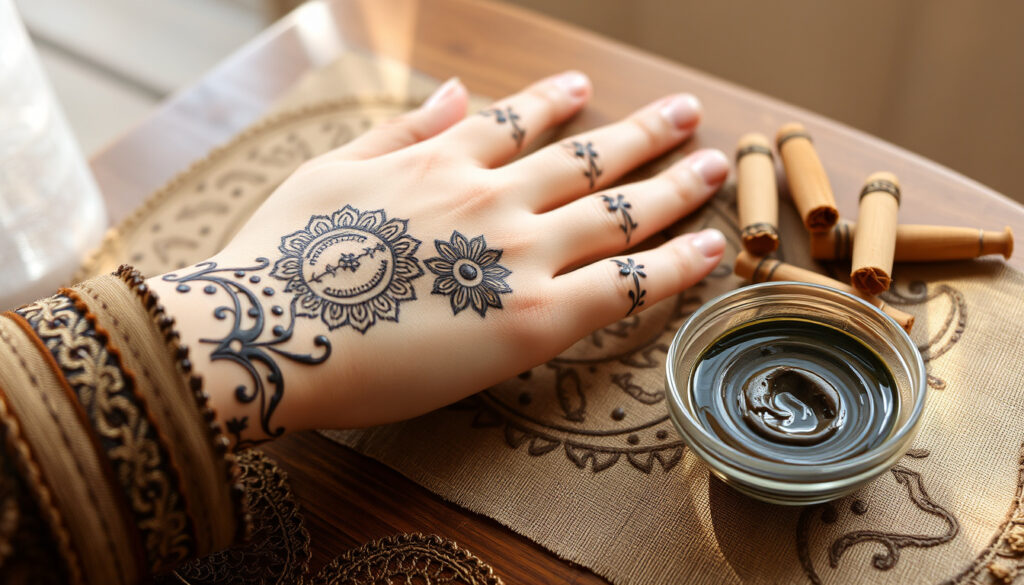
Henna Designs: Complete Guide to Meaning, Trends, and Aftercare
There’s something almost magical about the first time you see henna — the earthy paste goes on in delicate swirls, and hours later, you’re left with a rich, rust-colored design that feels both ancient and personal. Maybe you’ve spotted it at a wedding, tried a cone at a festival, or you’re just curious about the hype.
The table below captures the essential facts about henna’s benefits, risks, and care.
Key Facts at a Glance
- Henna’s active dye molecule is lawsone, which binds to keratin in the skin. (WebMD)
- The stain starts as a dark orange and oxidizes to a deeper brown over 24–48 hours. (Minnesota Department of Health)
- Natural henna is generally safe for most people when used correctly, but allergic reactions can occur in rare cases. (WebMD)
- “Black henna” is not real henna — it often contains PPD (p-phenylenediamine), which can cause severe allergic reactions and permanent scarring. (U.S. Food and Drug Administration)
- Keep the henna paste on your skin for 6–12 hours for a deeper stain; avoid water contact during this time. (Minnesota Department of Health)
- After removal, avoid scrubbing, soap, and excessive moisture for 24 hours to preserve the design. (Henna for Fun)
What Is Henna, Really?
Henna comes from the leaves of the Lawsonia inermis plant, which has been cultivated for over 5,000 years. The leaves are dried, ground into a powder, and mixed with liquids like lemon juice or tea to create a paste. When applied to the skin, the active dye molecule lawsone binds to the keratin in the top layers, creating a temporary stain. (WebMD)
The origin story points to Egypt or India around 3000 BCE, where henna was used for body art, hair dye, and even cooling the hands and feet in hot climates. Today, it’s a global phenomenon — Western interest has surged since the 2010s, with henna artists appearing at festivals, bridal showers, and wellness retreats. (WebMD)
The implication: knowing the plant origin and long history equips you to identify genuine henna and avoid synthetic fakes.
Is Doing Henna Racist?
Henna has been used for thousands of years in various cultures, including South Asian, Middle Eastern, and North African traditions. Respectful participation involves understanding and honoring the tradition, not treating it as a costume. Intent and context matter more than the act itself. (WebMD)
The pattern: when you wear henna with knowledge, you celebrate a heritage rather than exploit it.
What Does Henna Design Mean?
Henna designs often symbolize joy, blessings, and protection. Floral and paisley motifs are typical in South Asian bridal mehndi. Meaning can vary by region and occasion. (Mehndi Design Henna)
In many South Asian, Middle Eastern, and North African cultures, henna is not just decorative — it’s ceremonial. It’s commonly applied to bless newly married couples in Hindu and Muslim weddings, where the art form is known as mehndi. The phrase “henna is protection” appears in cultural practices tied to Islamic tradition, where henna is also used during celebrations like Eid and for events marking childbirth and coming-of-age. (WebMD)
The designs themselves carry meaning — paisleys represent fertility, peacocks symbolize beauty, and intricate geometric patterns are believed to offer protection from the evil eye. (Mehndi Design Henna)
- Weddings: Bridal mehndi parties are a multi-day tradition in India and Pakistan, with the bride’s hands and feet covered in elaborate patterns.
- Festivals: Eid, Diwali, and Karva Chauth all feature henna as a central part of celebration.
- Everyday beauty: In North Africa, henna is sometimes used as a natural cosmetic for staining lips or fingertips.
The catch: symbols carry weight; wearing them without context reduces a rich ritual to a fleeting fashion.
What Are the Trending Mehndi Designs for 2026?
Trends shift toward simpler, cleaner lines and negative space designs. Dark, long-lasting stains remain popular. Social media influences pattern popularity. (Mehndi Design Henna)
What this means: choosing a style is a trade‑off between contemporary aesthetics and stain longevity.
How Long Do Henna Designs Last?
Typical stain lasts 1–3 weeks depending on skin type and aftercare. Color deepens over 24–48 hours after paste removal. Leaving paste on longer (4–6 hours) yields darker stain. (Minnesota Department of Health)
Does Henna Get Darker the Next Day?
Yes, the stain oxidises over 24–48 hours, shifting from bright orange to deep brown. (Minnesota Department of Health)
Can I Leave Henna On for Only 2 Hours?
Yes, but the stain will be significantly lighter. The dye needs at least 6–12 hours on the skin to develop a deep, long-lasting color. (Minnesota Department of Health)
What Does Henna Look Like After 3 Hours?
After 3 hours the paste is dry, but the stain is still developing. The colour will be pale orange and will deepen over the next day. (Minnesota Department of Health)
The pattern: staining is a chemical process that cannot be rushed; time is the active ingredient.
What Are the Downsides of Using Henna?
Pure natural henna is generally safe but may cause contact dermatitis in rare cases. Black henna often contains PPD, which can cause severe allergic reactions. Henna can temporarily stain clothing, bed sheets, and porous surfaces. (WebMD)
However, the real danger comes from “black henna.” This product is not real henna at all — it’s a mixture that often contains PPD (p-phenylenediamine), a coal-tar dye used in hair color. PPD can cause severe allergic reactions, including blisters, permanent scarring, and lifelong sensitization to related substances. (U.S. Food and Drug Administration)
Black henna is not real henna — it often contains PPD (p‑phenylenediamine), which can cause severe allergic reactions and permanent scarring. — U.S. Food and Drug Administration
The state of Minnesota’s health department notes that black henna is often applied at tourist destinations and festivals, targeting people who don’t know the risks. Even a single application can cause severe skin damage. (Minnesota Department of Health)
Across the Atlantic, the Dubai Municipality has issued warnings against black henna for its skin-damaging effects, and in many European countries, PPD in cosmetics is heavily regulated or banned. A European Commission scientific opinion states that natural henna can be considered safe for consumers when formulated and applied as indicated, while other public-health sources advise that black henna products with added dyes are a higher-risk category than pure henna. (U.S. Food and Drug Administration)
Natural henna can be considered safe for consumers when formulated and applied as indicated, for example 100 g henna powder mixed with 300 ml boiling water. — European Commission Scientific Committee on Consumer Safety
What Not to Do After Henna?
The first 24–48 hours after henna application are critical. Many people unknowingly ruin their design by washing it too soon or using products that strip the top skin layers. (Henna for Fun)
- Do not scrub or use soap on the stain for 24 hours. The henna paste should be removed by scraping or flaking rather than washing.
- Avoid water contact for at least 6–12 hours after paste removal. If you must wash, use plain water — no soap, no scrubbing.
- Remove dried paste by gently scraping with a butter knife or credit card. (Henna for Fun)
- After paste removal, avoid pool chlorine, heavy sweating, and excessive water exposure for the first day. Moisturizing with natural oils like coconut or olive oil can help prolong the stain, but avoid anything with alcohol or exfoliating particles. (Mehndi Design Henna)
Going to bed with the paste on for maximum stain depth, then removing it in the morning by scraping, yields the best results. (Henna for Fun)
The pattern: discipline in the first day determines whether your design lasts one week or three.
Pros and Cons of Natural Henna vs Black Henna
| Natural Henna | Black Henna | |
|---|---|---|
| Safety | Generally safe; rare contact dermatitis | Often contains PPD; risk of burns, scarring |
| Stain colour | Reddish‑brown | Jet‑black (artificial) |
| Regulatory status | Approved for hair dye (FDA); safe for skin when pure | Illegal in many countries; banned in Australia |
The implication: black henna offers a darker immediate look but at a much higher health cost.
How to Identify Safe Henna
The color of the paste is your first clue. Real henna paste is greenish-brown and smells earthy, like dried leaves. If the paste is black, dark blue, or smells chemical, it’s not pure henna. (Minnesota Department of Health)
- Check the ingredient list: Pure henna contains only Lawsonia inermis powder and natural additives like eucalyptus oil or lemon juice. If it lists PPD, it’s a red flag.
- Test a patch: Apply a small dot on your inner arm 24 hours before the full design. This is especially important for people with sensitive skin or known allergies. (WebMD)
- Know the source: Buy from reputable suppliers who specify “natural henna” and avoid generic “black henna” products, especially those sold at temporary tattoo stands.
The catch: a simple visual and olfactory check can prevent a painful mistake.
Henna and Beauty: How It’s Used Today
Beyond temporary body art, henna is increasingly used in modern beauty routines. It’s been gaining popularity as a natural hair dye and conditioner for those who want to avoid synthetic ammonia and peroxide. (WebMD)
That said, a fact-checking search found no comprehensive text-based guide to henna in top search results — most of the information circulating online is scattered across user-generated content with no editorial oversight or expert verification. This gap is exactly why a reliable, fact-checked resource is so valuable. (WebMD)
What this means: the popularity of henna in beauty is outpacing reliable education; this article fills that void.
What We Know and What’s Uncertain
Confirmed Facts
- Natural henna is safe for most people when used correctly. (WebMD)
- Henna stains last 1–3 weeks. (Minnesota Department of Health)
- Black henna often contains PPD and can cause severe allergic reactions. (U.S. Food and Drug Administration)
- Henna designs have cultural significance in several global traditions. (WebMD)
What’s Unclear
- Exact origin of henna use remains debated among historians.
- Long-term effects of frequent henna use on skin are not well studied.
- Some claims about specific motif meanings are folkloric and vary by region.
The implication: while the core facts are solid, be cautious of overly specific claims about symbolism without local verification.
Related reading: Orla Kiely: Irish Designer, Bags & Bedding Guide · Personalised T-Shirt Printing: Fast Same-Day & Next-Day in Ireland
dm.gov.ae, hennasooq.com, cansa.org.za, biologyinsights.com, personalcareinsights.com, en.wikipedia.org, nutritionfacts.org
Frequently Asked Questions
What not to do after henna?
Do not scrub or use soap on the stain for 24 hours. Avoid washing with water for at least 6–12 hours after the paste is applied, and don’t use lotions with alcohol or exfoliating ingredients during the first day. Remove the dried paste by scraping or flaking, not washing. (Henna for Fun)
Can I leave henna on for only 2 hours?
Yes, but the stain will be significantly lighter. The dye needs at least 6–12 hours on the skin to develop a deep, long-lasting color. If you only leave it on for 2 hours, the stain will be faint and may fade within a few days. For a richer stain, leave it on overnight. (Minnesota Department of Health)
What is the difference between natural henna and black henna?
Natural henna comes from the Lawsonia inermis plant and stains skin a reddish-brown. Black henna is a synthetic mix that often contains PPD, a chemical that can cause severe allergic reactions and permanent skin damage. Black henna is not real henna. (U.S. Food and Drug Administration)
Is henna safe for children?
Natural henna is generally considered safe for children when used on intact skin and in small quantities, but it’s recommended to do a patch test first. Black henna should never be used on children — a severe reaction could cause permanent scarring. (WebMD)
How long does henna take to dry?
The paste typically takes 30–60 minutes to dry on the skin. Once dry, you should keep it on for another 6–12 hours (some people wear it overnight) for maximum stain depth. The stain will initially appear orange and darken to deep brown over 24–48 hours. (Minnesota Department of Health)
Does henna cause allergic reactions?
Natural henna can cause contact dermatitis in rare cases, especially in people with sensitive skin. It’s important to patch-test before a full application. Black henna, however, is much more dangerous — PPD allergies are common and can be severe. (WebMD)
More related posts
 Riyad Mahrez: Salary, Net Worth, Age, Career & Personal Life
 Max Holloway: Record, Next Fight & Only KO Loss | UFC Guide
 Harleymoon Kemp Partner: Love Life, Family & TV Revelations
 Stranger Things Season 4 Cast – Full List of Actors and Roles
 Danielle Scott-Haughton, BBC Death in Paradise Editor, Dies at 37
 Gregg Wallace MasterChef Exit: BBC Allegations & Legal Claim
 Bobby Norris 2025: TOWIE Exit, Facelift, and Podcast
 Estadi Olímpic Lluís Companys: Barcelona’s Temp Home Guide
