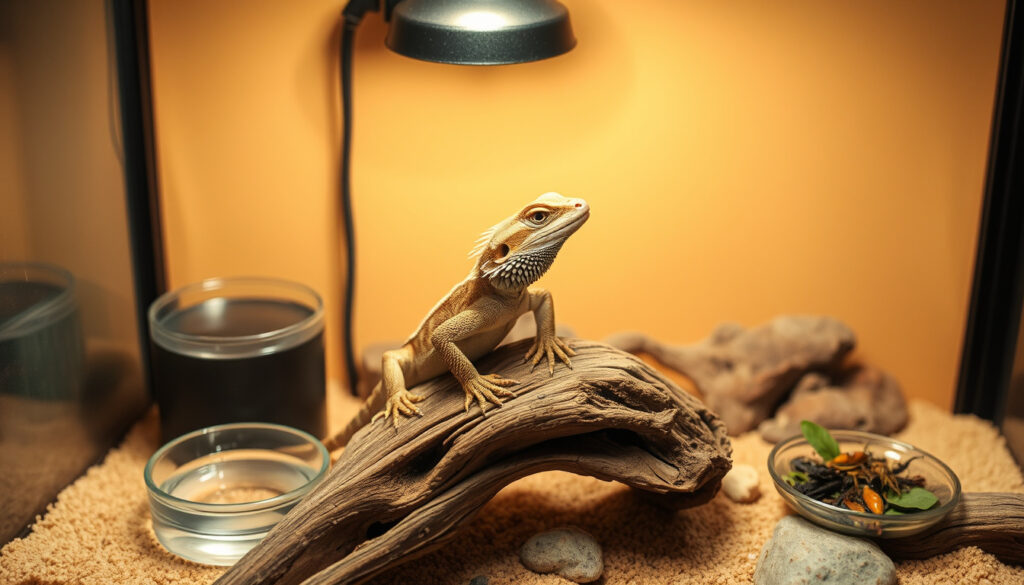
Bearded Dragon Pet Care: Costs, Behavior & Lifespan
So you’re thinking about bringing one of those calm, scaly nuggets home — or maybe you already have and you’re deep in a late-night care-rabbit hole. Bearded dragons are frequently the first reptile people consider, and it’s easy to see why: they have a reputation for being manageable, interactive, and a little bit comical with their head bobs and “wave” greetings. But behind the cute hand-petting videos lies a specific set of requirements that can surprise new owners.
Average Lifespan: 8 to 12 years in captivity | Adult Size: 18 to 24 inches (45 to 60 cm) | Pet Price: $40 to $80 (common morphs) | Setup Cost: $200 to $500 (enclosure, lighting, heating) | Diet: Omnivore – insects and leafy greens | Temperament: Docile, often tolerates handling
Lifespan & Size
- Average 8–12 years with proper care — RSPCA (UK) care sheet
- Adults reach 18–24 inches — NC State Veterinary Hospital
- Growth slows after first year
Cost Summary
- Pet: $40–$80 (common morphs) — New Age Pet
- Setup: $200–$500 — New Age Pet
- Yearly food/supplies: $100–$200
Temperament
- Docile, tolerant of handling — RSPCA (UK)
- Males may be more active
- Females often calmer
Daily Care
- Live insects (e.g., crickets, dubia roaches)
- Fresh greens daily
- UVB light 10–12 hours/day — NC State Veterinary Hospital
| Label | Value |
|---|---|
| Scientific Name | Pogona vitticeps (most common) |
| Native Range | Australia (arid regions) |
| Activity Pattern | Diurnal |
| Diet Type | Omnivore |
| IUCN Status | Not evaluated |
| Minimum Enclosure Size | 4×2×2 feet (120×60×60 cm) |
The pattern here: the specs confirm this is a long-commitment animal with specific environmental demands that drive both cost and daily routine.
Is a bearded dragon a good pet?
“Bearded dragons are generally docile and low-maintenance compared to other reptiles,” notes the RSPCA (UK). They are known for tolerating handling well, which is rare among pet lizards. However, that doesn’t mean they thrive on constant interaction — they just cope with it, and that threshold has limits.
Their temperament is best described as calm and opportunistic. They are not naturally aggressive toward humans, but they can become defensive if they feel threatened — usually by gaping their mouths or puffing out their beards. Learning to read those signals is essential to avoiding a defensive bite.
What are the downsides of owning a bearded dragon?
Upsides
- Docile temperament and tolerance of handling — RSPCA (UK)
- Lively diurnal behavior that aligns with human schedules
- Relatively compact enclosure footprint compared to larger reptiles
Downsides
- High initial setup cost of $200 to $500 — New Age Pet
- Daily feeding of live insects required
- UVB bulbs need replacing every six months at $20–$40 each
- Veterinary care requires exotic-pet specialists who are rarer and pricier
The implication: the daily live-insect feeding and recurring bulb replacements are the hidden costs that weed out unprepared owners.
Which gender of bearded dragon is nicer?
Males may be more territorial and display more head-bobbing and beard-darkening behaviors, especially during breeding season. Females are often calmer but both sexes can be handled regularly with consistent taming. Individual personality varies more than gender-based traits.
How much does a bearded dragon cost?
Before falling for those reptilian eyes, consider the recurring expenses. Setup costs often start around $200 to $500 for a proper enclosure, lighting, and heating gear, with a typical owner spending $40 to $80 on the lizard itself for common morphs. But the real line-item is the ongoing diet of live insects and fresh greens, which adds up monthly.
The monthly cost of feeding an omnivore like this hovers around $30 to $60 depending on the variety of roaches, worms, and vegetables you choose. Veterinary visits can be the real financial wildcard, since reptiles often need exotic-pet specialists who are rarer and pricier than standard vets.
RSPCA (UK) guidance emphasizes that these animals require a significant financial outlay before you even account for emergency care. That initial investment isn’t a one-time thing either — you’ll need to replace UVB bulbs roughly every six months to maintain the correct spectrum, which costs another $20 to $40 per bulb.
With proper heat, UVB, and diet, a captive lifespan of 8–12 years is realistic, but neglect can half that number — RSPCA Australia.
The catch: the $40–$80 purchase price is the smallest expense; the real cost is the decade of monthly food and bi-annual bulb replacements.
Lifespan Reality Check
Bearded dragons can live anywhere from 8 to 12 years in captivity, with some reaching 15 years under optimal care. That’s a longer commitment than most people expect when they buy a $60 lizard. The average lifespan is directly tied to husbandry quality, particularly UVB lighting and diet variety.
Neglecting temperature gradients or consistent insect protein often leads to metabolic bone disease, which drastically shortens lifespan. PetSmart’s bearded dragon care guide explicitly states that nighttime temperatures should not drop below 75 degrees Fahrenheit — a metric many new owners miss.
That temperature requirement matters because it’s easy to accidentally crash their metabolism with an overnight drop. A consistent, measured heat gradient is the difference between a 10-year companion and a 3-year emergency case.
With proper heat, UVB, and diet, a captive lifespan of 8–12 years is realistic, but neglect can half that number — PetMD.
What this means: a bearded dragon outlasts most small mammals — this is a pet that will share a decade of your life, not a few semesters.
Will bearded dragons cuddle with you?
Start with short handling sessions, gradually increasing duration as your dragon acclimates. A good rule of thumb is to begin with five minutes daily, slowly building up to your shoulder. Trust comes from predictability, so always support their body weight and handle them at the same time each day to establish a rhythm.
Watch for stress marks — the dark, oval patches under their jaws and on their bellies — as signals to slow down or stop the session. Regular, consistent handling is the foundation of a bonded pet, but this routine takes patience and can take weeks to establish.
They won’t “bond” the way a dog does, but they will learn to recognize you as a safe presence. Trust is built through routine, not lengthy sessions — a 15-minute daily interaction beats a 2-hour monthly cuddle marathon.
“The exact degree of bonding or recognition ability is not fully scientifically quantified, but they can learn to recognize your scent and handle you without fear.” — RSPCA Australia knowledge base
Can beardies remember you?
They can recognize your scent and presence, associating you with safety and food. Regular handlers report their dragons approaching the enclosure glass or relaxing more quickly during sessions. This isn’t mammalian emotional bonding, but it is a learned recognition that makes handling more rewarding over time.
Where should you not touch a bearded dragon?
Sensitive areas include the top of the head, tail tip, and belly, where they can feel threatened or vulnerable. Petting upwards from the nose to the eye is actually a stress trigger. These zones are best avoided during handling, as touching them can lead to your dragon inflating its body in a defensive display.
Focus on gentle strokes from shoulder to shoulder and the base of the tail. Forcing contact in sensitive areas can cause your pet to lurch or drop its tail, a defense mechanism that, while rare, is best avoided. Respect their body language — a relaxed dragon will close its eyes and lie flat, while a stressed one will open its mouth or run.
Forcing contact in sensitive areas risks a defensive response — always let your dragon set the pace for handling.
What makes a bearded dragon happy?
A young bearded dragon can start in a 20-gallon tank, but an adult needs a 4×2×2 feet (120×60×60 cm) enclosure at minimum. That’s not a suggestion; it’s the floor space needed to create a proper thermal gradient — a basking spot near 100°F and a cool side around 85°F, with nighttime lows not dropping below 75°F per PetSmart. The setup cost of $200 to $500 includes heat lamps, UVB fixtures, and décor, but hides and climbing branches often cost extra.
This is where many well-meaning owners fall short. A glass tank in a room with high human traffic can cause chronic stress, so provide visual barriers on at least one side. The enclosure must offer physical hides on both the warm and cool ends so they can thermoregulate without choosing between comfort and safety.
A proper setup isn’t static — it needs periodic adjustment for temperature swings during winter months. Invest in a quality thermostat for the basking bulb; they’re not just reptile luxury items but essential safety gear for preventing thermal burns.
“Bearded dragons need access to safe, high temperatures in captivity because they get body heat from the sun.” — RSPCA (UK) guidance
Can I leave my bearded dragon alone for 3 days?
No. They need access to fresh water, live insects, and varied greens daily, not to mention consistent heat and UVB cycles, which means you need someone to check on them at least every 24 hours.
Should I get 1 or 2 bearded dragons?
Housing bearded dragons together risks conflict, injury, and stress. They are solitary by nature and do not benefit from companionship. A single dragon housed correctly is far healthier than a pair forced to compete for basking spots and food.
Does a bearded dragon bite hurt?
Bearded dragon bites can break skin but are rarely severe; they have small, sharp teeth designed for crunching insects, not tearing flesh. The bite usually results from fear, hunger, or mistaken identity when a hand smells like food. Pain is comparable to a pinch, and keeping the wound clean prevents infection.
Bites are uncommon in well-handled dragons that recognize their owner. Most defensive displays — gaping mouth, puffed beard, hissing — give plenty of warning before any bite happens. If your dragon does bite, resist the urge to pull away quickly, which can cause more tissue damage. Instead, gently blow on its nose or offer a distraction to release the grip.
Is it safe to sleep with a bearded dragon in bed?
Many owners sleep with their bearded dragons, but the RSPCA details that this increases the risk of crushing, escape, or temperature drop. Supervised handling on your chest is one thing, but falling asleep with a bearded dragon on your bed? That’s the single riskiest behavior in this hobby.
Bearded dragons need a regulated thermal environment that a bed cannot provide. Nighttime temperatures should not drop below 75°F, and a bed offers no basking spot, no UVB, and no humidity control — just a dangerously unpredictable microclimate for a cold-blooded animal.
Sleeping with a bearded dragon is not safe — supervised handling is fine, but never leave them unattended in a bed. — RSPCA (UK)
The pattern: warm-blooded owners underestimate how much a reptile depends on external heat regulation — a bed is comfortable for you, dangerous for them.
Health Red Flags Every Owner Should Know
Bearded dragons are stoic animals that hide their illnesses well. Watch for signs like lethargy, a sunken tail base, or a lack of appetite that persists for more than a few days. Metabolic bone disease from insufficient UVB is common if lights are not replaced and is obvious in a rubbery jaw or swollen limbs.
Digestive issues like impaction can occur from loose substrate ingestion or improper temperatures. Parasites also thrive in captivity and show up in foul-smelling fecal matter — annual vet checks that include a fecal float are non-negotiable for responsible ownership.
Feeding sessions are also a time to watch for appetite changes, which are often the first indicator of stress or underlying illness. If your dragon skips two consecutive insect meals, that’s a red flag worth a health check-up.
“North Carolina State University reports a captive lifespan of seven to 10 years and emphasizes full-spectrum ultraviolet light is required for 12 to 14 hours daily in spring and summer.” — NC State Veterinary Hospital
The implication: most health problems in bearded dragons trace back to the same root cause — improper husbandry that is entirely preventable with correct setup and maintenance.
Related reading: Siberian Cat: Guide to Temperament, Size, and Allergies · Emperor Penguins: Size, Habitat, Myths, and Conservation
petsmart.com, seattle.gov, clawmate.com, thebeardeddragon.org, reptile.guide, thebeardie.com
Frequently Asked Questions
Do bearded dragons need a heat lamp at night?
Only if your home drops below 75°F at night. Use a ceramic heat emitter, not a light-emitting bulb, to avoid disrupting their sleep cycle.
What vegetables can bearded dragons eat?
Collard greens, mustard greens, butternut squash, and bell peppers are staples. Avoid spinach and kale in large quantities due to oxalates that bind calcium.
How often should I bathe my bearded dragon?
Once or twice a week in warm (not hot) water helps with hydration and shedding. Never leave them unsupervised in water.
Can bearded dragons eat fruit?
Yes, but sparingly — berries, mango, and papaya as occasional treats. Fruit is high in sugar and should make up no more than 5% of the diet.
How do I tell if my bearded dragon is stressed?
Dark stress marks under the jaw and belly, glass surfing, loss of appetite, and hiding more than usual are all stress signals.
What size tank does a baby bearded dragon need?
Start with a 20-gallon tank for a baby, but plan for the adult 4×2×2 feet (120×60×60 cm) enclosure within the first year.
Do bearded dragons hibernate?
They undergo brumation — a period of reduced activity during cooler months. It is normal but requires monitoring to ensure it is not illness masquerading as brumation.
More related posts
 Ralphie May: Net Worth, Weight, Children, Wife, and Death
 How Many People Died in World War II? Casualty Figures Explained
 Marisa Tomei Biography: Age, Ethnicity, and Personal Life
 Natalie Imbruglia 2026: New Album and Independent Pivot
 Mel Gibson’s Bipolar Diagnosis, Legal History & Net Worth 2024
 Argentina National Football Team vs Colombia National Football Team Lineups – Confirmed Starting XIs and Key Insights
 How to Measure Bra Size – Accurate UK Inch and CM Guide
 Cast of Scream VI: Full Actors List & Characters (2023)
