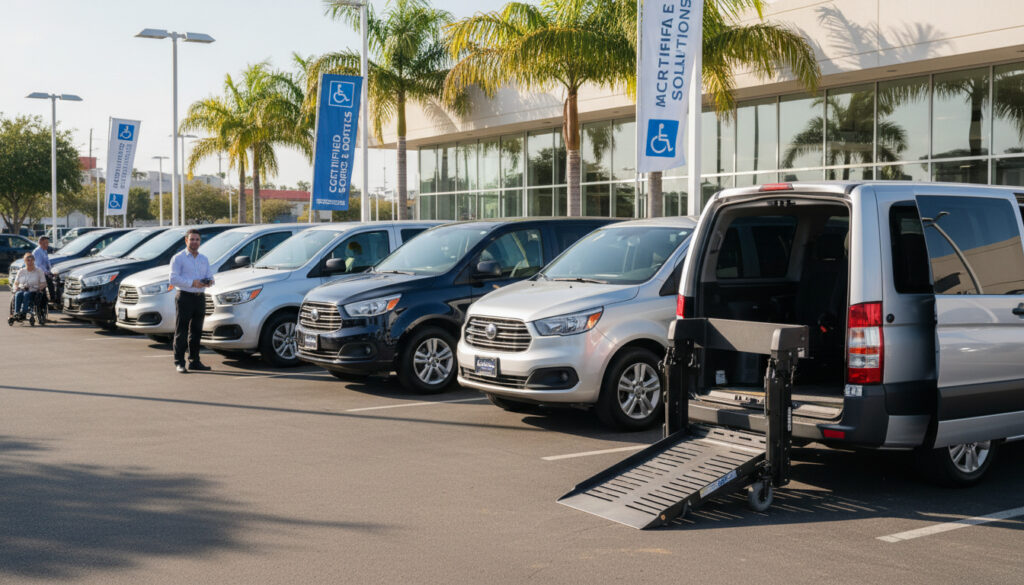
Disability Car Dealer Near Me – Certified Wheelchair Van Specialists
Locating specialized automotive dealers equipped to serve drivers and passengers with disabilities requires navigating a network of certified modification specialists and mobility consultants. Unlike standard car dealerships, these facilities provide vehicles engineered to exceed federal safety standards while accommodating wheelchairs, hand controls, and other adaptive equipment essential for independent transportation.
In regions like New England, established providers operate showrooms specifically designed for accessibility assessments, offering everything from new wheelchair vans to rental options and veteran support programs. These dealers function as compliance hubs, ensuring every modified vehicle meets ADA guidelines and National Mobility Equipment Dealers Association (NMEDA) certification requirements.
The search for local adaptive vehicle specialists extends beyond simple proximity. Buyers must verify certification status, evaluate modification portfolios, and confirm financing partnerships that accommodate disability-specific grants and VA benefits. This examination reveals how regional dealers structure their services around mobility independence rather than mere vehicle sales.
Wheelchair Van Dealers Near Me
Accessible vehicle dealers concentrate in metropolitan corridors and regional hubs, with networks spanning from Portland, Maine, to southern New Hampshire. These facilities maintain physical showrooms where certified consultants conduct needs assessments and demonstrate specific adaptations.
Top Local Dealer
New England Motor Car Company (Hudson, NH) operates the region’s largest indoor showroom, specializing in side and rear-entry conversions with 40+ years of family ownership.
Avg Cost Range
Pricing varies significantly by base vehicle and modification complexity; specific rates require direct dealer consultation due to customization variables.
Common Mods
Wheelchair lifts, transfer seats, swivel seating, hand controls, and lowered-floor conversions constitute standard adaptation offerings.
Financing Options
Credit applications processed in-house; partnerships with government programs and non-profit funding sources available.
Key Market Insights
- Demand for electric adaptive vans is rising, though inventory remains concentrated in traditional combustion models.
- NMEDA certification serves as the primary quality differentiator between specialty mobility dealers and standard used car lots.
- Veterans comprise a significant customer segment, with dedicated VA program specialists stationed at major dealerships.
- Rental fleets provide temporary solutions during personal vehicle maintenance or family travel periods.
- Side-entry configurations dominate urban markets, while rear-entry remains prevalent for suburban and rural users.
- Certified pre-owned wheelchair vans carry extended warranties up to 5 years or 100,000 miles at select dealers.
Adaptive Vehicle Facts
| Fact | Detail | Source Type |
|---|---|---|
| Primary Certification | NMEDA accreditation required for quality assurance | Industry Standard |
| Geographic Coverage | BraunAbility maintains locators for US and Canada | Dealer Network |
| Warranty Period | Up to 5 years/100K miles on certified used vans | Dealer Policy |
| Veteran Programs | VA 4502 and 1394 benefit integration available | Federal Benefit |
| Vehicle Types | Toyota Sienna, Chrysler Pacifica, Honda Odyssey most common | Inventory Data |
| Service Range | 50-mile pickup and delivery options in select regions | Dealer Service |
| Safety Standards | Federal Highway Safety and ADA compliance mandatory | Regulatory |
| Rental Availability | Daily and weekly rates offered at major locations | Service Offering |
BraunAbility operates a comprehensive dealer locator covering both the United States and Canada, allowing prospective buyers to enter ZIP codes for immediate local options.
Best Mobility Car Dealers for Disabilities
Quality disparity exists across the adaptive vehicle marketplace. Superior dealers distinguish themselves through NMEDA certification, comprehensive service departments, and established relationships with veterans’ benefit administrators.
Certified National Networks
BraunAbility-certified dealers undergo rigorous evaluation for technical expertise and facility accessibility. These locations stock converted minivans and SUVs from major manufacturers, including Toyota Sienna, Chrysler Pacifica, Chevrolet Traverse, and Honda Odyssey models. Each vehicle carries NMEDA certification verification, confirming compliance with national safety protocols for wheelchair securement systems and structural modifications.
Regional Family-Owned Specialists
New England Motor Car Company, situated in Hudson, New Hampshire, represents a family-operated enterprise with over four decades of specialization in mobility vehicles. Their facility houses the region’s largest indoor showroom for new and used side-entry and rear-entry vans. The dealership serves Cheshire, Hillsborough, and Rockingham counties in New Hampshire, plus Essex, Middlesex, and Worcester counties in Massachusetts.
Multi-State Service Providers
MobilityWorks maintains locations in Gray, Maine, and Londonderry, New Hampshire, creating a service corridor for Portland, Augusta, Lewiston, and coastal Maine communities, as well as Portsmouth and Rochester in New Hampshire. Their Gray facility at 32 Lewiston Road provides wheelchair van sales, rentals, roadside assistance, and scooter lifts. The Londonderry location extends coverage into southern New Hampshire.
New England Motor Car Company maintains approved status for VA programs 4502 and 1394, offering free oil changes, 50-mile pickup and delivery service, and same-day trade-in evaluations for eligible veterans.
Costs and Financing for Adaptive Vehicles
Financial accessibility remains a critical concern for mobility vehicle buyers. While standard automotive financing applies to the base vehicle cost, adaptive equipment often requires specialized funding mechanisms or grant assistance.
Understanding Vehicle Pricing
Specific pricing for wheelchair accessible vans varies substantially based on the donor vehicle’s make, model, and year, combined with the complexity of required modifications. Half-cut Toyota Sienna conversions accommodating wheelchairs plus seven passengers typically command premium positioning in the market. New England Motor Car Company emphasizes competitive pricing structures, though exact figures require individualized quotes reflecting specific adaptation needs.
Military and Veteran Benefits
Veterans accessing adaptive vehicles through VA benefits work with dealerships pre-approved for program 4502 (vehicle purchase assistance) and program 1394 (adaptive equipment grants). These partnerships streamline the approval process. MobilityWorks facilitates these applications alongside traditional vehicle credit arrangements.
Third-Party Funding Assistance
Dealers collaborate with governmental agencies and non-profit organizations to identify disability funding opportunities. While specific grant amounts fluctuate by jurisdiction and individual eligibility, certified dealers function as information clearinghouses for state rehabilitation programs and charitable mobility foundations.
Types of Disability Car Modifications Available
Adaptive vehicle modifications range from simple driver aids to complete structural reconstructions. Certified consultants assess individual mobility requirements to recommend specific equipment configurations.
Side-entry conversions allow wheelchair users to park in standard spaces and access curbside, while rear-entry configurations require additional space behind the vehicle but offer simpler ramp geometry and typically lower conversion costs.
All modifications must comply with Federal Motor Vehicle Safety Standards. NMEDA-certified dealers guarantee that wheelchair securement systems, ramp mechanisms, and lowered-floor alterations maintain structural integrity and crash-worthiness.
Entry and Exit Configurations
Conversion specialists install ramps with varying incline angles and weight capacities to accommodate manual and power wheelchairs. BraunAbility dealers in Maine offer models featuring kneeling suspension systems that lower the chassis height to reduce ramp angles. Transfer seats and swivel seating options assist individuals who can stand or pivot but require mechanical assistance moving from wheelchair to driver’s seat.
Driver Control Adaptations
Hand controls replace traditional foot pedals for gas and brake functions, available in mechanical and electronic configurations. Steering wheel adaptations include spinner knobs, palm grips, and tri-pin grips for single-handed operation. Digital systems integrate acceleration, braking, and secondary controls (turn signals, wipers) into joystick or touchpad interfaces for drivers with limited upper body mobility.
Timeline of Adaptive Vehicle Acquisition
Purchasing a wheelchair accessible vehicle follows a methodical progression from initial assessment through final delivery. Understanding this sequence helps buyers coordinate financing approvals and medical equipment transitions.
- Mobility Assessment: Certified specialists evaluate wheelchair dimensions, transfer capabilities, and driving potential to recommend appropriate base vehicles and modifications.
- Vehicle Selection: Buyers choose between new conversions, certified pre-owned inventory, or retrofitting existing vehicles based on budget and immediacy needs.
- Financing Approval: Credit applications process concurrently with VA benefit verification or third-party grant applications.
- Conversion and Fabrication: Custom modifications require 4-12 weeks depending on equipment complexity and parts availability.
- Safety Inspection: Completed vehicles undergo NMEDA quality verification and state inspection compliance checks.
- Delivery and Training: Technicians demonstrate securement systems, ramp operation, and adaptive control functions before transfer of ownership.
Established Facts and Market Variables
Clear demarcation exists between verified dealer capabilities and factors requiring individual investigation. Prospective buyers should distinguish absolute standards from negotiable elements.
Confirmed Standards
- NMEDA certification is mandatory for quality dealers
- VA 4502 and 1394 programs provide approved veteran benefits
- Federal ADA compliance is legally required
- 5-year/100K-mile warranties apply to certified used vans
- State inspection guarantees accompany purchases
Variables Requiring Verification
- Exact vehicle pricing depends on specific modifications selected
- Grant availability varies by county and state
- Inventory fluctuates seasonally at local showrooms
- Service pickup radius differs between dealers
- Rental fleet availability changes weekly
Regulatory Framework and Industry Context
The adaptive vehicle industry operates under dual oversight: Federal Motor Vehicle Safety Standards govern structural modifications, while the Americans with Disabilities Act mandates accessibility in sales facilities and service provision. Dealers must maintain liability insurance specific to mobility equipment installation, distinguishing them from standard automotive retailers.
Market concentration reflects population density and veteran demographics. New England hosts disproportionately high accessibility dealer density relative to population, serving rural communities where public transportation alternatives remain limited. Peugeot Garage Near Me – Official Dealers and Booking Guide illustrates how traditional dealership networks differ from specialized mobility providers in service scope and facility requirements.
Industry Credentials and Expert Perspectives
Expertise verification forms the cornerstone of consumer protection in adaptive vehicle sales. Industry organizations establish benchmarks separating qualified practitioners from uncertified modifiers.
NMEDA accreditation represents the gold standard for mobility equipment dealers, requiring rigorous training in wheelchair securement, vehicle structural integrity, and customer needs assessment.
— National Mobility Equipment Dealers Association Standards
Veterans accessing mobility benefits require dealerships capable of navigating VA approval workflows while maintaining inventory that meets adaptive equipment allowance specifications.
— Veteran Affairs Mobility Management Guidelines
Consumers seeking additional options beyond New England may consult The Mobility Resource, which aggregates inventory from over 100 dealers nationwide, including AMS Vans serving the Portland, Maine area with nationwide delivery capabilities.
Connecting with Local Adaptive Vehicle Providers
Successful procurement of wheelchair accessible vehicles demands alignment between individual mobility needs and dealer specialization. Houses for Sale Bolton – 2025 Prices, Best Areas & Insights demonstrates comparable local search strategies applicable to mobility equipment sourcing. Buyers should verify NMEDA certification, confirm VA program participation where applicable, and schedule in-person assessments to evaluate ramp angles and control ergonomics before finalizing purchases.
Common Questions About Disability Car Dealers
How do I choose between side-entry and rear-entry wheelchair vans?
Side-entry configurations suit drivers transferring from wheelchairs and require standard parking space accessibility. Rear-entry models work better when parking space behind the vehicle is consistently available and when budget constraints favor simpler mechanical systems.
What documents do I need for VA financing programs?
Veterans need VA authorization for program 4502 or 1394, service-connected disability rating documentation, and standard proof of income. Dealers certified in VA programs assist with pre-authorization verification.
Are used wheelchair vans reliable compared to new conversions?
Certified pre-owned vans with NMEDA inspection and extended warranties (up to 5 years/100,000 miles) offer substantial reliability. Key concerns involve ramp mechanism wear and battery condition for power systems.
How long do vehicle modifications typically take?
Standard conversions require 4-12 weeks depending on parts availability and customization complexity. Simple hand control installations may finish within days, while full lowered-floor reconstructions take longer.
Can I test drive adaptive vehicles before purchasing?
Major dealers maintain demonstration fleets allowing test drives with different control configurations. MobilityWorks and New England Motor Car Company specifically offer assessment drives to verify driver compatibility with adaptations.
Do dealers provide temporary vehicles during repairs?
Rental fleets are available at major locations like MobilityWorks Gray, ME, offering daily and weekly rates. Some service contracts include loaner vehicles during warranty repairs, though policies vary by dealership.
What is the difference between a mobility dealer and a regular car dealership?
Mobility dealers employ certified rehabilitation technicians, maintain NMEDA accreditation, and provide vehicles modified beyond factory specifications. They handle wheelchair securement, ramp installation, and driver adaptation equipment that standard dealers cannot service.
More related posts
 Wilson Isidor: Profile, Salary & Career Stats
 Nigel Slater: Biography, Partner James, Family, Career & Net Worth
 George Kay: Lupin Creator vs Kerry Katona’s Ex-Husband
 Michelle Dockery’s Baby, Fiance’s Death & New Marriage: 2025
 Amy Poehler: Biography, Relationships, Career, and Facts (2025)
 Sasha Grey: Biography, Career, and Current Life
 Anna Richardson: Lawsuit, Partner, Weight Loss & Body Blitz
 Richard Dean Anderson: Career, Net Worth, and Personal Life FAQ
