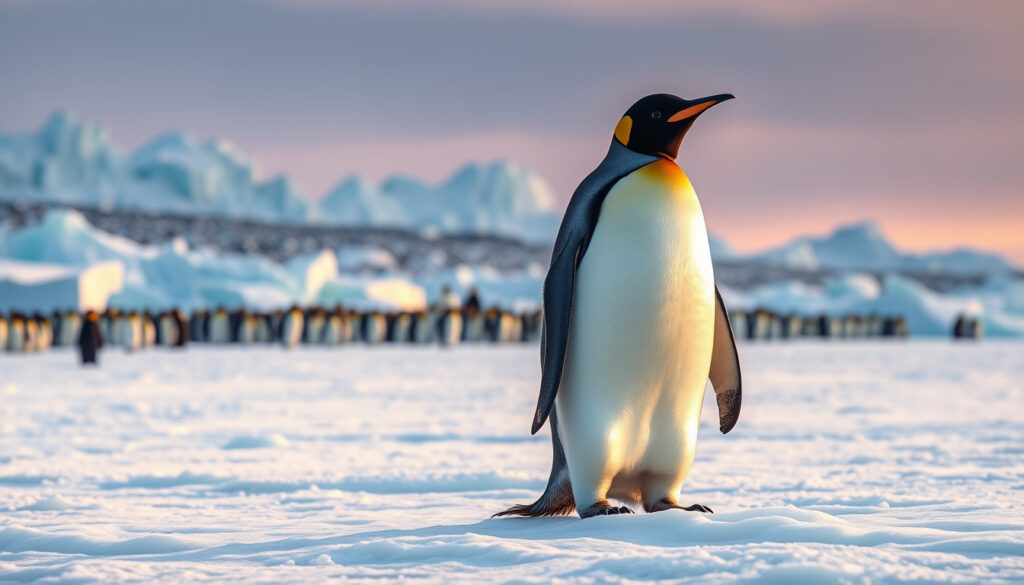
Emperor Penguins: Size, Habitat, Myths, and Conservation
Emperor penguins are often seen as the ultimate symbol of Antarctic resilience, but their story carries a fragile edge that surprises most people. These are the birds that raise their chicks in the harshest winter on Earth, and yet they are now facing pressures that go far beyond the cold.
Size & Weight
Breeding
- Breeds during Antarctic winter (March–December) per PMC peer-reviewed article
- Male incubates single egg on feet for 65 days per Wikipedia
- Females forage at sea; return to feed chick
Diet
- Main prey: fish, krill, squid per Global Penguin Society
- Dive up to 500 m (1,640 ft) deep per Wikipedia
- Can hold breath for 20+ minutes
Conservation
- Near Threatened (IUCN Red List) per Wikipedia
- Climate change reduces sea ice habitat per Global Penguin Society
- Estimated 600,000 mature individuals
Height: 1.1–1.3 m (3.6–4.3 ft) · Weight: 22–45 kg (49–99 lb) · Breeding season: March–December · Conservation status: Near Threatened
Classification and Species Overview
The emperor penguin (Aptenodytes forsteri) belongs to the order Sphenisciformes, family Spheniscidae, and genus Aptenodytes. It is the only species in its genus, and it stands apart for its size and the extreme environment it calls home. According to Wikipedia, the emperor penguin is the tallest and heaviest of all living penguin species, a distinction that shapes both its biology and its behavior.
The species has a circumpolar Antarctic distribution, mostly between 66° and 77° south latitude, which means it lives in some of the most isolated regions on Earth. The Global Penguin Society notes that emperor penguins live further south than any other penguin species, a fact that explains their unique adaptations to extreme cold and long periods of darkness.
Emperor penguins almost always breed on stable pack ice near the coast and up to 18 km offshore, as highlighted by Wikipedia. Breeding colonies are usually located where ice cliffs and icebergs provide some protection from wind, offering a tiny buffer against the brutal Antarctic elements.
The upshot: Emperor penguins are biologically wired for a life that almost no other bird could survive. Their classification isn’t just a taxonomic fact — it reflects a species that has evolved to dominate a niche where nothing else can compete.
Habitat and Breeding Cycle
Emperor penguins are the only penguin species that breeds during the Antarctic winter, a remarkable behavioral adaptation that sets them apart from all other birds. According to Wikipedia, they trek roughly 50–120 km over sea ice to reach their breeding colonies, a journey that often takes days and requires remarkable endurance.
“Emperor penguins are amazing birds. They not only survive the Antarctic winter, but they breed during the worst weather conditions on earth.” — Australian Antarctic Program
Breeding colonies can contain several thousand individuals, per Wikipedia, but the exact timing depends on pack ice formation. Australia’s Antarctic program, as cited in a peer-reviewed article on PMC, notes that breeding season typically runs from March through December, with eggs laid in winter and chicks fledging by early summer.
| Attribute | Details |
|---|---|
| Scientific name | Aptenodytes forsteri |
| Average height | 1.1–1.3 m (3.6–4.3 ft) |
| Lifespan in wild | 15–20 years |
| Diet | Fish, krill, squid |
| Conservation status | Near Threatened |
| Distribution | Antarctica only |
The timing of their breeding cycle is a masterclass in survival: eggs are laid in the dead of winter, and males incubate them for about 64 days while fasting, a feat of endurance that has fascinated researchers for decades. The Aquarium of the Pacific notes that emperor penguins are social and non-territorial, and they form huddles to stay warm — a behavior that can involve thousands of birds rotating positions to share heat.
Chicks remain in the colony for about 50 days after hatching, sheltered by parents who take turns foraging and warming them. Fledging occurs around December, when the sea ice begins to break up and the young penguins are finally ready to enter the water.
Which penguin is bigger, emperor or king?
Emperor penguins are significantly larger than king penguins in both height and weight. According to Wikipedia, emperor penguins reach up to 1.3 m (4.3 ft) and 45 kg (99 lb), while king penguins reach about 90 cm (3 ft) and 15 kg (33 lb). Emperors live exclusively in Antarctica, whereas kings inhabit sub-Antarctic islands.
Size and weight differences
- Emperor: 1.1–1.3 m tall, 22–45 kg per Wikipedia
- King: ~90 cm tall, ~15 kg per Wikipedia
Habitat and range distinctions
- Emperors: Antarctic coastline and sea ice per Global Penguin Society
- Kings: Sub-Antarctic islands (warmer range)
Visual identification guide
- Emperors have a broader yellow patch behind the ear, fading into white chest per Wikipedia
- Kings have a brighter, more vivid orange-yellow patch that extends to the upper chest
“These iconic penguins need our help to fight climate change.” — WWF UK
The pattern: Size differences between emperor and king penguins reflect the demands of their respective habitats — emperors need more bulk to survive Antarctic winters, while kings evolved for milder sub-Antarctic conditions.
Related reading: **Siberian Cat: Guide to Temperament, Size, and Allergies**
datazone.birdlife.org, knownanimals.com, seaworld.org, asoc.org, seaworld.org, betterplaneteducation.org.uk
Frequently Asked Questions
People ask some surprising questions about emperor penguins, from their intelligence to whether they fall in love. Here are the answers, grounded in the best available sources.
What is a sad fact about penguins?
The saddest fact about emperor penguins is that they are listed as Near Threatened due to climate change impacts, according to Wikipedia. As sea ice declines, the stable pack ice they depend on for breeding may become unreliable, and this existential threat hangs over a species that has survived millions of years of natural challenges.
Do emperor penguins feel love?
While emperor penguins form strong pair bonds for a single breeding season, the scientific consensus is that they do not experience “love” in the human emotional sense. The Aquarium of the Pacific describes their social and non-territorial behavior as functional, focused on survival and reproduction rather than long-term emotional attachment. Pairs typically reunite each season but do not necessarily stay together for life.
Are emperor penguins intelligent?
Emperor penguins are behaviorally advanced in ways that matter to their survival: they navigate across vast distances, recognize individual calls among thousands, and coordinate complex social huddles. However, the exact cognitive intelligence (IQ) compared to other birds is not standardized or measured, as noted by Wikipedia. Intelligence tests for penguins are not standardized, and their cognitive skills are best understood in the context of their specific ecological needs rather than a general IQ score.
Can I touch a wild emperor penguin?
No — touching a wild emperor penguin can harm both you and the bird. Human touch can transmit diseases penguins have no immunity for, and approaching them causes stress that disrupts breeding and feeding. The Global Penguin Society emphasizes the importance of maintaining respectful distance under Antarctic conservation guidelines.
Do emperor penguins mourn their dead?
There are documented observations of emperor penguins showing behaviors that appear like mourning — such as gathering around a deceased chick and vocalizing — but these behaviors may indicate distress and are not conclusively grief in the human sense. Research on emperor penguin behavior, including a peer-reviewed article, notes that interpretations of grief in animals remain controversial and require further study.
Are they gay?
Same-sex pairing has been documented in some penguin species, including emperors, but the scientific evidence for emperor penguins specifically is limited. Observational notes from Wikipedia describe social bonding behaviors that sometimes include same-sex pairs, a phenomenon seen in several bird species. Context for such findings is still evolving and does not offer a clear generalization.
Can I take photos of emperor penguins?
Photography of emperor penguins is generally allowed under Antarctic tourism guidelines, but only with strict limitations. The Global Penguin Society states that photographers must maintain a minimum distance, avoid using flash, and be accompanied by certified guides to ensure the birds are not disturbed or stressed.
What emotions do emperor penguins have?
Emperor penguins exhibit a range of behaviors that suggest basic emotions: they express joy through vocalizations when a mate returns, display stress through changes in posture and vocal tone, and protect chicks with remarkable intensity. The Aquarium of the Pacific notes that emotional expressions, while not identical to human emotions, are clearly observable in their daily interactions.
Why do they huddle?
Emperor penguins huddle to conserve heat and survive the Antarctic winter, a behavior described by Aquarium of the Pacific as social and non-territorial. Thousands of birds crowd together in a tight group that rotates continuously — those on the outside move to the center after a while — ensuring each penguin takes a turn in the warmest position.
Myths vs. Facts
There are more misconceptions about emperor penguins than most people realize, from claims about their intelligence to assumptions about their behavior. Here’s what the research actually says — and what it doesn’t.
- Myth: Emperor penguins are the only penguins that live in Antarctica. Fact: They are the only penguins that breed exclusively on the Antarctic continent, but other penguin species like Adelie and chinstrap also live in Antarctic waters, per Global Penguin Society.
- Myth: Emperor penguins mate for life. Fact: They form a pair bond for a single breeding season and often reunite, but they do not remain monogamous for life, according to Wikipedia.
- Myth: Emperor penguins have a high IQ. Fact: IQ tests are not standardized for penguins, and their cognitive intelligence is best understood through their navigational and social skills rather than human-centered metrics, as explained by Wikipedia.
- Myth: Emperor penguins cry like humans when sad. Fact: They produce a salt gland secretion that runs from their eyes, but this is not emotional tears. Mourning behaviors are recorded, but they’re not conclusive evidence of grief in the human sense, per PMC peer-reviewed article.
The trade-off: Myths persist because emperor penguins are so remote that most people never see them in person. The truth is more interesting than the legend: their real abilities — navigation, huddling, fasting — are more impressive than any human-like gift we try to project onto them.
Social Behavior and Intelligence
Emperor penguins are social and non-territorial, according to Aquarium of the Pacific, and they live in large colonies that function through coordination and recognition rather than aggression. Each penguin has a distinct call that allows parents and chicks to find each other among thousands, a remarkable feat of auditory memory.
The emperor penguin huddle is one of the most studied social behaviors in the animal kingdom. Individuals rotate through the interior and exterior of the huddle, and this constant movement ensures that no bird stays exposed for too long. The rotation pattern is so efficient that researchers describe it as a self-organizing system, per Wikipedia.
IQ tests are not standardized for penguins, and measuring their intelligence in human terms is misleading. Their cognitive skills are better framed as adaptive intelligence — the ability to navigate, remember calls, and coordinate in a changing environment. Emperor penguins can travel up to 100 km to find open water or a better breeding site, using the sun and landmarks to navigate.
The paradox: People often ask whether emperor penguins are “smart” in a human way, but the more accurate question is whether they are brilliantly adapted to their own environment. The answer is yes — just not in a way that a human IQ test could measure.
Human Interaction and Conservation
Human interaction with emperor penguins is bound by strict rules designed to protect both the birds and the fragile Antarctic ecosystem. The Global Penguin Society states that emperor penguins are naturally wary of humans, though they may show curiosity if approached slowly. However, any close approach is prohibited under the Antarctic Treaty System, which protects the species from disturbance.
The biggest threat to emperor penguins is not human contact but climate change. As the sea ice melts earlier each season, chicks may fledge before they are fully developed, reducing their survival chances. The Wikipedia entry lists emperor penguins as Near Threatened, a status driven by climate models that predict significant population declines by 2100.
There is also a legal framework governing human access to emperor penguin colonies. Permits are required, and only certified operators can lead visits — and even then, strict distance limits apply. These regulations are not just bureaucratic formalities; they are designed to prevent the transmission of diseases that emperor penguins have no immunity to, as the Global Penguin Society explains.
What to watch: The emperor penguin’s survival is now less about their own resilience and more about global climate action. The birds that mastered the harshest winter on Earth can’t adapt fast enough when the ice itself disappears. The next step is a choice — and it belongs to us, not the penguins.
The Bottom Line
Emperor penguins are more than just a symbol of the Antarctic — they are a precise, fragile machine for survival in an environment that no other bird can tolerate. They breed in winter, huddle for warmth, and trek up to 120 km over sea ice, all behaviors that evolved over millennia. But the stability they depend on — the pack ice — is now eroding, and the same adaptability that made them masters of the ice may not be enough to carry them through a rapidly changing climate.
The emperor penguin teaches us something uncomfortable: that resilience has limits. Their future depends less on their own endurance and more on whether human societies can act with the same restraint that the Antarctic Treaty has demanded of its visitors.
More related posts
 Peter Sarsgaard: Real Name, Family, and Skarsgard Mix-Up
 Hotpoint Washing Machine F05 Error Explained & Fixed
 Jonny Clayton: Gout, Limp, and Darts Success
 What Time Is Taco Tuesday in Steal a Brainrot – US, UK & 2026 Schedule
 Houses for Sale Stirling – 2025 Prices, Areas and Agents
 Is Frequent Diarrhea a Sign of Cancer? Key Signs
 Jony Ive: Biography, Net Worth, Designs, and Why He Left Apple
 Tennessee Thresher: Age, Net Worth, and Dating History
