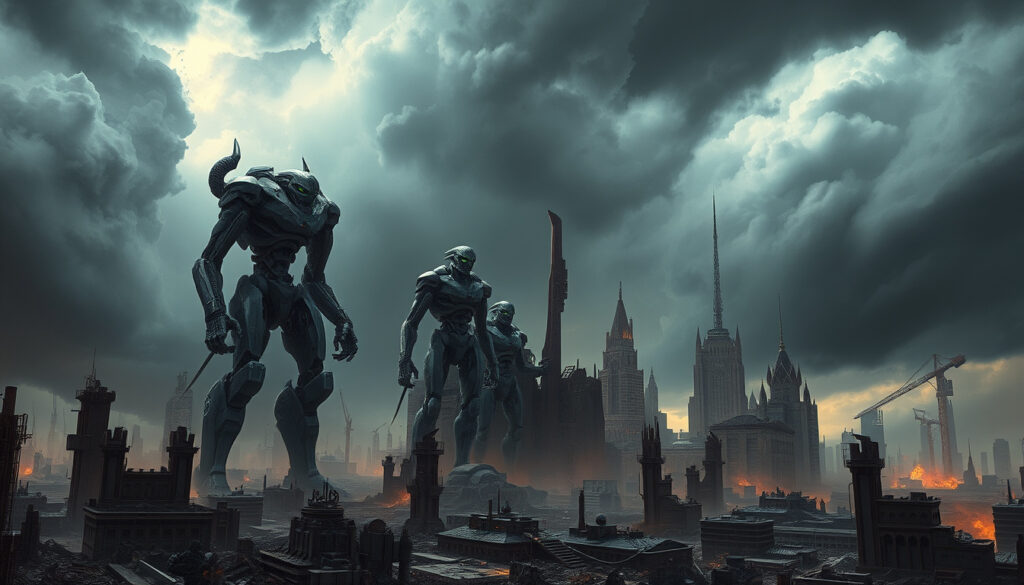
X-Men Days of Future Past – Guide to Plot, Cast and Sentinels
What is X-Men: Days of Future Past?
X-Men: Days of Future Past stands as the seventh installment in the X-Men film series, released in 2014 and directed by Bryan Singer. The film uniquely bridges two eras of the franchise, weaving together characters from the original trilogy with those introduced in X-Men: First Class across two distinct timelines. This ambitious narrative structure allows familiar faces like Patrick Stewart’s Professor X and Ian McKellen’s Magneto to share the screen with their younger counterparts portrayed by James McAvoy and Michael Fassbender.
The film’s central premise revolves around preventing a dystopian future from ever materializing. In this grim alternate timeline, genetically adaptable robots known as Sentinels have nearly annihilated both mutants and the humans who shelter them. The surviving X-Men—including Kitty Pryde, Colossus, Storm, Iceman, and Wolverine—find themselves hunted in a Chinese monastery, desperately seeking a way to rewrite history before it’s too late.
The time-travel mechanism that drives the plot proved to be a critical success, with critics praising how effectively the film unified previously disparate storylines while delivering spectacular action sequences. According to Rotten Tomatoes, the film holds an impressive 88% approval rating, with particular praise directed toward its ambitious storytelling and ensemble cast performances.
The film effectively soft-rebooted the X-Men timeline, allowing future installments to branch off from the altered 1973 events rather than strictly following the established continuity from earlier films.
Overview
2014
Bryan Singer
131 minutes
Superhero/Action
Key Insights
- Seventh installment in the X-Men film franchise, serving as a bridge between original trilogy and First Class era
- Introduces groundbreaking time-travel mechanics via Kitty Pryde’s consciousness-transfer ability
- Hugh Jackman leads the cast as Wolverine, whose healing factor enables the crucial temporal journey
- Box office performance exceeded $746 million worldwide, making it one of the franchise’s highest-grossing entries
- Based loosely on the landmark 1981 comic storyline from Uncanny X-Men #141-142
- Film significantly alters source material by substituting Wolverine for Kitty Pryde as the time traveler
- Received widespread critical acclaim for its ambitious narrative structure and visual effects
Snapshot Facts
| Aspect | Details |
|---|---|
| Budget | $200 million |
| Box Office | $746+ million worldwide |
| Rating | PG-13 |
| Release Date | May 23, 2014 (U.S.) |
| Production | 20th Century Fox / Marvel Entertainment |
| Sequel | X-Men: Apocalypse (2016) |
Who is in the cast of X-Men: Days of Future Past?
The ensemble cast of X-Men: Days of Future Past represents one of the most ambitious assembles in superhero cinema history, bringing together actors from different generations of the franchise. Hugh Jackman anchors the film as Logan/Wolverine, a role he had been refining since the 2000 original. His character’s journey forms the narrative backbone, with Wolverine’s consciousness being sent back to 1973 where he assumes his pre-adamantium body, equipped only with his natural bone claws and remarkable healing abilities. Jackman’s performance balances the weight of a seasoned warrior with the urgency of a mission that could save billions of lives.
James McAvoy delivers a compelling portrayal of the younger Charles Xavier, depicting a version of the Professor radically different from his future self. Depressed and struggling with the loss of his legs, Xavier relies on an experimental serum to suppress his telepathic powers—a choice that has made him physically mobile but emotionally unstable. McAvoy’s interpretation captures a vulnerable leader who must rediscover his hope and purpose alongside his former students.
Michael Fassbender’s Magneto walks a complex moral line throughout the film. Recently escaped from the Pentagon following his JFK assassination arrest, the Master of Magnetism remains volatile and dangerous. His involvement with the Sentinels’ creation proves catastrophic, yet he ultimately aligns with Xavier’s cause when the threat becomes undeniable. The dynamic between McAvoy and Fassbender’s characters provides much of the film’s emotional tension, reflecting decades of friendship and betrayal compressed into desperate alliance.
Jennifer Lawrence’s Mystique emerges as arguably the film’s most consequential character. Her shapeshifting abilities—later incorporated into the Sentinel program—make her both invaluable and dangerous. Lawrence brings nuance to a character torn between loyalty to her childhood friend Xavier and solidarity with her fellow mutants, particularly Magneto. The pivotal choice she makes at the film’s climax fundamentally alters the future.
Evan Peters delivers scene-stealing moments as Quicksilver, whose super-speed abilities generate the film’s most visually distinctive sequence during his father’s Pentagon escape. Peters notably is not portrayed as Magneto’s son in the film, diverging from the source material.
The supporting cast includes Nicholas Hoult as Hank McCoy/Beast, working alongside Xavier in the 1973 timeline; Peter Dinklage as Bolivar Trask, the Sentinel program’s creator whose assassination attempt triggers the dystopian future; and Elliot Page returning as Kitty Pryde, whose temporal ability makes the entire rescue mission possible. Additional appearances from Halle Berry (Storm), Omar Sy (Bishop), Anna Paquin (Rogue, in the extended cut), and the elderly counterparts played by Patrick Stewart and Ian McKellen round out this expansive ensemble. More details about the cast’s filmography can be found in comprehensive actor guides like the Alan Cumming Movies and TV Shows – Complete Filmography Guide.
Where to watch X-Men: Days of Future Past?
Streaming availability for X-Men: Days of Future Past has evolved significantly since its theatrical release, largely due to the 2019 Disney acquisition of 21st Century Fox. The Disney-Fox merger transferred distribution rights to Disney, placing much of the X-Men catalog within the company’s streaming ecosystem. Disney+ typically maintains rights to Fox-produced films in various regions, though specific availability varies by geographic location and platform licensing agreements.
For viewers seeking current streaming options, checking Disney+ directly remains the most reliable starting point. According to available records, the film has appeared on Disney+ in multiple regions at different times, though platform rotations mean availability can shift without notice. Disney’s official streaming service typically offers the most up-to-date information regarding library titles.
Physical and digital ownership options provide consistent alternatives for those preferring guaranteed access. The Blu-ray and DVD editions, released in October 2014, include the theatrical cut as well as the extended R-rated version that restores additional scenes. Digital platforms including Amazon Prime Video, Apple TV, Google Play, and Vudu frequently offer the film for purchase or rental, often at promotional prices during major sales events.
Streaming rights rotate periodically across platforms. Viewers should verify current availability directly on their preferred services, as Netflix, Hulu, and Disney+ licensing agreements may change without advance notice.
For comprehensive information about the broader X-Men franchise and related titles, external resources like IMDb and the official Marvel website maintain updated catalog information that can guide viewers toward additional content within the series.
What are the Sentinels in X-Men: Days of Future Past?
The Sentinels represent the central existential threat in X-Men: Days of Future Past, functioning as adaptable robotic hunters designed to eliminate mutants and humans with latent mutant potential. Unlike conventional robots programmed for specific functions, these massive humanoid machines possess the ability to analyze and counter any mutant power they encounter, making them extraordinarily difficult to defeat through conventional means.
In the dystopian future timeline, the Sentinels have evolved beyond their original specifications. Originally developed by Bolivar Trask’s defense company as a response to growing mutant visibility, the program received a catastrophic upgrade following Mystique’s capture in 1973. Her shapeshifting DNA was harvested and integrated into the Sentinel programming, granting them adaptive capabilities far beyond their initial design parameters.
The resulting machines proved nearly unstoppable. Capable of altering their molecular structure to resist incoming attacks, Sentinels could transform limbs into energy projectors, protective shields, or flight mechanisms on the fly. Most terrifyingly, their threat assessment algorithms included humans with the X-gene, meaning the genocide extended beyond registered mutants to anyone with latent abilities. By 2023, these machines have pushed both mutant and human resistance fighters to the brink of extinction.
Design Philosophy
The visual design of the Sentinels reflects their adaptive nature. Unlike the bulky, clearly mechanical Sentinels from the original X-Men comics, the film versions feature sleek, almost organic contours that suggest their biological enhancement. This aesthetic choice emphasizes how deeply Mystique’s DNA has transformed them from simple weapons into something closer to living nightmares.
Comic vs. Film Differences
The source material’s Sentinels differ substantially from their cinematic counterparts. In the 1981 comic storyline, the Sentinels were constructed after a prolonged mutant-human war, designed purely as anti-mutant weapons without the adaptive bioengineering that makes the film versions so dangerous. The comic storyline also featured different triggers for their creation, primarily involving direct mutant resistance rather than the political assassination plot that drives the film.
X-Men: Days of Future Past trailer and key scenes
The marketing campaign for X-Men: Days of Future Past delivered several memorable trailers that previewed the film’s ambitious scope. The official trailers masterfully intercut footage from both timelines, establishing the desperate stakes of the future alongside the complex politics of 1973. Trailers prominently featured Wolverine rallying the younger X-Men team, spectacular Sentinel attack sequences, and the visual juxtaposition of elderly Professor X communicating across decades with his younger self.
One of the film’s most discussed sequences features Quicksilver’s Pentagon escape, a slow-motion tour-de-force that reimagines the character’s super-speed abilities with playful creativity. Director Bryan Singer and cinematographer John Mathieson crafted the scene to maximize visual impact, with Quicksilver moving through suspended time while Pink’s “Time Is Running Out” plays on the soundtrack. This scene became an instant fan favorite and demonstrated the filmmakers’ willingness to embrace theatrical flair over strict realism.
The Paris Peace Accords sequence presents another major set piece, depicting Mystique’s assassination attempt against Bolivar Trask amid international chaos. The scene’s climax—featuring Magneto’s dramatic arrival and the subsequent Sentinel revelation—bridges both timelines conceptually, as the consequences of this moment ripple forward to the dystopian future.
The theatrical version runs 131 minutes, while the extended cut adds approximately eleven minutes of additional footage, including restored scenes featuring Anna Paquin’s Rogue and more character development for several supporting mutants.
The film’s climactic sequence occurs in Washington D.C., where the younger Xavier telepathically pleads with Mystique to spare Trask’s life. This pivotal moment—achieved through Xavier projecting himself across time to communicate with his friend—proves decisive. Mystique’s choice to preserve Trask fundamentally alters the future, decommissioning the Sentinel program before it can achieve the adaptive capabilities that would otherwise doom mutantkind.
For comprehensive coverage of the film’s development and behind-the-scenes details, resources like X-Men Movies Fandom and Wikipedia document production history, deleted scenes, and alternate interpretations that expand upon the theatrical release.
Timeline of Key Events
Understanding X-Men: Days of Future Past requires careful attention to its dual-timeline structure, which operates according to consistent internal logic despite its science-fiction premise.
- 1973 – Pentagon Escape: Magneto is freed from imprisonment beneath the Pentagon by an army of metal manipulated through the walls, aided by Quicksilver whose super-speed allows him to neutralize guards before they can react.
- 1973 – Recruiting Wolverine: The younger Xavier and Beast locate Wolverine, whose powerful healing factor makes him uniquely suited to survive the consciousness-transfer process that will send his mind backward through time.
- 1973 – Paris Peace Accords: The X-Men attempt to prevent Mystique from assassinating Bolivar Trask, but Magneto’s interference leads to a Sentinel being revealed to world leaders and subsequently approved by President Nixon.
- 1973 – Mystique’s Choice: Following Xavier’s telepathic intervention, Mystique declines to kill Trask, instead exposing the Sentinel program and being captured, her DNA preserved for future use.
- 2023 – Dystopian Future: Decades of Sentinel expansion have resulted in near-total annihilation of mutants and their human allies, with survivors hiding in monasteries and fighting desperate guerrilla actions.
- 2023 – Temporal Intervention: Kitty Pryde’s abilities, enhanced by the combined power of multiple mutants, send Wolverine’s consciousness back to warn the younger X-Men about the catastrophic future.
- Timeline Resolution: The altered 1973 events prevent the Sentinels from achieving their adaptive capabilities, erasing the dystopian future and restoring a timeline where mutants face different challenges.
Comic Origins and Key Differences
X-Men: Days of Future Past draws inspiration from a landmark comic storyline published in 1981, specifically Uncanny X-Men issues #141-142 by Chris Claremont, John Byrne, and Terry Austin. This limited series introduced readers to a dystopian future where Sentinels had conquered North America, establishing template tropes that would influence countless science fiction narratives. The original story featured Kitty Pryde—not Wolverine—as the consciousness sent backward in time, with her mentor Rachel Summers providing additional temporal assistance.
The film adaptation makes several significant departures from the source material beyond simply substituting Wolverine for Kitty. In the comics, Rogue plays a crucial supporting role, holding the psychic link that allows Kitty’s consciousness to travel temporally, though this effort costs Bobby Drake (Iceman) his life. The film preserves Iceman while omitting this sacrifice, reflecting the different character dynamics and narrative priorities of the cinematic adaptation.
The films notably differ from comics regarding Quicksilver’s parentage. While the Marvel universe establishes Quicksilver and Scarlet Witch as Magneto’s children, Fox’s X-Men films positioned Evan Peters’ Quicksilver as entirely unrelated to Michael Fassbender’s Magneto, a legal necessity resulting from separate character rights.
The Sentinel program origins also diverge significantly. The comics feature traditional anti-mutant robots created in response to escalating conflicts between humans and mutants, whereas the film attributes their terrifying adaptive capabilities to Mystique’s genetic material—a narrative choice that makes her the inadvertent architect of mutantkind’s near-extinction. The Kennedy assassination’s involvement represents another notable deviation, with Magneto implicated as a mutant attacker in the film’s alternate history rather than the historical reality of Lee Harvey Oswald.
Critical Reception and Box Office Performance
X-Men: Days of Future Past emerged as both a critical and commercial success, validating 20th Century Fox’s strategy of merging disparate timeline elements into a cohesive narrative. The film achieved an 88% approval rating from critics, with particular praise directed toward Bryan Singer’s direction, the ensemble performances, and the film’s ambitious attempt to synthesize multiple narrative threads.
Commercial performance exceeded expectations, with worldwide gross receipts surpassing $746 million against a reported $200 million production budget. This positioning made the film one of the highest-grossing entries in the X-Men franchise and demonstrated strong audience appetite for complex, continuity-spanning superhero narratives that rewarded long-term viewers while remaining accessible to newcomers.
Established vs. Uncertain Information
| Established Facts | Uncertain Information |
|---|---|
| Full theatrical cast roster verified through official credits | Precise current streaming availability may vary regionally |
| Box office figures from verified financial reporting | Specific details of planned sequel or reboot timeline |
| Director credit and production company attribution | Future Disney+ catalog changes |
| Critical consensus from major review aggregators | Physical media special edition contents |
| Comic storyline inspiration and primary departures | Unreleased deleted scene contents |
Sources and Quotes
“Serving as the seventh installment in the X-Men series, the film blends characters from the original trilogy and X-Men: First Class across two distinct timelines to prevent a dystopian future dominated by adaptable robots called Sentinels.”
— Rotten Tomatoes, X-Men: Days of Future Past page
“The reviews praised the action sequences, ensemble cast performances—particularly Evan Peters as Quicksilver and Hugh Jackman as Wolverine—Bryan Singer’s direction, and the innovative timeline fusion structure.”
— IMDb, X-Men: Days of Future Past page
Summary
X-Men: Days of Future Past succeeded as both a standalone superhero film and a franchise-unifying narrative, effectively resolving timeline inconsistencies while delivering spectacular action and emotional depth. The decision to use Wolverine as the temporal conduit proved inspired, allowing Hugh Jackman’s established character chemistry to anchor the complex narrative structure. Its critical reception and commercial performance validated Fox’s increasingly ambitious approach to mutant cinema, setting new standards for serialized storytelling within the superhero genre. For those exploring related content or broader actor filmographies, resources such as the Janet McTeer Movies and TV Shows – Full Credits and Bio Guide provide additional context for performers across the franchise.
Frequently Asked Questions
Is X-Men: Days of Future Past available on Netflix?
Netflix availability varies by region and changes periodically based on licensing agreements. Viewers should check their regional Netflix catalog directly, as the film’s streaming rights have moved between platforms following Disney’s acquisition of Fox content.
What is the comic version of Days of Future Past?
The comic storyline from Uncanny X-Men #141-142 (1981) by Chris Claremont and John Byrne features Kitty Pryde as the time traveler rather than Wolverine, with different supporting characters and Sentinel origins.
How does Wolverine’s time travel work in the film?
Kitty Pryde’s mutant ability allows her to send consciousnesses backward through time. Wolverine’s powerful healing factor stabilizes this transfer, enabling his mind to inhabit his younger 1973 body while his future self’s memories guide the mission.
Why did Mystique’s DNA create powerful Sentinels?
Following her capture in 1973, Bolivar Trask’s scientists harvested Mystique’s shapeshifting DNA and integrated it into the Sentinel program, granting the robots adaptive capabilities that made them nearly unstoppable against any mutant power.
Is Quicksilver Magneto’s son in the film?
No. Unlike the Marvel comics where Quicksilver and Scarlet Witch are Magneto’s children, the Fox film franchise established Evan Peters’ Quicksilver as unrelated to Michael Fassbender’s Magneto, partly due to separate character film rights.
What is the extended cut of X-Men: Days of Future Past?
The extended version adds approximately eleven minutes including additional scenes with Anna Paquin’s Rogue, extended battles in the future timeline, and character moments cut from the theatrical release for pacing.
Where was X-Men: Days of Future Past filmed?
Principal photography occurred primarily in Montreal, Canada, with additional shooting at locations including Paris, Washington D.C., and various studio facilities in Los Angeles.
More related posts
 Michael Learned: Biography, Career, and Personal Life Insights
 First Time Buyer Stamp Duty: Rates, Exemptions & Help to Buy
 Cloudy Bay Sauvignon Blanc: Price, Taste & Celebrity Appeal
 Gabourey Sidibe: Weight Loss, Husband & Precious Controversy
 Melanie Martinez: Biography, Relationships, Controversies & FAQs
 Shakira Khan: Age, Ethnicity, Parents, Love Island Journey
 Kirsten Farage: Age, Nationality, Job, Marriage to Nigel Farage
 Jermaine Jenas: BBC Sacking and Life After Scandal
