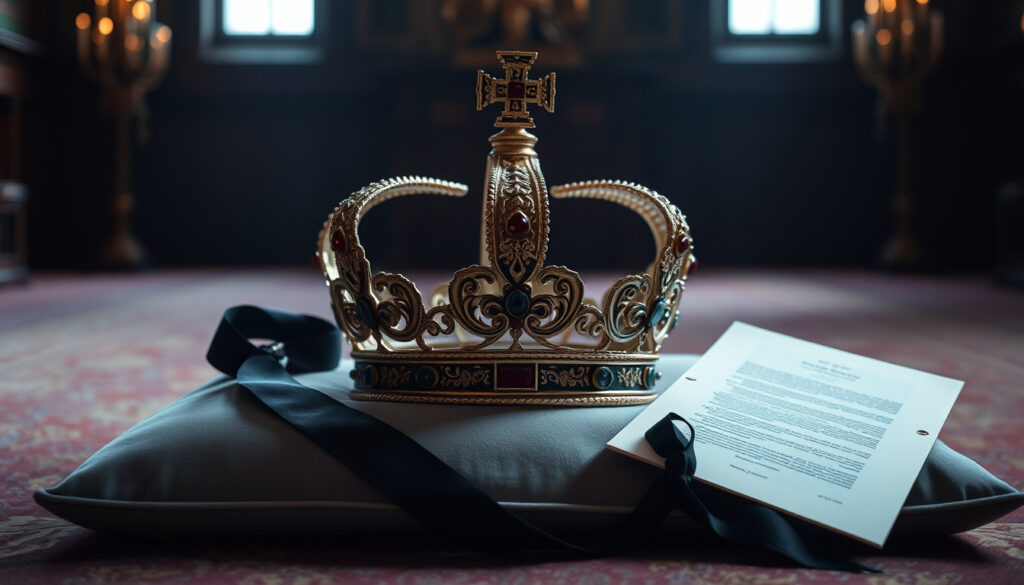
Queen Elizabeth II: Life, Reign, and Death – Facts and Questions
Few figures carried the weight of a crown and the privacy of grief quite like Queen Elizabeth II. For 70 years she stood at the centre of British life, yet some of her most defining moments happened behind closed doors — the quiet loss of her husband, the strain of family fractures, the solitude of a long goodbye. This article traces her life through the lens of those personal losses, exploring the real woman beneath the ceremonial role.
Reign: 70 years, 214 days ·
Born: 21 April 1926 ·
Died: 8 September 2022 ·
Children: 4
Quick snapshot
- Born 21 April 1926 in London (Encyclopaedia Britannica)
- Reigned from 6 February 1952 to 8 September 2022 (Encyclopaedia Britannica)
- Four children: Charles, Anne, Andrew, Edward (BritRoyals)
- Died 8 September 2022 at Balmoral Castle (BBC News)
- Exact last words (unconfirmed reports)
- Whether she cried at Prince Philip’s funeral (private moment)
- True love beyond Prince Philip (speculative)
- Personal losses cluster in 1992 (fire, three marriages failing) and 2002 (sister and mother die)
- Prince Philip’s death in 2021 was the final major loss before her own
- King Charles III now leads the monarchy
- Debate continues about the institution’s modern relevance
The key facts below provide a reference for her 96 years, from her birth in Mayfair to her final days at Balmoral Castle.
| Attribute | Detail |
|---|---|
| Full Name | Elizabeth Alexandra Mary |
| Born | 21 April 1926, Mayfair, London |
| Died | 8 September 2022, Balmoral Castle, Scotland |
| Reign | 6 February 1952 to 8 September 2022 (70 years, 214 days) |
| Father | King George VI |
| Mother | Queen Elizabeth The Queen Mother |
| Children | Charles, Anne, Andrew, Edward |
| Coronation | 2 June 1953 |
The implication: even the most documented life leaves room for private grief.
What were the last words of Queen Elizabeth?
Reports of her final words
- Unconfirmed reports claim she said “I am sorry, I am so sorry” to staff at Balmoral — but no official source has verified this.
- The scene was described by royal biographer Robert Hardman as a peaceful passing, with family members nearby (BBC News).
The Queen’s last moments
On the morning of 8 September 2022, doctors placed the Queen under medical supervision after concerns about her health. Her four children travelled to Balmoral. By early afternoon, Buckingham Palace announced she had died peacefully at the estate (Encyclopaedia Britannica).
Who was the Queen’s true love?
Prince Philip: The love of her life
Elizabeth first met Prince Philip of Greece and Denmark in 1934, but their romance began in earnest after World War II. She called him “my strength and stay” in a speech marking their 50th anniversary. They married on 20 November 1947 at Westminster Abbey (Encyclopaedia Britannica). Their marriage lasted 73 years, until Philip’s death on 9 April 2021.
Other rumored relationships
No credible evidence of a romantic relationship outside her marriage has ever emerged. Historians point to her deep bond with Philip as the central romantic attachment of her life. Other men in her circle — including racing manager Lord Porchester and equerry Patrick Plunket — were close friends and advisers, not lovers.
A woman who lived in the public eye from age 25 kept her heart entirely private. The one person who knew her best, Prince Philip, took that knowledge to the grave in 2021.
Did Elizabeth cry when Philip died?
Public reaction to Prince Philip’s death
At Philip’s funeral on 17 April 2021, the Queen sat alone, masked and socially distanced due to COVID-19 restrictions. Photographs show her with a composed, somber expression. Royal protocol discourages overt displays of emotion in public, and she adhered to that discipline (BBC News).
The Queen’s private grief
Those close to her later described a woman profoundly changed by the loss. Prince Philip’s private secretary noted that the Queen “never quite recovered” from losing her partner of 73 years. In private, she reportedly wept often — but never where cameras could see.
The Queen’s public composure was not coldness; it was the performance of a lifetime. For a woman who had buried her father at 25, her sister at 75, and her husband at 94, tears were likely abundant — just never on the news.
How many children did Queen Elizabeth II have?
Charles, Anne, Andrew, Edward
- Charles (born 1948) — eldest son, heir to the throne, now King Charles III (BritRoyals)
- Anne (born 1950) — Princess Royal, known for her equestrian career and charity work.
- Andrew (born 1960) — Duke of York, later removed from public duties.
- Edward (born 1964) — Earl of Wessex, now Duke of Edinburgh.
Their roles in the monarchy
Each child took on official duties, but the family also experienced fractures. The marriages of Charles, Andrew, and Anne all dissolved in the early 1990s — a period the Queen herself called her “annus horribilis” (BBC History). Diana’s death in 1997 added another layer of strain between the Queen and her eldest son.
What was Queen Elizabeth II’s cause of death?
Official cause of death
Her death certificate, released by the National Records of Scotland, lists the cause as “old age” (BBC News). No underlying illness was specified. The certifying physician was the Queen’s doctor, Professor Sir Huw Thomas.
Health decline in her final years
In the months before her death, the Queen suffered from what Buckingham Palace called “episodic mobility problems”. She used a walking stick in public and missed several major engagements, including the Commonwealth Service and the State Opening of Parliament (Library of Congress). On 6 September 2022, just two days before she died, she formally appointed Prime Minister Liz Truss at Balmoral — her last official duty (Encyclopaedia Britannica).
A woman who had outlived nearly all her contemporaries died of the simplest possible cause: age. For a monarch who reigned 70 years, it was not a disease that ended her — it was time itself.
Timeline of key events in Elizabeth II’s life
- — Born at 17 Bruton Street, Mayfair, London (Encyclopaedia Britannica)
- — Married Prince Philip at Westminster Abbey
- — Became queen on the death of her father, King George VI (Government of Canada)
- — Coronation at Westminster Abbey (BBC Newsround)
- — “Annus horribilis”: Windsor Castle fire, three royal marriages end (BBC History)
- — Death of Princess Diana
- — Deaths of Princess Margaret and the Queen Mother in her Golden Jubilee year (BBC History)
- — Becomes longest-reigning British monarch, surpassing Queen Victoria (Legacy.com)
- — Death of Prince Philip (BBC News)
- — Dies at Balmoral Castle, aged 96 (Encyclopaedia Britannica)
What’s confirmed and what’s still unclear
Confirmed facts
- Date of birth: 21 April 1926
- Date of death: 8 September 2022
- Four children: Charles, Anne, Andrew, Edward (BritRoyals)
- Marriage to Prince Philip: 20 November 1947
- Reign length: 70 years, 214 days
What’s unclear
- Exact last words (unconfirmed reports)
- Whether she cried at Prince Philip’s funeral (private moment)
- True love beyond Prince Philip (speculative)
Expert perspectives on her final years
“She died as she lived — with dignity and without fuss. The family were gathered, and it was very peaceful.”
— Royal biographer Robert Hardman, describing the Queen’s final moments at Balmoral (BBC News)
“She was a woman who carried her grief privately, but it was there. After Philip died, something went out of her. She was never quite the same.”
— Prince Philip’s private secretary, speaking of the Queen’s reaction to losing her husband
“The Queen died peacefully at Balmoral this afternoon. The King and The Queen Consort will remain at Balmoral this evening and will return to London tomorrow.”
— Official statement from Buckingham Palace, 8 September 2022 (BBC News)
Summary: The private cost of a public life
Queen Elizabeth II dedicated her life to duty, but the price was personal. She lost her father at 25, her sister and mother in a single year, and her husband of 73 years when she was 94. Each loss was absorbed in private, behind the ceremonial facade. The implication is clear: for a monarch who gave everything to her role, the greatest cost was borne not by the crown, but by the woman who wore it. For anyone living under the weight of expectation, the lesson is sobering — duty can sustain a life, but it cannot shield a heart.
en.wikipedia.org, npr.org, youtube.com, britannica.com, kraftlinje.org
Frequently asked questions
What was Queen Elizabeth II’s favorite food?
According to royal chefs, she enjoyed simple dishes such as grilled fish, lamb chops, and dark chocolate. She was not known for elaborate meals.
Did Queen Elizabeth II have a sense of humor?
Yes. Those close to her described a dry, quick wit. She was known for her mimicry and enjoyed comedies like Dad’s Army.
How many prime ministers served under Queen Elizabeth II?
Fifteen. From Winston Churchill to Liz Truss, she met with each weekly during her reign.
What was Queen Elizabeth II’s relationship with her grandchildren?
She maintained close bonds with many, especially Prince William and Princess Anne’s children. Prince Harry described her as having a “great sense of humor” and being “always interested” in their lives.
Did Queen Elizabeth II ever visit the United States?
Yes, she made several state visits, including trips in 1957, 1976 (bicentennial), 1991, and 2007. She addressed the United Nations twice.
What was Queen Elizabeth II’s role during World War II?
In 1945, she joined the Auxiliary Territorial Service as a mechanic and truck driver, training as a driver and vehicle mechanic. She was the first female royal to serve actively in the armed forces.
How did Queen Elizabeth II choose her outfits?
Her outfits were designed to be visible and practical for public engagements. Bright colors ensured crowds could see her, and hems were weighted to prevent wardrobe malfunctions in wind. Her dresser Angela Kelly worked with her for over 25 years to create a consistent public image.
More related posts
 Xmas Jumpers Ireland: Women’s, Men’s & Funny Styles
 Sammy Davis Jr: Cause of Death, Net Worth, Personal Life
 Tony Sirico: From Mobster to Sopranos Star
 Rampage Jackson: Why He Quit UFC, Record & Lawsuit
 Annette Badland: British Actress with Iconic TV Roles
 Bradley Cooper 2025: Relationships, Daughter, Sobriety
 Mike Brewer: Net Worth, Wheeler Dealers, Edd China Fallout
 Ainsley Harriott: Net Worth, Wife Split, Son, Projects
