Where is Costa Rica? Location, Safety, and Travel Facts
You’ve probably seen the photos of lush rainforests, howler monkeys, and waves crashing on two separate coasts, but when someone mentions traveling there, a practical question often comes first: where in the world is Costa Rica, and what’s it really like to visit or live in? This guide lays out the country’s exact location, its status as an independent nation, and the grounded facts about safety, costs, and current challenges that every traveler or curious reader should know.
Capital: San José ·
Official Language: Spanish ·
Currency: Costa Rican colón (CRC) ·
Population: Approximately 5.2 million ·
Area: 51,100 km² (19,730 sq mi) ·
Government: Unitary presidential constitutional republic
Quick snapshot
- Costa Rica is an independent country in Central America (CIA World Factbook)
- Official language is Spanish (Britannica)
- Currency is the Costa Rican colón (Costa Rica Guide)
- Current safety levels vary significantly by region (Smartraveller (Australian Government))
- Exact cost of a trip depends heavily on travel style and season (Never Ending Footsteps)
- Environmental and economic issues shift over time (World Bank Country Overview)
- No significant timeline signal available for Costa Rica (general geography guide)
- Check the latest travel advisory before booking (U.S. Department of State Travel Advisory)
- Assess budget for your specific travel style and season (Costa Rica Guide)
The following table provides key statistics about Costa Rica.
| Attribute | Details |
|---|---|
| Capital | San José |
| Official Language | Spanish |
| Currency | Costa Rican colón (CRC) |
| Population | ~5.2 million |
| Area | 51,100 km² |
| Government | Unitary presidential republic |
Where is Costa Rica located in the world?
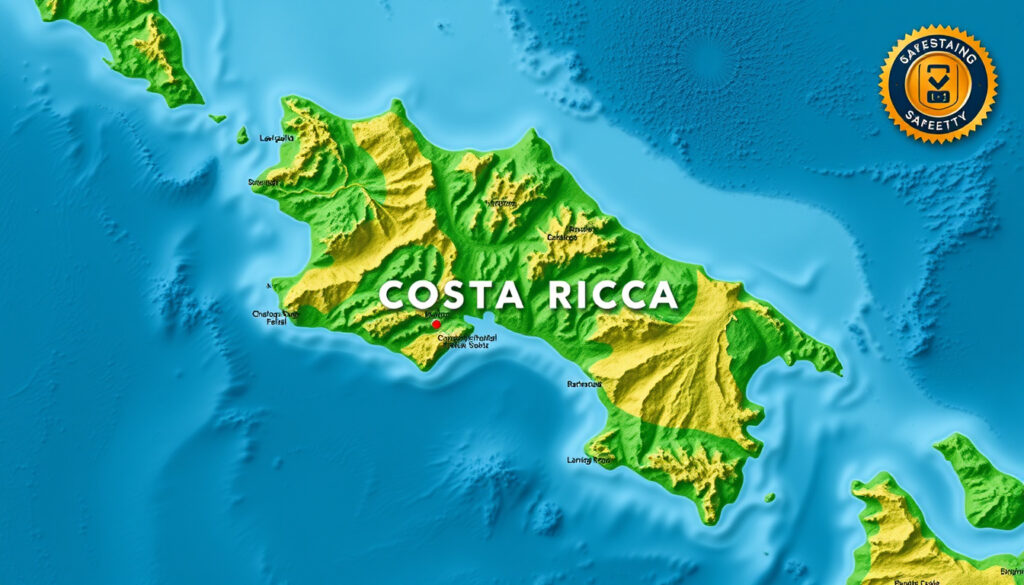
Costa Rica sits in Central America, the narrow land bridge connecting North and South America. It is bordered by Nicaragua to the north, Panama to the south, the Caribbean Sea to the east, and the Pacific Ocean to the west (CIA World Factbook). This strategic position gives it two distinct coastlines — one on the Caribbean and one on the Pacific — a feature that defines both its geography and its tourism appeal.
The country’s total area is 51,100 square kilometers (19,730 square miles), making it roughly four times the size of Jamaica or just slightly smaller than the U.S. state of West Virginia (Britannica). Despite its modest size, Costa Rica packs in an extraordinary range of ecosystems, from tropical dry forests to cloud forests and mangrove swamps.
“Costa Rica is a small country in Central America with two coastlines.” – CIA World Factbook
For a traveler flying from the United States, direct flights from Miami reach San José in about 3 hours; from New York, roughly 5 hours (Costa Rica Tourism Board). The country lies entirely within the Central Time Zone (UTC−6) and operates on a single time zone year-round, with no daylight saving time.
The trade-off: Costa Rica’s compact geography means you can drive from the Pacific coast to the Caribbean in about 4-5 hours, but that same small size also concentrates population and economic activity in the Central Valley around San José. Visitors expecting vast open spaces may find the country more densely settled than they imagined.
Costa Rica is a small but geographically pivotal country in Central America, offering two coastlines and remarkable biodiversity within a short travel distance. Its location is both a tourism asset and a practical constraint for travelers and residents alike.
The implication: Costa Rica’s compact geography makes it easy to explore but also means that the Central Valley is densely populated and urbanized.
Is Costa Rica a US or not?
No — Costa Rica is a fully independent, sovereign nation. It is not a U.S. state, territory, colony, or commonwealth. The country gained independence from Spain in 1821 and became a republic in 1848 (Britannica). It maintains diplomatic relations with the United States but operates under its own constitution, laws, and government.
Costa Rica is a unitary presidential constitutional republic. Its political system includes a president, a Legislative Assembly, and a Supreme Court. Notably, Costa Rica abolished its army in 1949, a decision that has defined its peaceful international identity (CIA World Factbook).
The country belongs to the United Nations, the Organization of American States, and the Central American Integration System. It also maintains free trade agreements with the United States (CAFTA-DR), Canada, China, and the European Union (U.S. Department of State).
What this means: for any practical purpose — travel documents, visa requirements, tax laws, citizenship — Costa Rica is treated exactly as any other foreign country by the United States and all other nations. U.S. citizens need a valid passport for entry, and stays exceeding 90 days require a visa extension or residency (Costa Rica Tourism Board).
Is it safe to travel to Costa Rica right now?
The short answer: generally safe, but with important caveats. The U.S. State Department rates Costa Rica at Level 2: Exercise Increased Caution due to crime (U.S. Department of State Travel Advisory). Australia’s Smartraveller similarly advises a high degree of caution (Smartraveller (Australian Government)).
Petty crime — pickpocketing, bag snatching, and theft from vehicles — is common throughout the country, especially in crowded tourist areas, on public buses, and at beaches. The U.S. State Department warns that violent crime, including armed robbery, homicide, and sexual assault, also affects tourists (U.S. Department of State Travel Advisory).
“Costa Rica is classified as an upper-middle-income country by the World Bank.” – World Bank Country Overview
The Costa Rica Tourism Board advises travelers not to flash cash, to keep valuables secure, and to be cautious even on buses (Costa Rica Tourism Board). Some ATMs operate limited hours and remain closed from 11 p.m. to 5 a.m. in certain areas (Costa Rica Tourism Board).
Is Costa Rica expensive?
Yes — for many travelers, Costa Rica is more expensive than other Central American destinations. A week-long vacation for an average traveler staying in mid-priced hotels and taking standard tours costs between $850 and $1,450, according to Costa Rica Guide (Costa Rica Guide). Backpackers can manage on as little as $250 per week for dorm accommodation and basic meals, while beachfront lodging and high-cost activities like deep-sea fishing can push a budget over $2,500 (Costa Rica Guide).
Airfare under $750 per person from the U.S. can bring a superior-class Costa Rica vacation total to about $1,900 to $2,500 per person in double occupancy (Costa Rica Guide). A 2025 travel budget breakdown on Never Ending Footsteps reports a daily average of $74.50 per person, with accommodation at $32.37 per person per day and food at $11.60 (Never Ending Footsteps).
Prices vary significantly by season. Costs can be 5% to 10% lower during the low season (May to November) and 5% to 10% higher during the high season (December to April). Around Christmas, Easter, and New Year’s, prices can spike by up to 50% (Costa Rica Guide).
How much is a bottle of beer in Costa Rica?
A domestic beer such as Imperial or Pilsen typically costs between $2 and $3 in a bar or restaurant, and around $1 to $1.50 in a supermarket (Costa Rica Guide).
How much does a 2 week trip to Costa Rica cost?
For a comfortable mid-range trip for two people sharing accommodation, the typical range is $1,500 to $3,000 per person, including flights, according to Costa Rica Guide (Costa Rica Guide).
Is Costa Rica a rich or poor country?
Costa Rica is classified as an upper-middle-income country by the World Bank, with a GDP per capita of approximately $12,000 (World Bank Country Overview). While it has relatively high human development compared to regional peers, it still faces economic challenges: about 20% of the population lives below the national poverty line, and the national debt-to-GDP ratio exceeds 60% (CIA World Factbook).
What not to do when visiting Costa Rica?
- Don’t leave valuables unattended on beaches or in rental cars — theft is common in both settings (U.S. Department of State Travel Advisory).
- Don’t drink tap water in rural areas — bottled or filtered water is recommended outside of San José and major tourist centers (Costa Rica Tourism Board).
- Don’t swim at unmarked or dangerous beaches — strong rip currents and riptides cause fatalities every year (U.S. Department of State Travel Advisory).
What to be cautious of in Costa Rica?
- Petty theft is the most common crime affecting tourists (U.S. Department of State Travel Advisory).
- Road conditions vary; 4×4 vehicles are recommended for unpaved rural roads, especially in remote national parks (Costa Rica Tourism Board).
- Scams involving fake tour operators or unofficial taxis exist; use licensed guides and official airport transport (Costa Rica Tourism Board).
For U.S. travelers, the combination of Level 2 advisory, common petty crime, and seasonal price surges means that careful planning — not fear — is the right response. The country is not dangerous in the way that active conflict zones are, but the casual visitor who assumes “paradise is safe” may face unpleasant surprises.
What is Costa Rica best known for?
Costa Rica’s global reputation rests on three pillars: biodiversity, ecotourism, and a legacy of peace. The country hosts roughly 5% of the world’s known species despite covering only 0.03% of the Earth’s land surface (World Bank Country Overview). It has over 20 national parks and dozens of protected reserves, including the famous Volcán Arenal National Park, Corcovado National Park, and Tortuguero National Park.
Its coffee is globally renowned — Costa Rican beans are known for their bright acidity and full body, and the country produces some of the finest Arabica coffee in the world (Britannica). The fertile volcanic soils of the Central Valley are ideal for growing coffee, and the industry employs about 10% of the population directly or indirectly.
Costa Rica is also known for having abolished its army in 1949, redirecting military spending to education, health, and environmental protection — a fact that has made “Pura Vida” (the country’s unofficial slogan) more than a tourist catchphrase (CIA World Factbook). It consistently ranks near the top of global happiness and environmental performance indices relative to its economic output.
What is a current issue in Costa Rica?
No country is perfect, and Costa Rica faces several pressing challenges. Deforestation remains a concern, though at a lower rate than in the 1980s and 1990s. The World Bank notes that water pollution from agricultural runoff — particularly from pineapple and coffee farming — threatens freshwater ecosystems and public health in some areas (World Bank Country Overview).
Economically, Costa Rica wrestles with high public debt — the debt-to-GDP ratio exceeded 60% as of 2024, among the highest in Latin America. This constrains government spending on infrastructure, healthcare, and education (CIA World Factbook). The growing gap between the high-end tourism sector and local employment levels also creates social tensions, as seen in periodic strikes by public sector workers over pension reforms and cost-of-living adjustments.
The pattern: Costa Rica’s environmental and social progress is real, but it coexists with old challenges — economic inequality, environmental degradation from intensive agriculture, and fiscal pressures — that no single policy has resolved. The country’s “ecotopia” image is earned in many ways, but incomplete in others.
Recent environmental concerns
Illegal logging and land conversion for agriculture — especially for pineapple plantations and cattle ranching — continue to threaten (forest) cover in remote areas, though reforestation efforts have regained some ground. The Osa Peninsula and the Talamanca region remain hotspots of biodiversity loss amid competing economic pressures.
Economic pressures
Tourism accounts for about 8% of GDP, making it the largest single industry. The country relies heavily on this sector, which makes it vulnerable to external shocks — a lesson brought home sharply during the COVID-19 pandemic, when tourism revenue collapsed by over 50% (World Bank Country Overview).
The pattern: Costa Rica’s environmental and economic challenges are ongoing and require balancing tourism growth with sustainability.
Pros and Cons of Visiting or Living in Costa Rica
Upsides
- Remarkable biodiversity and natural beauty
- Long-established tourism infrastructure
- Political stability and no army since 1949
- Generally friendly and welcoming culture
- English widely spoken in tourist areas
- Good medical facilities in San José
Downsides
- Petty crime is common, especially in cities and beaches
- Higher cost of living and travel than most Central American countries
- Road infrastructure is poor outside the Central Valley
- Seasonal price surges (up to 50% during holidays)
- Economic inequality and limited public services in rural areas
- High public debt constrains government spending and reforms
costaricatravelblog.com, maximonivel.com, backpackersblueprint.com
Frequently asked questions
What is the capital of Costa Rica?
The capital is San José, located in the Central Valley. It is the largest city in the country, with a population of about 346,000 in the city proper and over 2 million in the metropolitan area (CIA World Factbook).
What language do they speak in Costa Rica?
The official language is Spanish, though English is widely spoken in tourist-oriented areas, hotels, and by many service professionals (Costa Rica Tourism Board).
Do I need a visa to visit Costa Rica?
U.S., Canadian, EU, and most Latin American citizens do not need a visa for tourist stays of up to 90 days. A valid passport is required. Travelers from some countries (e.g., India, China, several African nations) need a visa in advance (Costa Rica Tourism Board).
What is the best time of year to visit Costa Rica?
The dry season (December to April) offers the most reliable weather, with sunny days and less rain. The green season (May to November) has more rain but offers cheaper prices and fewer crowds. November and December are transition months with good conditions and lower costs (Costa Rica Guide).
What is the currency used in Costa Rica?
The official currency is the Costa Rican colón (CRC). U.S. dollars are widely accepted in tourist areas, hotels, and larger restaurants, but you’ll get better exchange rates at local banks. Major credit cards (Visa, Mastercard) are accepted in most hotels and tourist businesses (Costa Rica Tourism Board).
Is Costa Rica part of Mexico?
No — Costa Rica is a separate country south of Mexico. Mexico and Costa Rica are both Spanish-speaking nations, but they are distinct sovereign states with different governments, cultures, and borders. The distance between them is approximately 1,500 kilometers (930 miles) (CIA World Factbook).
How far is Costa Rica from the United States?
It depends on your departure city. From Miami, the flight is about 3 hours and 950 km (590 miles). From New York, it’s about 5 hours and 3,500 km (2,175 miles). From Los Angeles, about 5.5 hours and 4,600 km (2,860 miles) (Costa Rica Tourism Board).
For the U.S. traveler weighing a Costa Rica trip, the implication is clear: budget accordingly — and prepare for the real Costa Rica, not just the Instagram version. The country delivers extraordinary nature and genuine warmth, but also demands awareness of safety, cost, and infrastructure limits. Either you plan with those realities in mind, or they plan for you.
More related posts
 Ian Holm: Biography, Cause of Death, and Iconic Roles
 Effy Skins Mental Illness: What Disorder Did Effy Stonem Have
 Welcome to the Jungle – Meaning, Lyrics and Origins
 How to Reduce Blood Pressure: Fast Relief & Long-Term Control
 Beth Rigby Biography: Age, Career and Family Facts
 Tamzin Outhwaite: Biography, EastEnders Role, and Daughters
 Chris Noth: Allegations, Co-Star Reactions, Current Status
 King of the Hill – Revival Guide, Characters and Where to Watch
