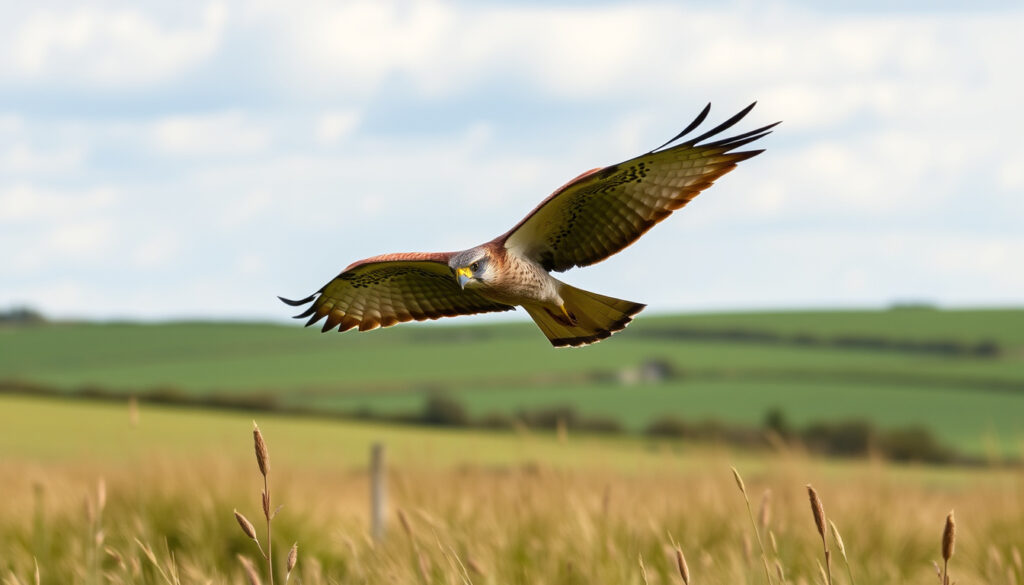
UK Birds of Prey: Identification Guide & Species List
There’s something quietly thrilling about spotting a bird of prey against a grey British sky, whether you’re walking the South Downs or looking out your kitchen window. This guide helps you tell apart the 15 species that breed in the UK, using size, wing shape, and behaviour — so that fleeting glimpse becomes a confident identification.
UK bird of prey species: 15 · Most common species: Common buzzard · Largest species: White-tailed eagle · Smallest species: Merlin · Fastest species: Peregrine falcon
Quick snapshot
- Common buzzard is the most numerous raptor in the UK (NHBS, a wildlife book and equipment retailer)
- White-tailed eagle is the UK’s largest bird of prey, with a wingspan up to 2.4 m (The Wildlife Trusts, a federation of wildlife conservation charities)
- Peregrine falcon is the fastest animal on Earth (NHBS, a wildlife book and equipment retailer)
- 15 species of diurnal raptors breed in the UK (Centre of Excellence (wildlife education provider))
- Exact number of vagrant raptor species recorded annually
- Population trends for scarce species like honey buzzard
- Impact of climate change on raptor distribution in the UK
- Goshawks persecuted to extinction, later re-established in southern Scotland, northern England and Wales
- White-tailed eagles reintroduced to Isle of Wight
- Continued monitoring of rare species like hen harrier and honey buzzard
- Best viewing times: spring migration (March–May) and autumn dispersal (September–October)
- Public engagement through nest cams and local nature reserves
Five key figures, one pattern: the UK’s raptor community is a story of extremes — from the tiny merlin to the massive white-tailed eagle, with the common buzzard anchoring the middle ground.
| Attribute | Value | Source |
|---|---|---|
| Number of breeding species | 15 | Centre of Excellence |
| Largest species | White-tailed eagle (wingspan up to 2.4 m) | The Wildlife Trusts |
| Smallest species | Merlin (length 26–33 cm) | |
| Most common species | Common buzzard | NHBS |
| Fastest species | Peregrine falcon (over 320 km/h in stoop) |
What is the most common bird of prey in the UK?
The common buzzard (Buteo buteo) holds the title. With an estimated 63,000 breeding pairs across the UK, it is by far the most numerous raptor, according to NHBS. The RSPB confirms it is widespread, present in every county except the Scottish Highlands and offshore islands.
How many species of birds of prey are there in the UK?
- The UK hosts 15 regularly breeding species of diurnal raptors (Centre of Excellence).
- Other common species include the kestrel, sparrowhawk, and red kite (RSPB).
- Rarer breeders include goshawk, white-tailed eagle, and long-eared owl (The Wildlife Trusts).
- The Lincolnshire Wildlife Trust (a local conservation charity) also lists merlin, peregrine, marsh harrier, hen harrier, osprey, and short-eared owl as rarer species to look out for.
The buzzard’s resurgence from near extinction in the 19th century to top spot is a conservation success story. For anyone new to birdwatching, it’s the most reliable raptor to start with — you’ll almost certainly see one on a walk in upland England.
How do I identify a bird of prey in the UK?
Identification rests on four features: size, wing shape, tail shape, and behaviour. The RSPB identification guide emphasises these as the quickest ways to separate species.
What key features should I look for?
How to identify a buzzard from an eagle?
What to notice during flight?
Size is the starting filter. A buzzard is roughly the size of a large crow; a white-tailed eagle dwarfs a buzzard by half. Wing shape splits the rest: broad and rounded means buteo or hawk; long and pointed means falcon.
Step-by-step identification guide
- Estimate size — compare to a crow (30 cm), buzzard (50 cm), or goose (80 cm+).
- Look at wing shape — broad and rounded (buzzard, eagle, harrier) or long and pointed (falcon, hobby).
- Check tail shape — square or rounded (buzzard, sparrowhawk), forked (red kite), or long and narrow (harrier).
- Observe behaviour — soaring in wide circles (buzzard), hovering (kestrel), high-speed stoop (peregrine).
- Listen — buzzards give a mewing “kee-aa” call; kestrels have a rapid “kee-kee-kee”.
To separate a buzzard from a golden eagle: buzzards have shorter wings and a more compact look, while golden eagles soar with wings held in a shallow V. The Wildlife Trusts note that golden eagles are largely confined to the Scottish Highlands.
The pattern: once you’ve learned buzzard and red kite, everything else is a variation on those two body plans. Most misidentifications come from ignoring size and wing shape.
What is the UK’s biggest bird of prey?
The white-tailed eagle (Haliaeetus albicilla) is the undisputed largest, with a wingspan up to 2.4 metres. The Wildlife Trusts describe it as a successful reintroduction story, especially on the Isle of Wight. The golden eagle is also large — wingspan around 2.2 m — but its range is limited to Scotland.
What is the smallest bird of prey in the UK?
The merlin (Falco columbarius) is the smallest, measuring just 26–33 cm in length — about the size of a blackbird. The RSPB identification guide specifically highlights the merlin as the UK’s smallest raptor.
Which eagle is the largest in Britain?
- White-tailed eagle: heavier, broader wings, pale head, prefers coastal cliffs and islands.
- Golden eagle: slightly smaller, golden nape, hunts in open moorland and mountains.
The UK’s largest and smallest raptors are both falcons — the white-tailed eagle (sea eagle) and the merlin. Yet one is a coastal giant and the other a moorland darter. That size gap is the single most useful tool for a beginner.
Did I see a hawk or a falcon?
This is the most common question among UK birdwatchers. Hawks and falcons belong to different groups, and the difference is visible in wing shape and hunting style. The RSPB notes that sparrowhawks (hawks) have rounded wings and long tails, while peregrines (falcons) have pointed wings and streamlined bodies.
What are the main differences between hawks and falcons?
Three contrasts, one takeaway: the environment tells you more than the colour.
| Feature | Hawk (e.g. sparrowhawk) | Falcon (e.g. peregrine) |
|---|---|---|
| Wing shape | Broad, rounded | Long, pointed |
| Tail | Long, often banded | Short, narrow |
| Hunting style | Short bursts through woodland | High-speed stoop in open air |
| Typical habitat | Woodland, gardens, farmland | Cliffs, urban towers, open moor |
| Examples | Sparrowhawk, goshawk, buzzard | Peregrine, kestrel, hobby |
How to tell a sparrowhawk from a kestrel?
- Sparrowhawk: brown back, barred chest, long tail, rounded wings, fast and agile in gardens.
- Kestrel: rufous back (male), blue-grey head (male), hovering habit, pointed wings, often seen along roadsides.
The difference is immediate if you catch the flight pattern: kestrels hover, sparrowhawks dash. The RSPB says sparrowhawks are widespread across almost all of the UK except parts of Scotland.
Why this matters: hawks are woodland specialists; falcons are open-space hunters. Spotting the habitat narrows the ID instantly.
What are the 13 birds of prey?
The phrase “the 13 birds of prey” appears often in online searches, but it refers to a North American list, not a UK one. The UK is home to 15 species of regularly breeding diurnal raptors, plus several vagrants. The RSPB and Wildlife Trusts cover the following UK breeders:
- Common buzzard
- Red kite
- Sparrowhawk
- Goshawk
- Marsh harrier
- Hen harrier
- Honey buzzard
- Osprey
- Peregrine falcon
- Kestrel
- Merlin
- Hobby
- White-tailed eagle
- Golden eagle
- Short-eared owl (included as a raptor-like bird but in a separate order)
Owls (Strigiformes) are also birds of prey but are taxonomically separate. The Lincolnshire Wildlife Trust includes short-eared owl and long-eared owl in its regional bird of prey identification guides.
Confirmed facts
- Common buzzard is the most numerous UK raptor (NHBS)
- White-tailed eagle is the largest UK raptor (The Wildlife Trusts)
- Peregrine falcon is the fastest animal on Earth
- 15 species of diurnal raptors breed in the UK (Centre of Excellence)
- Estimated 63,000 buzzard pairs, 4,600 red kite pairs, 1,750 peregrine pairs (NHBS)
What’s unclear
- Exact number of vagrant raptor species recorded annually
- Population trends for scarce species like honey buzzard
- Impact of climate change on raptor distribution in the UK
- Precise breeding success rates for golden eagles in changing moorland conditions
“The common buzzard is now the UK’s most numerous bird of prey.”
— RSPB
“White-tailed eagles were successfully reintroduced to the Isle of Wight.”
— The Wildlife Trusts
For anyone in the UK with a pair of binoculars and a bit of patience, the common buzzard is your gateway. Red kites and sparrowhawks follow once you know the wing shapes. The white-tailed eagle and peregrine are the headline acts, but they’re rare enough that a sighting still feels like a gift. For the beginner birdwatcher in the UK, the choice is clear: start with the buzzard, and the rest will fall into place.
Related reading: Edinburgh Zoo Live Cam · UK Cold Weather Warning
Frequently asked questions
What do birds of prey eat?
Diurnal raptors in the UK eat small mammals (voles, mice, rabbits), birds (pigeons, starlings), carrion, and sometimes insects. Eagles and buzzards are opportunists; peregrines specialise in pigeons.
Where do birds of prey nest?
They nest on cliffs (peregrine, white-tailed eagle), in trees (buzzard, sparrowhawk, goshawk), on the ground (hen harrier, short-eared owl), or on artificial platforms (osprey).
How long do birds of prey live?
Larger species like eagles can live 20–30 years in the wild; smaller falcons like kestrels average 3–5 years. Many deaths occur in the first year due to starvation and collision.
Are all birds of prey protected in the UK?
Yes, all wild birds of prey are protected under the Wildlife and Countryside Act 1981. It is illegal to kill, injure, or take them, or to disturb their nests.
Can I keep a bird of prey as a pet?
In the UK, you can keep a captive-bred bird of prey only with a licence under the Wildlife and Countryside Act. Falconry is regulated, and the bird must be ringed and legally sourced.
What is the difference between a bird of prey and a raptor?
The terms are interchangeable. “Raptor” comes from Latin rapere (to seize) and includes hawks, eagles, falcons, owls, and vultures.
When is the best time to see birds of prey in the UK?
Spring (March–May) for display flights and migration; autumn (September–October) for dispersal of young birds. Many species are active year-round.
More related posts
 Peugeot Garage Near Me – Official Dealers and Booking Guide
 Giovanni Leoni ACL Injury: Recovery Timeline, Height, Dad & More
 Nintendo Switch 2 Pro Controller: Compatibility, Review & Price
 Rosemary Clooney: Addiction, Assassination, Comeback
 Megan Ramsay: Age, Career, and Why She Skipped Netflix
 Jeffrey Archer: Prison, Bestsellers & Final Novel 2026
 Disability Car Dealer Near Me – Certified Wheelchair Van Specialists
 Dominic Fike: Euphoria Firing, Baby, Legal Troubles
