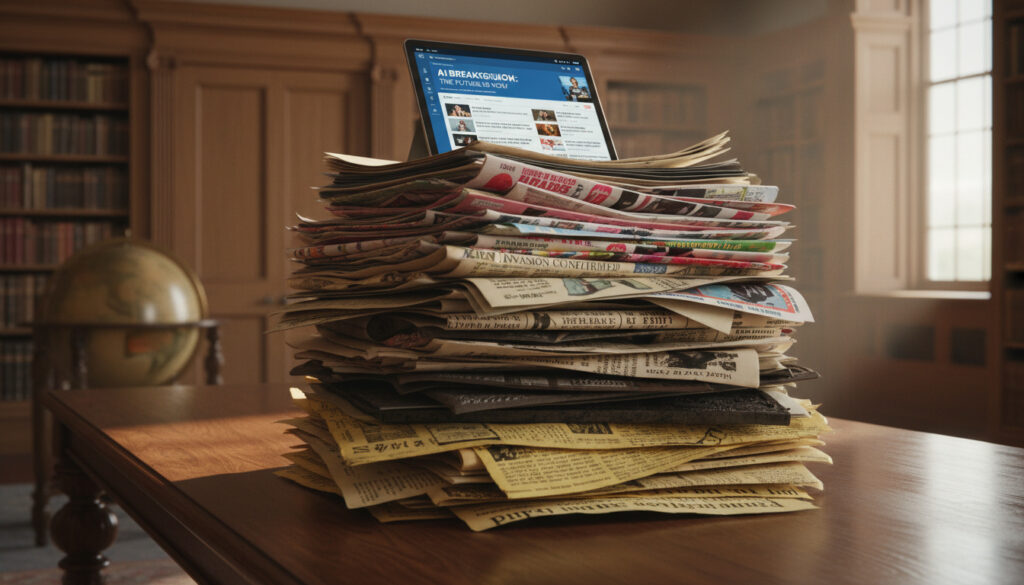
Newspaper – Definition, History, Types and Evolution
A newspaper is a periodical publication containing written information about current events, typically issued daily, weekly, or at other regular intervals. These publications deliver news, views, features, and other information of public interest. Many rely on advertising revenue for support, as noted by Britannica.
Newspapers have shaped public discourse for centuries. From ancient precursors to digital editions, they remain key sources of information. Their evolution reflects technological advances and shifting reader habits.
Newspapers offer a look at their definition, history, types, and adaptation to modern media landscapes, drawn from established sources.
What is a newspaper?
| Core Feature | Description |
|---|---|
| Publication Type | Periodical issued at regular intervals |
| Primary Content | Written information on current events, news, views, and features |
| Frequency | Typically daily, weekly, or other regular schedules |
| Revenue Model | Often supported by advertising |
- Newspapers focus on public interest topics.
- They originated in ancient public notices.
- Modern forms emerged in Europe with printing technology.
- Formats vary from broadsheets to tabloids.
- Geographic scope ranges from local to national.
- Digital versions now dominate readership.
| Aspect | Key Detail |
|---|---|
| Definition | Periodical with current events information |
| Ancient Origin | Acta diurna in Rome, 59 BC |
| Modern Start | Handwritten sheets in Venice, 1566 |
| Printing Press | Johannes Gutenberg, mid-1400s |
| First Printed | Relation in Germany, 1605 |
| First Daily | Einkommende Zeitung, Leipzig, 1650 |
| First English Daily | The Daily Courant, 1702–35 |
| Censorship Lift | England, 1695 |
| Mass Expansion | 1830s high-speed presses |
| Digital Shift | Internet rise, online primary |
What types of newspapers exist?
Newspapers vary by format and geographic reach. These classifications help distinguish their style and audience.
What are the main format types?
Broadsheets feature large pages for in-depth coverage, like The New York Times. Tabloids use smaller formats with emphasis on entertainment and sensationalism. Berliners sit between these sizes, per Study.com.
Broadsheets prioritise detailed reporting; tabloids favour compact, eye-catching stories.
How are newspapers classified by geography?
National dailies cover entire countries. Metropolitan ones serve cities, while suburban and small-town editions target local areas. Ethnic publications cater to specific language groups.
These scopes ensure tailored content for diverse readers, from national news to community updates.
How have newspapers evolved over time?
Newspapers transitioned from handwritten sheets to printed mass media. The internet prompted a shift to digital platforms, where online editions now lead, though print persists.
Competition from radio, television, and digital sources began in the 1920s, yet newspapers endure as vital information providers, according to Wikipedia and Australia Insight.
Many print editions have become secondary or ceased, reflecting reader preferences for online access.
What are the key milestones in newspaper history?
- Around 59 BC: Roman Acta diurna inscribed on metal or stone for public forums – Study.com.
- 1566: Oldest handwritten news sheets in Venice – Wikipedia.
- Mid-1400s: Gutenberg’s printing press enables mass production – Fiveable.
- 1605: First printed newspaper, Relation, weekly in Germany.
- 1650: First daily, Einkommende Zeitung in Leipzig.
- 1695: English censorship relaxed, sparking growth.
- 1702: First English daily, The Daily Courant.
- 1830s: High-speed presses expand access to masses.
Which newspaper facts are established and what is less certain?
| Established Information | Information that Remains Unclear |
|---|---|
| Acta diurna as early news form, 59 BC | Precise influence on modern newspapers |
| Gutenberg press revolutionised printing, mid-1400s | |
| Einkommende Zeitung as first daily, 1650 | |
| Relation generally considered first printed newspaper, 1605 | Exact status as undisputed “first” |
| Digital shift to online primacy | Long-term viability of print |
| Types: broadsheets, tabloids, geographic variants |
Why do newspapers hold significance?
Newspapers inform the public on events and issues. They blend news with analysis and features, fostering informed societies. Advertising sustains operations while reaching broad audiences.
Their persistence amid media changes underscores enduring value.
What sources support facts on newspapers?
Newspapers provide news about current events, often daily or weekly.
Supported by advertising, they cover news, views, and public interest.
What defines newspapers in summary?
Newspapers are scheduled publications delivering timely information on events. From Roman origins through printing innovations to digital adaptation, they vary in format and scope while remaining essential.
What was the first newspaper?
Relation in 1605 Germany is generally considered the first printed newspaper.
What is a broadsheet?
A large-format newspaper emphasising in-depth news coverage, like The New York Times.
When was the first daily newspaper published?
Einkommende Zeitung in Leipzig, 1650.
How did the printing press change newspapers?
Gutenberg’s mid-1400s invention enabled mass production of news.
What is a tabloid newspaper?
A smaller format focusing on entertainment and sensational stories.
Are newspapers still printed?
Many have shifted online, with print secondary or discontinued.
What ancient precursor existed?
Roman Acta diurna around 59 BC shared public news.
More related posts
 1 Pound to TL Exchange Rate: Live GBP/TRY 60.67 TRY
 Scottish School Holidays 2025: Guide for Every Council
 Keisha Buchanan in 2024: Solo Music, Motherhood & More
 How Old is Sharon Osbourne? Age, Family & Bio (2024)
 Funny Pictures: Best Sources for Laughs, Memes & Profile Photos
 Bed Bath & Beyond: Bankruptcy, Comeback and Current Status
 Jorja Smith: Children, Partner, Drake Age & Ethnicity
 Ned Flanders: Catchphrases, Religion, and Character Analysis
