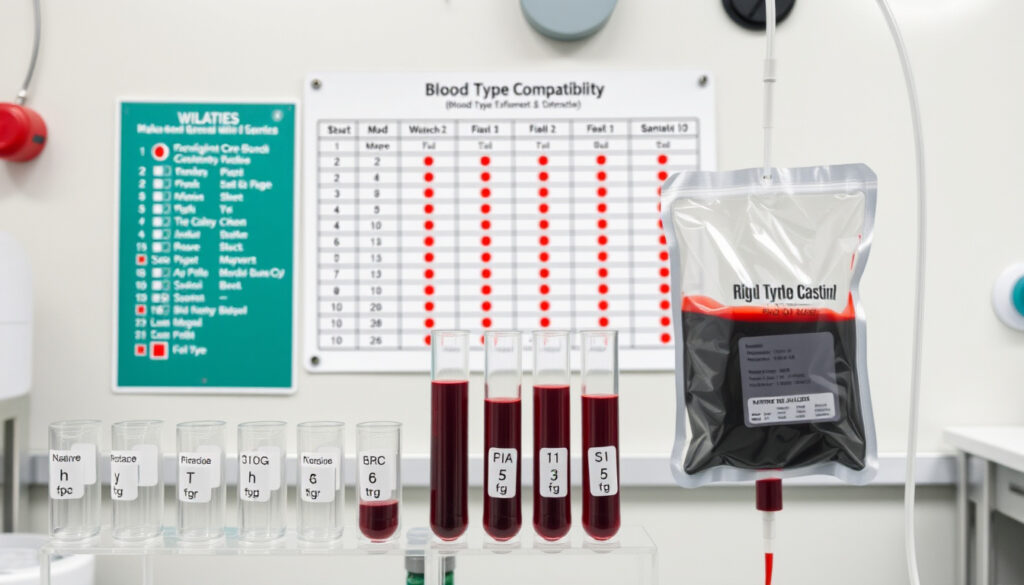
Blood Types: Compatibility, Rarity, and Transfusion Science
One letter on a medical bracelet — A, B, AB, or O — can determine whether a transfusion saves a life or triggers a crisis, and the practical difference between, say, A+ and O+ decides who can receive which unit. Blood types are a compatibility system built from antigens on red blood cells, not a ranking of health — and among 43 recognized blood group systems, ABO and Rh do the heavy lifting in everyday medicine.
Most common standard type: O+ · 37.4% of Stanford Blood Center’s reference population (Stanford Blood Center (university blood bank)) ·
Universal red-cell donor: O- (NCBI Bookshelf (National Library of Medicine reference)) ·
Universal red-cell recipient: AB+ (NCBI Bookshelf (National Library of Medicine reference))
Quick snapshot
- ABO-incompatible red cells can cause severe and potentially fatal hemolytic reactions (Royal Children’s Hospital Melbourne (clinical transfusion guide)).
- Rh status comes down to the presence or absence of the D antigen (Cleveland Clinic (academic medical center)).
- Whether blood type influences longevity, memory, or how often you get sick — not established in large studies.
- What the Ro subtype should mean for everyday clinical decisions — still being defined.
- ABO antibodies appear early in life; anti-Rh antibodies usually develop only after transfusion or pregnancy exposure (Bloodworks Northwest (regional blood center)).
- Blood group systems recognized by ISBT reached 43 by 2023 — the eight-type list is a simplification of a larger map. (Bloodworks Northwest (regional blood center))
- Donate through a blood service and your ABO/Rh type is confirmed and recorded for future care. (University of Michigan Pathology (hospital blood bank))
- Same ABO type is the first choice for transfusion; when inventory is limited, compatibility rules guide the alternative (University of Michigan Pathology (hospital blood bank)).
Six reference points, one pattern: everything that matters in a transfusion runs through the A, B, and D antigens.
| Reference point | What to know |
|---|---|
| Blood types defined | Determined by the presence or absence of A, B, and Rh D antigens on red blood cells (Cleveland Clinic (academic medical center)). |
| Blood group systems | 43 recognized by the International Society of Blood Transfusion as of 2023; ABO and Rh carry most of the clinical weight. |
| O+ frequency | About 37% worldwide; 37.4% in Stanford Blood Center’s reference population (Stanford Blood Center (university blood bank)). |
| Ro subtype | A variant within the Rh system; not counted in the standard eight-type rarity ranking. |
| Compatibility testing | At least one regional protocol treats a type-and-screen as valid for only three days because antibody status can change after a transfusion (Bloodworks Northwest (regional blood center)). |
| Rh-negative rule | Rh-negative recipients are prioritized for Rh-negative red cells to avoid alloimmunization (AMBOSS (physician medical reference)). |
What are the different types of blood transfusions?
Transfusions are classified by component, not by whole blood: red cells, platelets, plasma, and cryoprecipitate each carry their own compatibility logic.
Red blood cell transfusion
- ABO matching is the primary safety rule because ABO-incompatible red cells can cause severe and potentially fatal hemolytic reactions (Royal Children’s Hospital Melbourne (clinical transfusion guide)).
- Same ABO type is the first choice; when inventory is limited, compatibility rules allow a safe alternative (University of Michigan Pathology (hospital blood bank)).
Platelet transfusion
- Platelets are ideally transfused ABO- and RhD-identically; compatible alternatives can be used when supply is tight (New Zealand Blood Service (national transfusion service)).
Plasma transfusion
- Plasma has its own ABO pattern: group O recipients can receive plasma from any ABO donor, while AB recipients receive only AB plasma (Canadian Blood Services (national blood authority)).
Cryoprecipitate transfusion
- Cryoprecipitate is the fourth standard component; a clinician orders it for specific needs, and the lab still works through the same compatibility check before release.
The same unit that restores oxygen-carrying capacity can turn deadly if the ABO match is wrong — compatibility is a hard check, not a preference.
The implication: component therapy means each donation can help multiple patients, and each component carries different matching demands.
What are the rarest blood types?
Rarity depends on the list you are reading. Among the eight standard ABO/Rh combinations, the order is well documented; beyond those eight, rare takes on a different meaning.
AB-
- AB- is the least common of the eight standard types in Stanford Blood Center’s reference population, at 0.6% (Stanford Blood Center (university blood bank)).
B- and A-
- The Rh-negative versions of B and A are also uncommon relative to their Rh-positive counterparts; blood banks weigh inventory carefully when matching them (University of Michigan Pathology (hospital blood bank)).
Rh-null and other rare subgroups
- Rh-null is one of the rarest blood types in the world, with fewer than 50 known individuals (Cleveland Clinic (academic medical center)).
- The Ro subtype, a variant within the Rh system, is not part of the standard eight-type rarity lists.
The pattern: “rare” on a donor record does not automatically mean “most needed” — the most useful units in an emergency are the ones that fit the widest range of patients, not the scarcest letters.
What is the difference between A+ and O+ blood types?
The difference shows up whenever a patient needs red cells: the letters decide which units the blood bank can release.
Antigens present on red blood cells
- A+ red cells carry the A antigen and the Rh D antigen; O+ red cells carry no A or B antigens and do carry the D antigen.
Antibodies in plasma
- Group A plasma carries anti-B antibodies; group O plasma carries both anti-A and anti-B — the antibody pattern that makes O the ABO-universal donor (Royal Children’s Hospital Melbourne (clinical transfusion guide)).
Compatibility for transfusion
- O+ red cells can go to any Rh-positive recipient because the ABO side is universal, while A+ recipients can receive from A+, A-, O+, and O-.
A+ patients have more compatible donor options; O+ donors can help more Rh-positive patients — the same antigen difference works in opposite directions.
What this means: being O+ is an advantage when you donate, while being A+ gives you more flexibility when you receive.
Why can’t O+ donate to everyone?
The short answer is the Rh factor: O+ covers the ABO side for everyone, but the “+” makes it unusable for Rh-negative patients.
Rh factor mismatch
- Rh-positive recipients can receive Rh-positive or Rh-negative red cells, while Rh-negative recipients should receive Rh-negative units to avoid forming anti-D antibodies (Canadian Blood Services (national blood authority)).
Universal donor is O-
- Type O red cells can be given to recipients of any ABO type in emergency and universal-donor contexts (NCBI Bookshelf (National Library of Medicine reference)); because O- also lacks the D antigen, it is the only red-cell type that fits both the ABO and Rh requirements for every patient.
O- is the emergency inventory that cannot wait for type-matching, which is why donation services pay special attention to Rh-negative donors and AB plasma.
The catch: “universal donor” is shorthand for red cells only. In plasma, the logic flips — AB is the universal plasma donor, while AB recipients can receive only AB plasma.
What two blood types are not compatible for pregnancy?
Incompatibility in pregnancy is about antibodies crossing the placenta, and two ABO/Rh pairings get the most attention.
Rh-negative mother with Rh-positive baby
- If an Rh-negative mother carries an Rh-positive baby, fetal red cells can trigger anti-Rh antibodies — the same alloimmunization process transfusion services try to prevent (AMBOSS (physician medical reference)).
- Preventive treatment during pregnancy is now standard care for Rh-negative mothers.
ABO incompatibility (usually mother O, baby A or B)
- When a group O mother carries an A or B baby, her anti-A/anti-B antibodies can cross the placenta; the reaction is usually milder than Rh disease.
The takeaway: prenatal blood typing turns a potentially serious mismatch into a managed condition — screening, not fear, is the point.
Two common types, one split: A+ displays the A antigen, O+ displays neither A nor B, and that single difference sets their donor lists apart.
| Attribute | A+ | O+ |
|---|---|---|
| Antigens on red cells | A antigen + Rh D | No A or B; Rh D present |
| Antibodies in plasma | Anti-B | Anti-A and anti-B |
| Can donate red cells to | A+ and AB+ | A+, B+, AB+, and O+ |
| Can receive red cells from | A+, A-, O+, O- | O+ and O- |
What this means: O+ donors reach more patients, while A+ patients have more donor options — the same letter works differently in each direction.
Eight standard types, one rule: every red-cell unit is matched by ABO first and Rh second, and the same logic runs through every component order (New Zealand Blood Service (national transfusion service)).
| Type | Antigens on red cells | Antibodies in plasma | Can receive red cells from |
|---|---|---|---|
| O- | No A, no B, no Rh D | Anti-A and anti-B | O- |
| O+ | No A, no B; Rh D present | Anti-A and anti-B | O+, O- |
| A- | A; no Rh D | Anti-B | A-, O- |
| A+ | A; Rh D | Anti-B | A+, A-, O+, O- |
| B- | B; no Rh D | Anti-A | B-, O- |
| B+ | B; Rh D | Anti-A | B+, B-, O+, O- |
| AB- | A and B; no Rh D | No ABO antibodies | AB-, A-, B-, O- |
| AB+ | A and B; Rh D | No ABO antibodies | All ABO/Rh types |
What’s confirmed — and what isn’t
Blood type science is on solid ground for transfusion matching. The claims that get murkier are the health ones.
Confirmed facts
- The ABO and Rh systems are set by inherited antigens, and transfusion rules follow directly from antigen-antibody matching.
- Compatibility-test results are not permanent: one regional protocol treats a type-and-screen as valid for only three days because antibody status can change after a transfusion (Bloodworks Northwest (regional blood center)).
- Rh-negative patients are prioritized for Rh-negative red cells to avoid alloimmunization (AMBOSS (physician medical reference)).
What’s unclear
- Whether blood type influences longevity or disease risk — not established in large studies.
- Whether blood type predicts memory problems — no confirmed link.
- Whether a specific type makes you “healthier” overall — no such ranking exists in the clinical evidence.
- How the Ro subtype should change everyday care — still being defined.
The distinction matters: confirmed science drives transfusion policy; unconfirmed claims drive headlines, and the two should not be confused.
What the experts say
“ABO compatibility for plasma is not the same as for red cells: group O recipients can receive plasma from any ABO donor, while AB recipients can receive only AB plasma.”
— Canadian Blood Services (national blood authority)
“Platelets are ideally transfused ABO- and RhD-identically, but compatible alternatives may be used when inventory is limited.”
— New Zealand Blood Service (national transfusion service)
“Rh-negative recipients are commonly prioritized for Rh-negative red cells to avoid alloimmunization.”
— AMBOSS (physician medical reference)
What this means: the organizations that collect and issue blood every day describe the same system — matching first, rarity second.
Blood types are a compatibility code, not a health scorecard: the science is settled on which units are safe, and the everyday decisions follow from the A, B, and D antigens. O- remains the emergency red-cell standard, AB plasma the universal plasma type, and the pairing rules protect both transfusion recipients and newborns. For first-time donors, the decision is simple: give once, let the blood center confirm the letters on your record — or stay guessing until an emergency makes them matter.
Frequently asked questions
How can I determine my blood type?
A clinician-ordered blood test or a type-and-screen is definitive. Donating through a blood service also records your ABO/Rh type; at-home kits exist, but a lab or blood center result is the standard.
What is the difference between a blood group and a blood type?
The terms are often used interchangeably. “Blood group” usually refers to the ABO system (A, B, AB, O), while “blood type” commonly includes the Rh factor — the + or − that follows the letter.
Is the Ro subtype the same as the Rh factor?
No. The Rh factor refers to the D antigen; Ro is a variant within the broader Rh system and is a different marker.
Can O+ blood be given to someone with A+ blood?
Yes. O+ red cells carry neither A nor B, so there is no ABO mismatch with an A+ recipient, and both are Rh-positive, so the Rh side is compatible too.
What blood type is considered the healthiest?
No blood type has been shown to be objectively healthier. Longevity and “healthiest type” claims are not backed by solid clinical evidence.
Does blood type affect how often you get sick?
Not in any way established by large studies. “Blood type determines immunity” claims should be treated with skepticism.
Can blood type affect memory?
There is no confirmed link between blood type and memory problems; such claims sit outside mainstream clinical evidence.
Related reading
More related posts
 Argentina National Football Team vs Colombia National Football Team Lineups – Confirmed Starting XIs and Key Insights
 Yootha Joyce: Life, Death, and Career of the George and Mildred Star
 Jon Cryer: Health, Net Worth, and Relationships in 2025
 Anthea Turner: Illness, Cosmetic Surgery & Career 2025
 Anna Samson: Age, Home and Away Role, Death in Paradise & More
 Steve Rosenberg: Wife, Religion, Salary, BBC Russia Editor
 Is A3 Bigger Than A4? Paper Size Comparison Guide
 Welcome to the Jungle – Meaning, Lyrics and Origins
