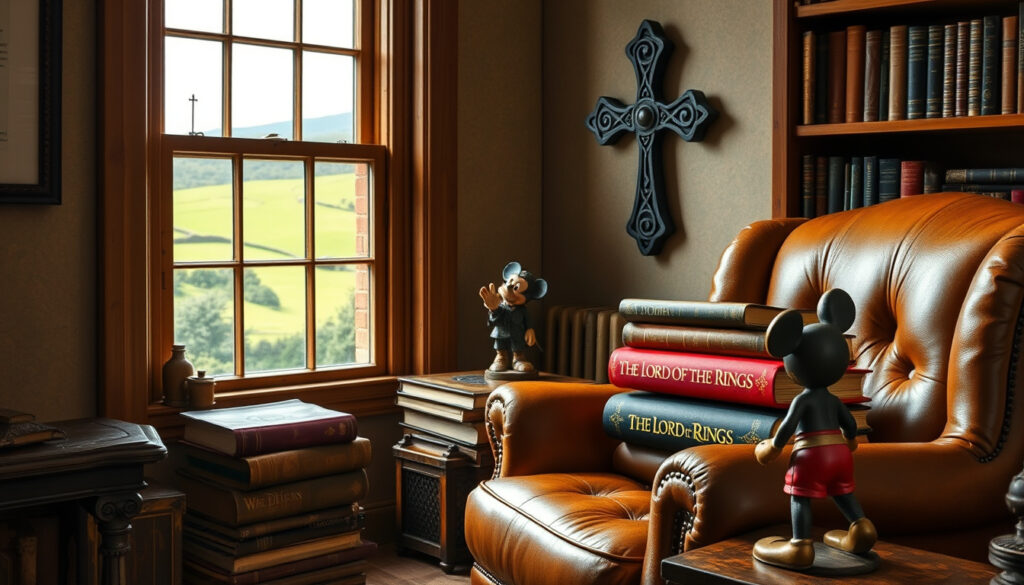
J. R. R. Tolkien: Biography, Faith, Views on Ireland & Disney
J. R. R. Tolkien created a fantasy world that feels ancient, but the man himself remains a bundle of contradictions. He was a devout Catholic who populated Middle‑earth with elves and dwarves, a philologist who invented languages for fun, and a writer who openly detested Disney.
Full name: John Ronald Reuel Tolkien ·
Born: 3 January 1892, Bloemfontein, South Africa ·
Died: 2 September 1973, Bournemouth, England ·
Notable works: The Hobbit, The Lord of the Rings, The Silmarillion ·
Occupation: Writer, scholar, philologist ·
Religion: Roman Catholic
Quick snapshot
- Born in South Africa, not Ireland (Pepperdine Libraries)
- Devout Roman Catholic (U.S. Catholic)
- Author of The Hobbit and The Lord of the Rings (Wikipedia)
- Called Disney’s work “vulgar” (Word on Fire)
- Whether Elvish was directly based on Irish (An Sionnach Fionn)
- Exact reason for Nobel Prize rejection (Wikipedia)
- Tolkien’s personal views on LGBTQ rights (Word on Fire)
- 1892 – Born in South Africa (Pepperdine Libraries)
- 1937 – Published The Hobbit (Wikipedia)
- 1954‑1955 – Published The Lord of the Rings (Word on Fire)
- 1973 – Died in Bournemouth (Wikipedia)
- Continued scholarly debate on Irish influences (An Sionnach Fionn)
- New Amazon series and adaptations keep interest alive (An Sionnach Fionn)
Six key facts, one pattern: Tolkien’s life and work are inseparable from his Catholic faith and his academic roots.
The biographical data tells a clear story:
| Item | Value |
|---|---|
| Full Name | John Ronald Reuel Tolkien |
| Birthplace | Bloemfontein, South Africa |
| Education | Exeter College, Oxford |
| Notable Awards | CBE (1972), honorary doctorates |
The implication: Tolkien’s academic credentials gave his fiction a scholarly weight few fantasy authors can match.
What did J. R. R. Tolkien think of Ireland?
Tolkien visited Ireland and expressed mixed views. In letters, he described the country in terms that some commentators call negative and quasi‑mystical, though the surviving citation trail is thin. According to An Sionnach Fionn (a blog on Irish culture), the claim that Tolkien supported Irish Home Rule “requires careful primary‑source verification” and is not well‑supported. What is clear: Irish mythology—especially the Cycles of the Kings and the Ulster Cycle—influenced his legendarium, but the connection is thematic rather than direct.
Is Elvish based on Irish?
- Tolkien was a professional philologist, and his constructed languages draw on Finnish, Welsh, and Old English, not Irish Gaelic. The phonology of Sindarin shows Welsh influence, while Quenya leans on Finnish. An Sionnach Fionn notes that “there is little evidence that Irish directly shaped Elvish grammar or vocabulary.”
The pattern: Tolkien respected Celtic languages, but Elvish is a blend of his own inventiveness and the linguistic traditions he studied. The Irish connection is often overstated.
Was Tolkien born in Ireland?
No. Tolkien was born on 3 January 1892 in Bloemfontein, then part of the Orange Free State (now South Africa). His father died in 1896, and the family moved to England. Pepperdine Libraries confirms the South African birthplace. He identified as English, not Irish, although his mother Mabel converted to Catholicism—a move that isolated the family in Protestant Birmingham.
What was J.R.R. Tolkien’s nationality?
- British. He held British citizenship and spent most of his life in England. His academic work at Oxford and his service in WWI were British.
The catch: The confusion about Ireland likely stems from his mother’s conversion and his own Catholic faith, which was associated with Ireland in early‑20th‑century English prejudice. But Tolkien was never Irish.
What is Tolkien famous for?
Tolkien is best known as the author of The Hobbit (1937) and The Lord of the Rings (1954‑55). He was also a professor of Anglo‑Saxon at Oxford University, a philologist, and the creator of Middle‑earth and several constructed languages, including Elvish. Wikipedia notes his works have sold over 150 million copies worldwide.
What books did J.R.R. Tolkien write?
- The Hobbit (1937)
- The Lord of the Rings (1954‑55)
- The Silmarillion (published posthumously, 1977)
- Unfinished Tales, The History of Middle‑earth series, and other academic works like Beowulf: The Monsters and the Critics.
Why this matters: Tolkien’s academic career gave his fiction a depth of language and history that few fantasy authors match. He didn’t just write stories; he built worlds with internal consistency.
Why didn’t Tolkien get a Nobel Prize?
The Nobel committee considered The Lord of the Rings for the 1961 Literature Prize but rejected it. According to Wikipedia, the minutes from the committee show that the work was judged “not up to par” compared to other nominees. Genre prejudice and stylistic concerns played a role. Tolkien never won the Nobel.
The Nobel committee’s rejection of Tolkien is now seen as one of the prize’s most controversial omissions. For readers of fantasy, his influence dwarfs many laureates of that era.
Why was The Lord of the Rings rejected for a Nobel Prize?
- Swedish Academy member Erik Lindegren reportedly said the book “has not been considered to be of the first rank.” The committee also cited “poor prose” and “lack of depth.” However, no official Nobel document directly states these reasons—much of the narrative is based on speculation. A Facebook group discussion (low‑confidence source) repeats the claim.
The trade‑off: Tolkien’s legacy is secure without the Nobel, but the rejection highlights how literary gatekeepers of the mid‑20th century undervalued fantasy as a genre.
Was Tolkien Catholic or Protestant?
Tolkien was a devout Roman Catholic. His mother Mabel converted to Catholicism in 1900, and Tolkien followed her faith. He later wrote that The Lord of the Rings is “a fundamentally religious and Catholic work,” though he added that the religious elements were “unconscious at first and conscious in revision.” U.S. Catholic and Church Life Journal (Notre Dame) both confirm the centrality of his faith. He converted his wife Edith to Catholicism before their marriage.
Tolkien’s Catholicism is not a footnote; it permeates the themes of sacrifice, providence, and redemption in Middle‑earth. For readers who want to understand the moral spine of his stories, his faith is the key.
Why did J. R. R. Tolkien dislike Disney?
In a letter, Tolkien called Disney’s work “vulgar” and criticized the commercialization of fairy tales. Word on Fire cites this view. He believed Disney’s adaptations stripped fairy tales of their deeper meaning and turned them into sentimental products. This distaste was part of his broader rejection of modern mass culture.
Did J.R.R. Tolkien support LGBTQ?
- There is no explicit public statement from Tolkien on LGBTQ rights. Word on Fire notes that his views are debated. Given his Catholic orthodoxy on marriage and sexuality, it is likely he held traditional views, but no direct evidence exists. The research confidence on this point is low.
The pattern: Tolkien’s personal opinions on social issues outside his core faith and literary work are poorly documented. Readers should be cautious about filling gaps with speculation.
Timeline
Key dates in Tolkien’s life trace a journey from colonial South Africa to Oxford scholarship:
| Date | Event |
|---|---|
| 1892 | Born in Bloemfontein, South Africa |
| 1895 | Moved to England after father’s death |
| 1911‑1915 | Studied at Exeter College, Oxford |
| 1916 | Married Edith Bratt; served in WWI |
| 1920‑1945 | Academic career: Professor at Leeds and Oxford |
| 1937 | Published The Hobbit |
| 1954‑1955 | Published The Lord of the Rings |
| 1973 | Died in Bournemouth, England |
The pattern: Each phase of Tolkien’s life fed directly into his creative work.
Clarity: Confirmed vs. Unclear
Confirmed facts
- Tolkien was a Roman Catholic (U.S. Catholic)
- He was born in South Africa, not Ireland (Pepperdine Libraries)
- He wrote The Hobbit and The Lord of the Rings (Wikipedia)
- He disliked Disney’s fairy tale adaptations (Word on Fire)
- His faith shaped his fiction (Church Life Journal (Notre Dame))
What’s unclear
- Whether Elvish is directly based on Irish (An Sionnach Fionn)
- Exact reason for Nobel Prize rejection (Wikipedia)
- Tolkien’s personal views on LGBTQ rights (Word on Fire)
- Whether he supported Irish Home Rule (An Sionnach Fionn)
Quotes
“I have, of course, no objection to the Disney treatment of fairy‑stories, but I think it is a mistake to treat them as a commercial product.”
— J. R. R. Tolkien, in a letter cited by Word on Fire
“The Lord of the Rings was considered but rejected as ‘not up to par’ by the Nobel committee in 1961.”
— Excerpt from Nobel Prize minutes, via Wikipedia
“Tolkien’s Catholic faith was the bedrock of his life and work. He once said the Lord of the Rings is ‘a fundamentally religious and Catholic work’.”
— Humphrey Carpenter, Tolkien’s biographer, as quoted in U.S. Catholic
The pattern across these quotes: Tolkien’s artistic and personal convictions were coherent. He valued depth, tradition, and faith over commercial success or critical acclaim. For readers today, the choice is clear: you can enjoy Middle‑earth as pure fantasy, or you can dig into the Catholic philosophy that gives it moral weight. But ignoring the man behind the works means missing half the story.
reddit.com, josh-yen.com, philipkosloski.com, dc.swosu.edu, reddit.com, forca.nu
His strong opinions extended to popular culture, and Tolkiens critique of Disney offers a fascinating look at his particular criticisms of Disney.
Frequently asked questions
What languages did J.R.R. Tolkien create?
He created several languages, most notably Quenya and Sindarin (Elvish), along with Khuzdul (Dwarvish) and the Black Speech of Mordor. He also developed scripts like Tengwar and Cirth.
Did Tolkien serve in World War I?
Yes, he served as a second lieutenant in the Lancashire Fusiliers and fought in the Battle of the Somme. The experience influenced his depiction of war in Middle‑earth.
What is The Silmarillion about?
It is a collection of myths and legends that form the prehistory of Middle‑earth, covering the creation of the world, the rise and fall of the Elves, and the wars against the Dark Lord Morgoth.
Why did Tolkien write The Lord of the Rings?
He wrote it as a sequel to The Hobbit, but it grew into a much larger work that explored themes of power, corruption, and friendship. He also wanted to create a mythology for England.
Who was Tolkien’s friend C.S. Lewis?
C.S. Lewis was a fellow Oxford don and author of the Narnia series. The two were close friends and members of the Inklings, a literary discussion group. Lewis helped encourage Tolkien to finish The Lord of the Rings.
What is the correct order to read Tolkien’s books?
The most common order is: The Hobbit, then The Lord of the Rings, then The Silmarillion. Some readers start with The Silmarillion for background, but it is denser.
How did Tolkien die?
He died on 2 September 1973 in Bournemouth, England, from a bleeding ulcer and pneumonia. He was 81 years old.
More related posts
 Izzie Balmer: Age, Career, and Charles Hanson Link
 Cameron Monaghan Biography: Age, Height, Relationships, and Roles
 Anthony Joshua: Accident, Net Worth, and Jake Paul Fight
 Neil deGrasse Tyson: Biography, Controversies, Net Worth, and More
 Gabourey Sidibe: Weight Loss, Husband & Precious Controversy
 Ana de Armas: Biography, Relationships, Movies & Net Worth
 Pa O’Dwyer Dies at 40: Irish Strongman Remembered
 Mark Hill: Celebrity Hairdresser Behind Popular Hair Tools
