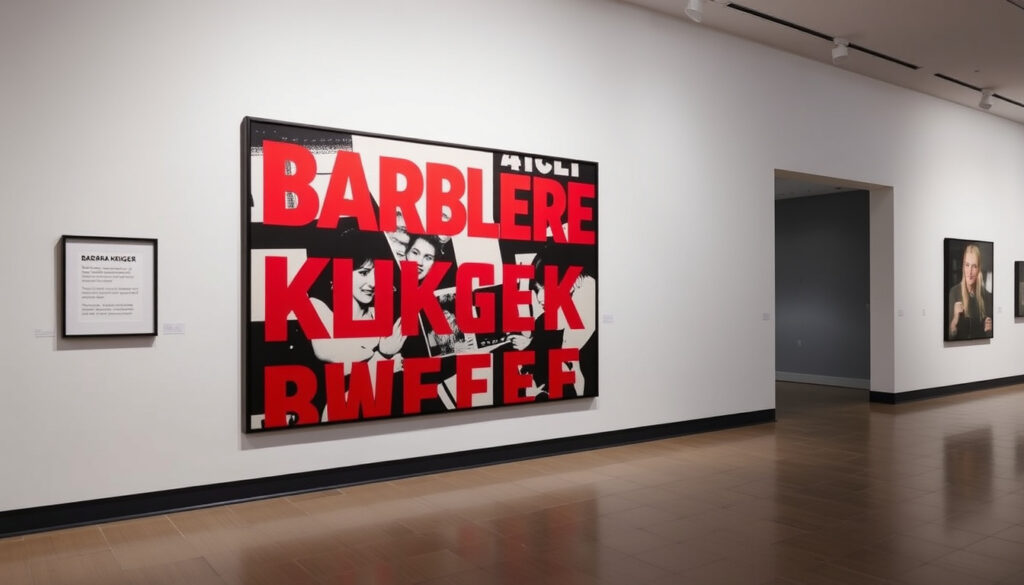
Barbara Kruger: Life, Art, and Famous Quotes Explained
You’ve probably seen Barbara Kruger’s work even if you don’t know her name—a black-and-white photograph slapped with a red text bar that cuts straight to the bone. Since the 1980s, she has turned the language of advertising into a sharp critique of consumerism, gender, and power.
Born: January 26, 1945 · Nationality: American · Movement: Pictures Generation, Feminist art · Known for: Conceptual art, collage, text-and-image overlays · Famous work: Untitled (I shop therefore I am) · Technique: Photographic silkscreen with red text on black-and-white images
Quick snapshot
- Born January 26, 1945, in Newark, New Jersey (The Broad)
- American conceptual artist associated with the Pictures Generation (Smarthistory)
- Uses silkscreen, found photographs, and bold red text in Futura Bold Oblique (National Gallery of Art)
- Famous work: Untitled (I shop therefore I am) (1987) (The Broad)
- Exact personal life details—Kruger is known to be private
- Current net worth or sales figures
- Specific future exhibition schedule beyond announced shows
- : Born in Newark (The Broad)
- : Created Untitled (Your gaze hits the side of my face) (Smarthistory)
- : Solo exhibition at Guggenheim Bilbao (The Broad)
- Active on Instagram @barbarakruger45 with new digital works
- Continues large-scale installations and video pieces
- Her critique of consumerism remains highly relevant in the social media age
Seven key facts about Kruger, from her training to her signature mediums.
| Label | Value |
|---|---|
| Full Name | Barbara Kruger |
| Born | January 26, 1945, Newark, New Jersey, USA |
| Education | Syracuse University, Parsons School of Design |
| Movement | Pictures Generation, Conceptual art, Feminist art |
| Mediums | Photography, silkscreen, text, video, installation |
| Famous Work | Untitled (I shop therefore I am) (1987) |
| Website | barbarakruger.com (archived, also Instagram @barbarakruger45) |
What is Barbara Kruger best known for?
Kruger is best known for her provocative text-and-image works that critique consumerism, feminism, and power structures. She culls black-and-white photographs from mass media and overlays them with bold red text in Futura Bold Oblique, often using personal pronouns like “you” and “I” to directly address the viewer (The Broad). Her work is closely associated with the Pictures Generation, a group of artists who appropriated imagery from popular culture to examine how images shape meaning (Smarthistory).
Kruger’s signature style—black-and-white photos with red text bars—has become a visual shorthand for institutional critique. In a world saturated with branding, her work still cuts through the noise.
Where is Barbara Kruger now?
Kruger remains active in the 2020s, creating digital works and large-scale installations. In 2023, she had a solo exhibition at the Guggenheim Bilbao. She also runs an Instagram account (@barbarakruger45) where she posts new pieces that adapt her signature style to digital platforms, including a work titled Iphone therefore I am—a direct update of her 1987 classic.
The implication: Kruger has not only sustained her relevance but has actively adapted her critique to the very devices that define modern consumerism.
Why does Barbara Kruger use pronouns?
Kruger’s use of pronouns is a deliberate formal technique to collapse the distance between the artwork and the viewer. “Direct address has motored my work from the very beginning,” she has said (The Broad). By using “you,” “I,” “we,” and “they,” she assigns the viewer a role—sometimes as the subject, sometimes as the object of critique. This creates a confrontational yet intimate dialogue that forces the audience to question their own position within systems of power (National Gallery of Art).
According to a Columbia University art history analysis, pronouns in Kruger’s work create “two locations of meaning,” structuring relational meaning between the viewer and the image (Columbia University). In Untitled (Your gaze hits the side of my face) (1981), the phrase explicitly addresses an assumed male viewer, resisting the objectifying male gaze theorized by Laura Mulvey (Pera Museum).
What this means: Pronouns are not just a stylistic choice—they are the engine of Kruger’s political and feminist critique. They turn passive observation into active engagement.
What technique does Barbara Kruger use?
Kruger’s technique combines photographic silkscreen printing with text overlays. She sources black-and-white images from old magazines, manuals, and advertisements, then screen-prints them onto canvas or paper. Over these images she adds red text bars in Futura Bold Oblique, a font that mimics the authoritative language of headlines and advertising (National Gallery of Art).
Her process is fundamentally appropriative—she takes existing mass-media imagery and recontextualizes it with her own text. This approach places her within the tradition of appropriation art, shared by other Pictures Generation artists like Cindy Sherman and Richard Prince (The Broad). In later decades, she expanded into large-scale installations, video works, and digital pieces that wrap entire rooms in text and image.
Kruger’s technique is disarmingly simple—a graphic designer’s toolkit—but its power lies in the precision of the word-image pairing. The familiar look of advertisements makes her critique hit harder, but it also means her work can be easily co-opted by the very commercial culture she attacks.
What is a famous quote by Barbara Kruger?
Kruger’s most famous quote is actually a visual work: Untitled (I shop therefore I am) (1987). The phrase is a parody of René Descartes’ “I think, therefore I am,” replacing rational thought with consumer purchase. It appears on a black-and-white image of a woman’s hand holding a credit card, rendered in Kruger’s signature red text (The Broad).
Another iconic text: Untitled (Your body is a battleground) (1989), created for a pro-choice rally, uses a woman’s face split down the middle—one half positive, one negative—with the words overlaid in red. The piece directly addresses the viewer’s body as a site of political struggle (Pera Museum).
Kruger also gives memorable interviews. She told Interview Magazine: “I never say I do political art. Nor do I do feminist art. I’m a woman who’s a feminist, who makes art” (Interview Magazine). This quote separates her identity from the label, insisting that the art comes from a person, not a category.
The pattern: Kruger’s words—whether on canvas or in conversation—are designed to unsettle easy assumptions. They force the audience to reconsider who is speaking and who is being addressed.
What does I shop therefore I am mean?
The phrase “I shop therefore I am” is a direct parody of Descartes’ philosophical dictum. Where Descartes argued that the act of thinking proves existence, Kruger suggests that in a consumer society, the act of shopping has become the primary means of constructing identity. The work critiques how capitalism reduces people to their purchasing choices (The Broad).
In the 2020s, this critique has only intensified. Kruger updated the concept with Iphone therefore I am, referencing how smartphones and social media turn every user into a brand. The implication is that we now shop not just for goods but for likes, shares, and digital self-worth.
Why this matters: The meaning of “I shop therefore I am” has evolved from a commentary on 1980s mall culture to a lens on the algorithmic identity economy. Kruger’s 1987 work anticipated the influencer era by four decades.
Timeline
Key moments in Kruger’s career, from birth to recent exhibitions.
- : Born in Newark, New Jersey
- : Studied design at Syracuse University and Parsons School of Design
- : Began creating collages from found images; worked as a graphic designer at Condé Nast
- : Developed signature style—black-and-white photos with red text; gained critical acclaim
- : Produced large-scale installations and public art; taught at major universities
- : Continued creating digital works; exhibitions at MoMA, Guggenheim, Tate Modern
- : Created Iphone therefore I am; solo exhibition at Guggenheim Bilbao (2023)
The trajectory shows an artist who never stopped evolving—from print to digital, from gallery walls to Instagram feeds.
Certainty and clarity
Confirmed facts
- Born January 26, 1945 (The Broad)
- American conceptual artist associated with the Pictures Generation (Smarthistory)
- Uses silkscreen, found photographs, bold red text (National Gallery of Art)
- Famous work Untitled (I shop therefore I am) (1987) (The Broad)
- Active Instagram account @barbarakruger45
What’s unclear
- Exact personal life details (she is known to be private)
- Current net worth or sales figures
- Specific future exhibition schedule
Quotes from the artist
“Direct address has motored my work from the very beginning.”
Barbara Kruger, as quoted by The Broad
“I never say I do political art. Nor do I do feminist art. I’m a woman who’s a feminist, who makes art.”
Barbara Kruger, Interview Magazine
For collectors and curators, the decision is clear: Kruger’s work remains essential viewing, or risk missing the conversation on power and representation that she has been leading for four decades.
artshelp.com, pandamoniumfap.wordpress.com, grapheine.com, awomensthing.org, artlab.hyundai.com, myartbroker.com, suomianalyysi.fi
For readers wanting to explore her complete biography and key artworks, complete biography and key artworks offers an excellent starting point.
Frequently asked questions
How did Barbara Kruger become an artist?
She studied design at Syracuse University and Parsons School of Design, then worked as a graphic designer at Condé Nast. In the 1970s she began making collages from found images, and by the 1980s she had developed her signature text-and-image style (The Broad).
What is the Pictures Generation?
A group of artists in the late 1970s and 1980s who appropriated images from mass media to critique how visual culture shapes meaning. Members include Kruger, Cindy Sherman, Richard Prince, and Sherrie Levine (Smarthistory).
Is Barbara Kruger still making art?
Yes. She continues to create digital works, large-scale installations, and video pieces. She is active on Instagram (@barbarakruger45) and had a solo exhibition at the Guggenheim Bilbao in 2023.
Where can I buy Barbara Kruger prints?
Licensed prints are available through museum shops and authorized galleries. Be cautious of unlicensed reproductions—Kruger controls the use of her images.
What materials does Kruger use?
She uses photographic silkscreen on canvas or paper, found black-and-white images, and red text in Futura Bold Oblique. For installations she uses vinyl text, video projection, and digital media (National Gallery of Art).
How does Kruger’s work relate to feminism?
Her work confronts patriarchal assumptions about who looks and who is looked at, often using the male gaze as a target. She is considered a key figure in feminist art, though she personally avoids labeling her work as “feminist art” (Smarthistory).
What is the meaning of ‘Your body is a battleground’?
Created in 1989 for a pro-choice rally, the work uses a split image of a woman’s face with the text to argue that women’s bodies are sites of political and social struggle. It remains a powerful statement on reproductive rights (Pera Museum).
Does Barbara Kruger have a book of her art?
Several monographs exist, including Barbara Kruger: Thinking of You (1999) and Barbara Kruger: Desire Exists (2015), published by specialized art publishers.
Related reading
More related posts
 Benjamin Netanyahu: Biography, Family, and Key Facts
 Michael Learned: Emmy Wins and Why She Left The Waltons
 Telly Savalas: Death, Baldness, Hotel Life & Aniston Link
 Hrithik Roshan: Biography, Movies, Wife & Upcoming Films (2025)
 UK Co t of Living Payment: Statu and 2026 Change
 Karren Brady: Net Worth, Weight Loss, and 2026 West Ham Exit
 Thomas Edison: Inventions, Deafness, Sleeping Habits & Last Words
 Maisie Adams: Husband, Age, and Confusion with Maisie Williams
