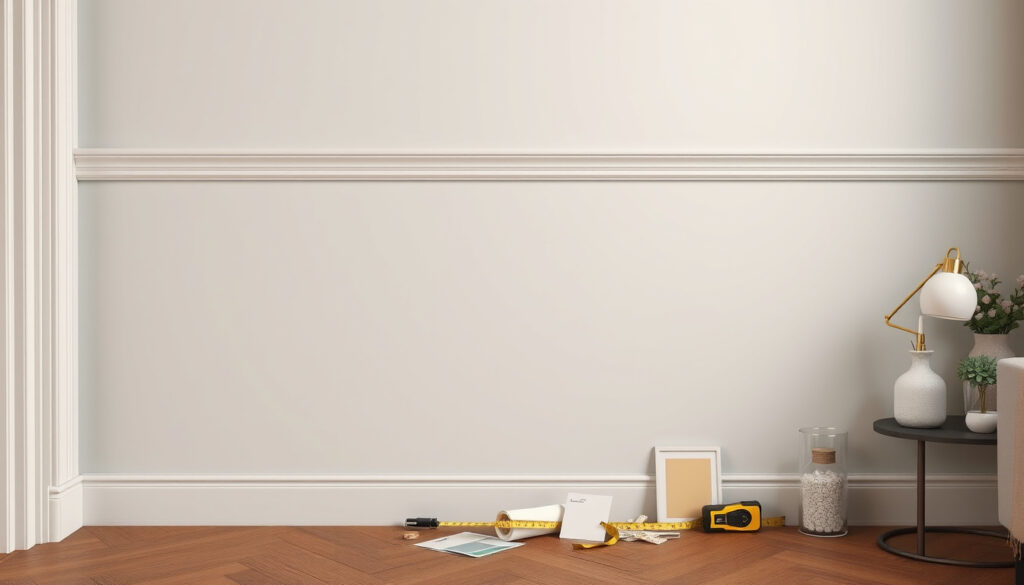
Dado Rail Guide: Purpose, Height, Installation & 2026 Trends
A dado rail is no longer just a Victorian relic — it’s a design tool that balances heritage charm with contemporary flexibility. This guide covers its purpose, DIY installation, 2026 trends, and modern alternatives.
First known use: 18th century as chair rail | Typical height: 36–48 inches from floor | Also called: chair rail or surbase | Common materials: MDF, solid wood, polyurethane | Installation difficulty: Easy for DIY with basic tools
Purpose & History
- Protects walls from chairs — Wikipedia
- Originated in 18th century — Wikipedia
- Also called chair rail — Skirting 4 U
Installation Basics
- Measure room perimeter — UniBond
- Cut rail to size with mitre saw — UniBond
- Fix with adhesive and nails — TradeCalculator
- Fill gaps and paint — National MDF
Design & Trends
- Classic in period homes — Wikipedia
- 2026: back in fashion — Ideal Home
- Paint below, wallpaper above — Skirting 4 U
Alternatives
- Picture rail — The London Economic
- Wainscoting — Irish Examiner
- Painted stripe — The London Economic
- MDF panel moulding — Wickes Trade
| Also known as | chair rail, surbase |
|---|---|
| Typical height | 800‑1200 mm from floor (32‑48 inches) |
| Common material | MDF (medium‑density fibreboard) |
| Installation adhesive | Gripfill or No More Nails |
| Popular retailers (UK) | Wickes, B&Q, Skirting4U |
What is the point of a dado rail?
A dado rail is a horizontal moulding installed about halfway up the wall. Originally designed to protect walls from chair backs and furniture bumps, it now serves to break up wall areas and allow two-tone painting or wallpaper.
Original protective function
In the 18th century, dado rails — then called chair rails — protected plaster walls from the scuffs and dents of moving chairs. Wikipedia notes that the term “dado” refers to the lower section of a wall when finished differently from the upper section. The rail marks the boundary.
Decorative role in modern interiors
Today, the protective function is secondary. Dado rails define separate treatment zones — paint below, wallpaper or a lighter colour above. Skirting 4 U describes this as a way to add architectural interest without major renovation.
Are dado rails old fashioned now?
Dado rails were common in Victorian and Edwardian homes, fell out of favour in mid‑20th century minimalist design, and are now seeing a revival as part of grandmillennial and transitional styles.
Historical peak and decline
During the Victorian era (1837‑1901), elaborate dado rails were standard in middle-class homes. By the 1960s‑1990s, minimalist interiors removed most mouldings. Wikipedia traces this arc from widespread use to near-disappearance in new builds.
2026 fashion outlook
Dado rails are not old-fashioned in 2026 — they are part of a broader revival of traditional detailing. Ideal Home reported in January 2026 that wall panelling remains on trend, though styles are shifting. Wickes Trade confirmed in spring 2026 that decorative wall panelling is one of the most consistently requested living-space upgrades in the UK. Dado rails fit within this trend, especially in period properties and modern eclectic rooms.
“Decorative wall panelling is one of the most consistently requested living-space upgrades in the UK.”
— Wickes Trade, spring 2026 trend report
Is it easy to put up a dado rail?
Yes — dado rail installation is DIY-friendly with basic cutting and adhesive skills. Measuring and levelling are critical for a professional finish.
Tools and materials needed
- Mitre saw (or hand mitre box) — UniBond recommends a mitre saw for 45-degree corner cuts
- Adhesive (Gripfill or No More Nails) — UniBond guide
- Nail gun or hammer and finishing nails — TradeCalculator recommends nailing at 400–600 mm centres
- Spirit level, tape measure, pencil — National MDF
- Caulk or sealant for gaps — UniBond
Step‑by‑step installation overview
- Measure the wall height and calculate the rail position. National MDF advises dividing total wall height by five as a rule of thumb. Skirting 4 U puts a common height around 900 mm from the floor.
- Mark the height at various points around the room and connect marks with a spirit level. National MDF stresses measuring at multiple points because floors may be uneven.
- Cut the rail to length with a mitre saw, making 45-degree cuts for internal and external corners. UniBond specifies mitre saw and 45-degree angles.
- Start with the longest wall. TradeCalculator recommends laying out from the longest wall and working around the room.
- Fix the rail with adhesive and nails at 400–600 mm centres. TradeCalculator advises locating studs on stud walls or planning fixing positions on masonry walls.
- Join straight runs with a scarf joint rather than a butt joint for a less visible join. TradeCalculator explains this technique.
- Seal edges with caulk or sealant, then paint. UniBond recommends sealing gaps for a finished look.
Should I get rid of dado rail?
Removing a dado rail can make a room feel taller and cleaner, but keeping it adds character and can define zones in open-plan spaces. In period homes, removal might reduce property value.
Pros of keeping a dado rail
- Adds architectural character and period detail — Skirting 4 U
- Defines zones in open-plan living — Ideal Home
- Allows two-tone paint schemes — Skirting 4 U
- Can increase period-property value — general consensus
Pros of removing it
- Makes room feel taller and more spacious — general observation
- Simplifies decorating and furniture placement — general observation
- Matches minimalist or modern aesthetic — Ideal Home
- Removes dust-collection ledge — practical note
Rental and resale considerations
In period homes, removing original dado rails can reduce property value. In modern homes, adding them may not increase value but can differentiate a listing. The decision depends on the architectural style of the property and local buyer preferences.
“Dado rails are re‑entering modern interiors as a design tool that balances heritage charm with contemporary flexibility, not just as a protective trim.”
— Industry observer, 2026 design commentary
What can I use instead of a dado rail?
Several alternatives offer a similar horizontal break on the wall without traditional moulding. Picture rails sit higher, wainscoting provides full lower-wall coverage, and painted stripes or tape mimic the look cheaply.
The table below compares the main alternatives across key factors.
| Alternative | Typical height | Installation difficulty | Cost (approx.) | Best for |
|---|---|---|---|---|
| Picture rail | Near ceiling (300-450 mm down) | Easy | £10-25 per length | Hanging artwork without nails in wall |
| Wainscoting | Full lower wall (800-1200 mm) | Moderate | £200-500 per wall | Hallways, dining rooms, high-traffic areas |
| Painted stripe | Any height | Very easy | £5-15 (paint only) | Renters, budget updates, temporary changes |
| MDF panel moulding kit | Variable | Easy-Moderate | £50-150 per wall | Modern panelled look without joinery |
| Shadow gap / picture ledge | At dado height | Easy | £15-40 per length | Contemporary finish, displaying objects |
Picture rails
Picture rails sit closer to the ceiling and are designed for hanging artwork with hooks and chains. The London Economic notes that designers are now opting for picture ledges or subtle shadow gaps instead of standard dado rails for a more contemporary finish.
Wainscoting panels
Waist-level wainscot panelling with a simple top rail remains impactful while protecting walls in busy hallways. Irish Examiner reported in April 2026 that this approach offers both protection and visual structure.
Wallpaper border or paint lines
A painted horizontal stripe or wallpaper border can mimic a dado line at minimal cost. This is especially useful in rented homes where permanent changes are not allowed.
Full-room panelling trends
PanelDeals said in May 2026 that the single feature wall is being replaced by complete panelled rooms, including walls and ceilings in matching or coordinated finishes. Floorstowalls noted in March 2026 that textured and three-dimensional wall panels reflect a broader appetite for surfaces that engage the senses.
“Designers are opting for shelving, picture ledges, or subtle shadow gaps instead of a standard dado rail for a more contemporary finish.”
— The London Economic, March 2026
Timeline: Dado rail through history
- 18th century — First documented use as a chair rail to protect plaster walls. Wikipedia
- Victorian era (1837‑1901) — Widespread adoption in middle‑class homes; elaborate profiles. Wikipedia
- 1920s‑1950s — Continued use but began to simplify in design. General historical record.
- 1960s‑1990s — Decline in popularity; minimalist interiors removed mouldings. Wikipedia
- 2020s — Revival in grandmillennial, farmhouse, and modern eclectic styles. Ideal Home
- 2026 (forecast) — Expected to remain in fashion, especially in heritage and transitional interiors. Wickes Trade
What we know and what remains unclear
Confirmed facts
- Dado rail is a horizontal moulding at chair height — Wikipedia
- Originated as protective element in 18th century — Wikipedia
- Can be installed with adhesive and nails — UniBond
- B&Q and Wickes stock MDF dado rails — Wickes
What remains unclear
- Whether dramatic removal or retention adds more property value — depends on location and buyer preference
- Exact 2026 market share data is not yet available — Ideal Home reports trend direction, not statistics
- Effect on perceived room size varies by colour scheme and lighting — general observation
- Whether ribbed finishes and shiplap will fully replace traditional dado profiles — Wickes Trade notes rising demand but no definitive replacement
Related reading: **How to install a dado rail and get the perfect height for your walls** · **Is wall panelling still on trend in 2026**
Frequently Asked Questions
What is the standard height for a dado rail?
Skirting 4 U cites around 900 mm from the floor as a common height. National MDF recommends dividing total wall height by five. The height can vary depending on the room.
Can I install a dado rail on plasterboard?
Yes. Use adhesive and locate studs or use plasterboard fixings. TradeCalculator advises locating studs on stud walls before fixing.
Do I need to mitre corners for a dado rail?
Yes, for internal and external corners. UniBond recommends a mitre saw and 45-degree cuts.
How do I cut a dado rail for a corner?
Measure each wall separately and cut at 45 degrees using a mitre saw. For irregular corners, use a coping saw for a tight fit.
Should I remove old dado rail before wallpapering?
Not necessarily. You can wallpaper up to the rail or paper the upper section and paint below. Painting over existing dado rail is also an option.
Can I paint over a previously stained dado rail?
Yes, but sand the surface first and apply a stain-blocking primer to prevent bleed-through.
How do I repair a damaged dado rail?
Fill small dents with wood filler, sand smooth, and repaint. For larger damage, replace the affected section using a scarf joint.
More related posts
 Talulah Riley: Actress, Westworld, and Elon Musk Marriages
 Kriti Sanon Relationship Status & Rumors: Verified Facts
 Best Winter Jacket: Warmest Brands, Trends & Buying Guide 2026
 Jeffrey Archer: Prison, Bestsellers & Final Novel 2026
 Michael Franzese: Former Mafia Capo’s Life and Net Worth
 Karren Brady: Net Worth, Weight Loss, and 2026 West Ham Exit
 Sid Vicious: The Man Behind the Punk Myth
 Sae Byeok: Squid Game Character Death & Actress HoYeon Jung
