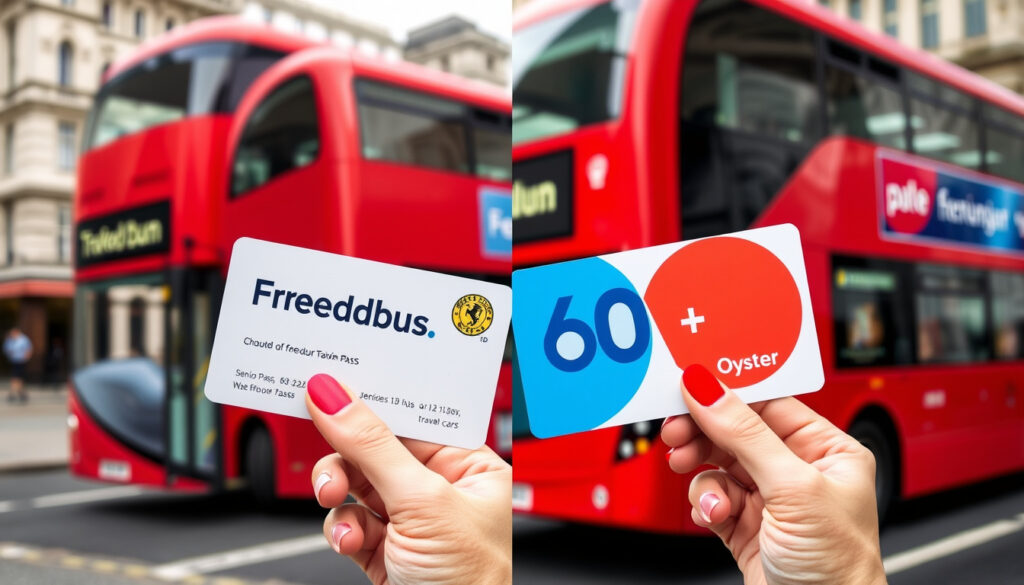
Freedom Bus Pass vs 60+ Oyster: What’s the Difference
Ask any Londoner when the bus becomes free and you will hear a few different answers. The Freedom Pass and the separate 60+ Oyster card both offer free travel in London, but they are not the same pass — and the difference can change where you can travel and when.
Two passes, one city: 60+ Oyster from age 60 · Freedom Pass from State Pension age or with a qualifying disability · Apply through London Councils or TfL, never a paid service.
Freedom Bus Pass at a glance
Two distinct passes
The Freedom Pass and the 60+ Oyster card overlap on TfL buses, but they have different age rules and national travel boundaries. (London Councils)
Age is not one simple number
The 60+ card is for residents from age 60. The older person’s Freedom Pass is available at State Pension age. (GOV.UK)
Coverage has limits
The Freedom Pass does not cover the whole National Rail network, and many rail routes have a 09:30 weekday rule. (Freedom Pass)
Apply through official channels
Use TfL for the 60+ card and your council for the Freedom Pass. Never pay a third-party to do it for you. (TfL)
What are the benefits of a Freedom Pass?
London bus fares and travel are fully covered by the Freedom Pass on TfL services. The pass is the London concessionary travel pass, issued through London councils. The two main types are the older person’s Freedom Pass and the disabled person’s Freedom Pass. The pass covers London buses and other TfL services such as the Tube, DLR, London Overground, Elizabeth line and London Trams. The Freedom Pass includes the statutory local-bus concession in England and is not valid for buses in Scotland, Wales or Northern Ireland.
Here is where the two schemes stop being interchangeable: the 60+ Oyster card is a TfL product, while the Freedom Pass is issued through London boroughs and coordinated by London Councils.
| Issuing body | London Councils (the body that coordinates the Freedom Pass) |
|---|---|
| Older person’s eligibility | State Pension age, not simply age 60 — check GOV.UK (central government guidance) |
| Main pass types | Older Person’s Freedom Pass, Disabled Person’s Freedom Pass and the separate 60+ Oyster card |
| 60+ card age | London residents from age 60 — Transport for London (the authority that operates the Oyster card) |
| Bus coverage | TfL buses, most other London buses and many local bus services across England |
| Rail coverage | Some National Rail services in London, usually off-peak on weekdays; not the whole National Rail network |
| Not covered | The full National Rail network, a blanket entitlement for children, and any third-party paid application route |
| Application route | TfL for the 60+ card; your council for the Freedom Pass |
What is the difference between a 60+ card and a Freedom Pass?
The 60+ Oyster card is a TfL pass for London residents from age 60. The Freedom Pass is run through London Councils and has an older-person version for people at State Pension age and a disabled-person version for people who meet the disability rules.
The 60+ card includes TfL services such as the Tube, DLR, London Overground, Elizabeth line and London Trams. It is not automatically the same as the older person’s Freedom Pass, which has wider coverage on many local bus services across England.
Put them side by side and the pattern is simple: the Freedom Pass has wider bus coverage outside London, while the 60+ card gives you a clean TfL product from age 60.
| Feature | 60+ Oyster card | Freedom Pass |
|---|---|---|
| Who qualifies | London residents aged 60+ | Older person at State Pension age, or a disabled person who meets the scheme rules |
| TfL services | Buses, Tube, DLR, Overground, Elizabeth line and trams | TfL buses at any time, plus other TfL services depending on pass type |
| National Rail | Some services in London, usually with off-peak time windows | Some services in London; not the whole network; 09:30 weekday rule applies to many rail routes |
| Local buses outside London | Not the same national bus map | Most local bus services across England on many routes |
| Application route | TfL | Your council, through London Councils |
The implication: Your travel habits—inside London or across England—determine which pass truly saves you money.
Who is eligible for a 60+ Oyster card?
The short answer is: London residents from age 60. You do not need to be at State Pension age to apply for the 60+ card, but you do need to show proof of age and address.
For the older person’s Freedom Pass, the age test is different. You need to have reached State Pension age, which is set nationally and has changed over time.
Do over 60s get a free bus pass in England?
In England, a free local bus pass is not linked only to age 60; it is linked to State Pension age for the standard older person’s pass. Freedom Pass eligibility for older people depends on the State Pension age rules in force at the time of application. Find out more about how the State Pension age works.
Some older search results still describe the 2020 renewal process. Use the current pages on your council’s website or TfL’s website before you rely on a contact number.
If you are applying through the disabled person’s Freedom Pass, the test is based on qualifying disability rather than age. A PIP award can be useful evidence, but not every PIP award automatically creates eligibility.
The catch: The gap between age 60 and State Pension age is exactly why the 60+ card exists.
Can I use my Freedom Pass before 9.30 am in London on buses?
On London buses, the Freedom Pass is valid for bus travel at all times; the 09:30 rule applies to many National Rail and some other travel concessions, not to London buses. The Freedom Pass covers local buses in England as part of the national concession, but not buses in Scotland, Wales or Northern Ireland.
Can I use my Freedom Pass on National Rail?
On TfL buses, both cards feel similar. On National Rail, the position is more restricted. The Freedom Pass official guidance says National Rail use is generally off-peak: on weekdays that usually means after 09:30, with weekend and public holiday use already allowed.
The same guidance says that the Freedom Pass does not cover the whole National Rail network. You still need to check the route or station before you travel.
For the 60+ Oyster card, National Rail coverage is also limited. The card works mainly within TfL’s network and on some London-area services, with time windows that depend on the route.
How to apply: freedom pass vs 60+ card
- Choose the right scheme. For the 60+ card, start at TfL. For the Freedom Pass, start at your council or the London Councils website.
- Check residence first. You need to be a London resident at the time of application.
- Gather proof of age and address. Disabled applicants should also gather evidence that links to the scheme’s disability test. Read more about disabled concessionary travel.
- Use the council’s contact details from its current page. Contact details change, and some older pages still describe the 2020 process.
- Do not pay a third-party to apply for you. The official route is free to use and the council will not refund a fee charged by someone else.
What this means: The application process is straightforward if you use the official channels and gather the right documents beforehand.
Confirmed rules vs common confusion
The official guidance clears up a few misunderstandings that are common in online travel groups.
- Older Person’s Freedom Pass holders can use the pass on most local bus services across England. (GOV.UK)
- The disabled pass also has a weekday time window on non-London buses, generally 09:30 to 23:00. (Freedom Pass)
- If you move out of London, you can lose your pass. (Freedom Pass)
- The Freedom Pass covers the whole National Rail network.
- A PIP award automatically means a pass is granted.
- Children are automatically entitled to a pass through a parent’s card.
- You need to pay a third-party for a faster application.
The pattern: The official guidance helps you avoid costly mistakes, especially around third-party services and rail assumptions.
What the official guidance says
The Freedom Pass official pages say TfL buses are covered at any time, with no weekday time restriction, even though the 09:30 rule appears in National Rail guidance.
— Freedom Pass scheme pages
Transport for London’s 60+ page is aimed at London residents aged 60 and over, and it describes the card as part of the TfL Oyster family.
— Transport for London
London Councils says the application route is through the council and that current contact details should be checked before starting an application.
— London Councils
If you live in London and qualify by age or disability, the right pass is the one issued for your circumstances — not the card that sounds broader in a Facebook comment. Start with your council’s official page, check the National Rail time windows, and do not pay a third-party for something the official scheme already gives you. Check the Oyster and 60+ card page for more details.
londoncouncils.gov.uk, brent.gov.uk, freedompass.org, fis.cityoflondon.gov.uk, londoncouncils.gov.uk, rbkc.gov.uk, freedompass.org, lbbd.gov.uk, londoncouncils.gov.uk, towerhamlets.gov.uk
Frequently asked questions
What is the minimum age for a 60+ Oyster card?
You need to be age 60 or over and a London resident at the time of application.
What is the minimum age for an older person’s Freedom Pass?
You need to have reached State Pension age, which is set nationally by GOV.UK.
Does a PIP award get me a Freedom Pass automatically?
No. A PIP award can be evidence, but the Freedom Pass depends on the disability and residence rules set by London Councils.
Are children automatically entitled to a Freedom Pass?
No. A disabled child may be able to apply if they meet the scheme’s eligibility rules, but there is no automatic family entitlement.
Can I use a Freedom Pass anywhere on National Rail?
No. The pass covers some National Rail services, usually off-peak, but not the whole network.
What happens if I move out of London?
The pass is linked to London residence. If you move out of London, you can lose eligibility and should contact the council issuing the pass.
More related posts
 AFC Bournemouth vs Liverpool F.C. Standings: H2H & Results
 What Happens to Bank Account When Someone Dies Without a Will UK – 2025 Intestacy Guide
 Moses Itauma: Biography, Record, Ethnicity, Religion & Next Fight
 Spanish Dance Crossword Clue – Solutions by Length and Tips
 Black Cat Meaning in Ireland: Luck, Lore & Symbolism
 Jamie Sives: Biography, Pronunciation & Game of Thrones Role
 Siobhán McSweeney: accent, age, accident, and personal life FAQ
 What Does 333 Mean? Angel Number in Love & Career
