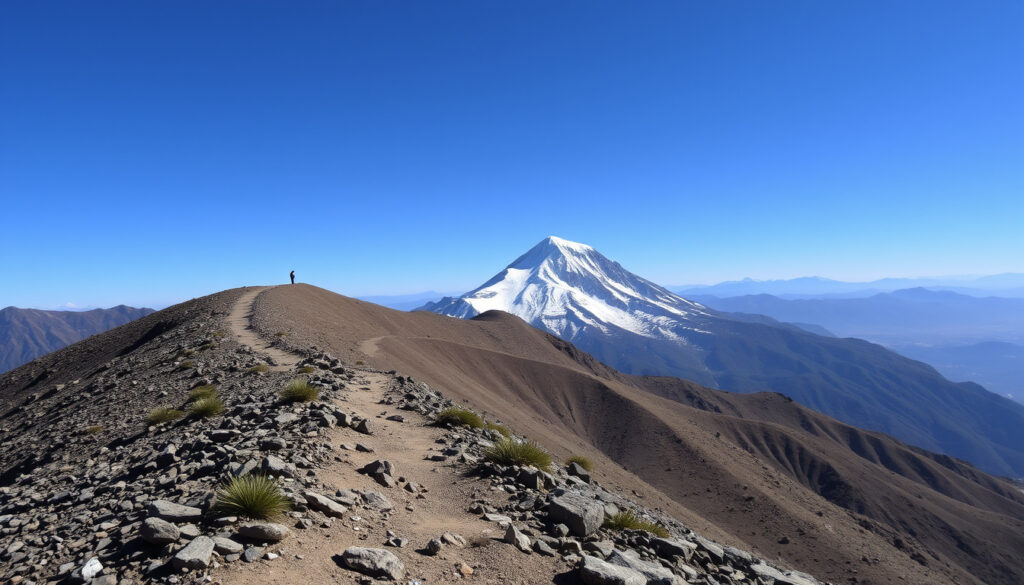
Mount Toubkal Difficulty: A Beginner’s Guide & Height
At 4,167m, Mount Toubkal is North Africa’s highest peak and a genuine altitude trek — not a walk-up. This guide uses source-backed data to show why the standard two-day route is beginner-friendly for fit hikers, but still demands respect for altitude, weather, and pacing.
Mount Toubkal: A Complete Guide to Difficulty, Height & Preparation
Height: 4,167 m (13,671 ft) · Location: High Atlas Mountains, Morocco · Rank: Highest peak in North Africa and the Arab world · Typical Duration: 2 days · Difficulty: Moderate (non-technical scramble)
The numbers below are the ones to verify before booking.
| Spec | Value |
|---|---|
| Height | 4,167 m (13,671 ft) |
| Location | High Atlas Mountains, Morocco |
| Rank | Highest peak in North Africa and the Arab world |
| Distance from Marrakech | ~65 km (40 mi) south |
| Summit season | April to October (best) – winter requires technical gear |
| Typical group size | 4–12 trekkers |
| Standard duration | 2 days |
| Technical rating | Non-technical scramble |
Difficulty
- A non-technical scramble, but the summit altitude of 4,167 m is the real test. Morocco Escape’s trek guide
Duration
- The standard route is a two-day trek from Imlil to the Toubkal Refuge, followed by a pre-dawn summit push. GuideMe’s Toubkal guide
Altitude
- Toubkal’s summit is 4,167 m, which makes it the highest peak in North Africa. the official Mount Toubkal website
Guides
- Many beginners complete Toubkal with a guide, and no rope or technical equipment is required. Roam With Ross’s climbing guide
How hard is Mount Toubkal to climb?
The short answer: it is a hard hike, not a technical climb. The route from Imlil to the Toubkal Refuge and then to the summit is a scramble over rocky ground; ropes and climbing hardware are not needed.
“The standard Toubkal climb is a non-technical two-day trek from Imlil to the Toubkal Refuge and then a pre-dawn summit push.”
GuideMe
The label “non-technical” can mislead. Fit hikers will still cover 5–6 hours on day one and 8–10 hours on day two, much of it above 3,000 m. The climb is not hard because of vertical rock; it is hard because of altitude.
Physical demands and route difficulty
The route is a non-technical scramble. Day one follows switchbacks out of Imlil, then a rocky valley to the refuge. Summit day adds a long scree slope and a final rocky ridge. Morocco Escape describes the climb as a trek, not a mountaineering route.
The vertical total matters. From the Imlil trailhead at roughly 1,800 m to the 4,167 m summit, the route gains about 2,200 m over two days. Even with the refuge sleep, the summit push starts from 3,207 m and climbs almost 1,000 m before dawn.
Typical summit times and rest breaks
Day one usually takes 4–6 hours depending on pace. Day two is the longer test: a pre-dawn start, a 3–4 hour ascent to the summit, then 4–6 hours of descent back to Imlil. Serenity Morocco Tours puts the full summit-and-return day at 8–10 hours.
Rest breaks should be built around altitude, not mileage. A short pause every 45–60 minutes gives the body time to adjust and gives the group a chance to check for early altitude sickness symptoms.
Required fitness and experience
No previous climbing experience is necessary. What matters is the ability to hike uphill for 5–6 hours with a daypack, and to keep moving after a poor night of sleep at altitude. Roam With Ross’s climbing guide makes the same point: beginners can do it, but only if they arrive fit.
A practical test: if you can walk continuously on a 600 m elevation-gain trail and still hold a conversation, you have the baseline for Toubkal. If that sounds easy, remember that altitude will make the same effort feel harder than it does at sea level.
The pattern from operator reports is consistent: the mountain filters by altitude tolerance, not by technical skill.
Can a beginner climb Mount Toubkal?
Yes, with conditions. A beginner who has built basic cardiovascular fitness and who follows a sensible itinerary can complete the standard two-day route. The phrase “beginner-friendly” from Wide Open Trail’s Toubkal guide means friendly for fit beginners, not for someone using the mountain as their first ever hike.
Prerequisites for beginners
Minimal prerequisites: no ropes, no technical gear, no previous climbing resume. The non-technical nature of the route is confirmed by Morocco Escape’s trek guide, but the caveat is that good cardiovascular fitness and acclimatization are essential.
The refuge overnight is not a luxury; it is the acclimatization step. GuideMe emphasizes sleeping at 3,207 m before summit day as the standard pattern.
Training recommendations before the trek
Train for sustained uphill walking, not gym strength alone. Three to four weeks before the trek, do two or three longer hikes with a loaded daypack; add stairs or treadmill incline sessions if you live in flat terrain.
Climbing Toubkal is a decision, not a fitness accident. On the mountain, the work is not a single steep pitch; it is hours of continuous uphill movement at altitude. If you prefer shorter outdoor walks while building a routine, RHS Gardens: Complete Guide to Visiting, Tickets, and Membership is a low-stakes option for more time on your feet.
Common beginner mistakes and how to avoid them
- Starting summit day too fast after a sleepless night at the refuge.
- Treating a headache as a normal dehydration sign and continuing upward.
- Carrying too much weight; a daypack with water, layers, snacks, and a camera is enough.
- Skipping the pre-trip night at moderate altitude when the itinerary allows.
Upsides
- Short two-day commitment — easier than a week-long expedition.
- Refuge accommodation removes the need for tent camping.
- Guides and mule support are widely available in Imlil.
Downsides
- Altitude is a real medical risk, even for fit beginners.
- The summit day is long and tiring.
- Weather can change quickly, especially outside summer.
The catch is that “beginner-friendly” is a conditional label: it depends on training, pacing, and honest self-assessment at altitude.
Is Toubkal or Kilimanjaro harder?
Kilimanjaro is the harder climb by almost every measure. Atlas Hikes’ comparison guide puts Toubkal’s summit at 4,167 m and Kilimanjaro’s at 5,895 m. The gap matters more than the number suggests because it pushes sleep altitude and oxygen availability into different territory.
Altitude comparison: Toubkal 4,167m vs Kilimanjaro 5,895m
Toubkal summits at 4,167 m; Kilimanjaro at 5,895 m. Kilimanjaro normally takes 7–9 days, whereas Toubkal is usually climbed in 2–3 days. The extra days on Kilimanjaro exist because the body needs time to adapt to sleeping higher.
Duration and route difficulty differences
Kilimanjaro is a trekking peak, not a technical climb, but it is a long, sustained expedition. Toubkal is also non-technical, yet its compressed itinerary means less time to acclimatise. The route difficulty is similar in style; the duration and altitude are not.
Which peak suits different experience levels
For a first high-altitude trek, Toubkal is the safer test. It exposes a beginner to altitude without the weeks of logistics required by Kilimanjaro. For someone who wants the full East African mountain experience and can invest 8–9 days, Kilimanjaro offers a bigger challenge — and a bigger altitude risk.
The table below shows the two peaks side by side.
| Metric | Mount Toubkal | Kilimanjaro |
|---|---|---|
| Height | 4,167 m | 5,895 m |
| Typical duration | 2–3 days | 7–9 days |
| Route style | Non-technical scramble | Trekking route, non-technical |
| Sleep altitude | Around 3,207 m at refuge | Above 4,000 m on most routes |
What this means for a first-timer: Toubkal is the shorter, lower-risk way to learn how your body behaves above 4,000 m. Kilimanjaro is reserved for hikers who want a longer expedition and more time at altitude.
How many days does it take to climb Mount Toubkal?
The standard answer is two days. Most trekkers climb from Imlil to the refuge on day one, summit before dawn on day two, and descend to Imlil by afternoon. Some operators add a third day for acclimatization, but the canonical route is the two-day climb.
“One widely described day-2 profile is a 3–4 hour ascent to the summit at 4,167 m followed by descent back.”
Morocco Escape
Standard 2-day itinerary
The typical day-1 transfer from Marrakech to Imlil takes about 1.5 hours, according to Hungry Soles’ climbing guide. The hike from Imlil to the refuge takes 4–6 hours depending on the pace. Serenity Morocco Tours’ route guide puts the summit-and-return day at 8–10 hours.
Alternative 3-day options for acclimatization
A three-day version adds an extra night below the refuge or a rest day at the refuge. City Tours Morocco’s altitude guide makes the case for a slower approach: sleeping one or two nights at 1,500–2,000 m before the trek can reduce altitude sickness risk.
What to expect each day
- Day 1 – Morning: Leave Marrakech, transfer to Imlil (~1.5 hours), then start hiking toward the refuge.
- Day 1 – Afternoon/Evening: Arrive at the Toubkal Refuge at 3,207 m, rest, hydrate, and eat an early dinner.
- Day 2 – Pre-dawn: Start between 4 and 5 a.m.; climb for 3–4 hours to reach the summit.
- Day 2 – Descent: Return to the refuge for a break, then continue down to Imlil; many trekkers finish in late afternoon.
The implication: two days is enough, but only because the refuge sleep is treated as a mandatory rest stop rather than an optional one.
Is Mount Toubkal a hard climb?
Hard is a relative word. Most trekking operators rate the standard route as “moderate,” meaning no technical gear, no glacier travel, and no ropework. That rating is useful, but it does not capture the altitude factor.
Subjective difficulty based on fitness level
For a trail runner, Toubkal is a long training day. For a desk-based hiker who has not done a mountain day in years, the same route can feel like a serious physical test. Both descriptions are accurate.
Comparison to other common trekking peaks
Ben Nevis Mountain: Climbing, Safety, and Key Facts covers another summit that is non-technical but weather-sensitive. Toubkal is similar in style but nearly 1,400 m higher than Ben Nevis.
Key challenge: altitude, not technical terrain
The summit at 4,167 m sits high enough to cause altitude sickness. The refuge at 3,207 m is below the danger zone for severe high-altitude illness, but it is high enough to disrupt sleep and trigger a headache. Morocco Escape reminds trekkers that altitude sickness can appear at the refuge elevation.
The implication: “hard” on Toubkal is mostly an altitude question. On a clear summer day, the scramble is manageable; with a headache and nausea, that same scramble can feel like a much bigger route.
What is confirmed and what is unclear?
The research behind this guide is drawn from multiple commercial trekking operators and guide sites. Some claims are consistent across nearly all sources; others depend on individual fitness and route conditions.
Confirmed facts
- Mount Toubkal is 4,167 m high and the highest peak in North Africa.
- The Toubkal Refuge is at 3,207 m.
- The standard route is a non-technical two-day climb.
- Altitude sickness symptoms include headache, nausea, dizziness, and loss of appetite.
What is still unclear
- The exact beginner difficulty rating varies by individual fitness and prior trekking experience.
- Altitude sickness risk is individual and cannot be predicted with certainty.
- Winter conditions can make the route more technical, but equipment lists vary by operator.
- Guide requirements depend on the route and the operator; the official rule is not consistently stated.
The pattern: Toubkal’s confirmed facts are stable, but the personal variables — fitness, altitude tolerance, and winter weather — make the “hard or not” question differ for every trekker.
frommilestosmiles.com, reddit.com, marrakechecotours.com, tunextravels.com
Frequently Asked Questions
What should I pack for climbing Mount Toubkal?
Bring layers, sun protection, water bottles or a hydration bladder, a headlamp, snacks, and a warm layer for the pre-dawn summit. The temperature at 4,167 m is much colder than in Marrakech.
Is a guide required to climb Mount Toubkal?
Most first-timers use a guide because the route involves navigation, weather decisions, and mule logistics. A guide is strongly recommended even when the official rule is not consistently enforced.
What is the best time of year to climb Mount Toubkal?
April to October is the most reliable window. Winter climbs are possible but require technical gear such as crampons and an ice axe.
How do I train for Mount Toubkal?
Train with sustained uphill hikes and stair sessions. Aim for 5–6 hours of hiking effort with a loaded daypack before you arrive in Morocco.
Can I climb Toubkal in winter?
Yes, but it is a different mountain. Snow and ice can turn the upper route into a steep grade where crampons and an ice axe are necessary, and operator equipment lists vary.
What altitude sickness symptoms should I watch for on Toubkal?
Watch for headache, nausea, dizziness, and loss of appetite. If symptoms worsen, descend; do not push through.
More related posts
 Kaido Lee Roberts: Age, Girlfriend, Dhar Mann Quit Rumors
 Ian Watkins: Verified Facts on Prison Stabbing and Death
 Leyton Orient vs Man City Lineups: FA Cup 2025 Starting XI
 Steve Buscemi: 9/11 Firefighter, Actor, and His Famous Smile
 Zoe Perry Biography: Age, Family, Young Sheldon Role
 Davy Crockett: Frontier Legend and Alamo Martyr – Biography
 Victoria Coren Mitchell: Children, Net Worth & Poker
 Nikola Tesla: Tragic Story, Inventions, and IQ Myths
