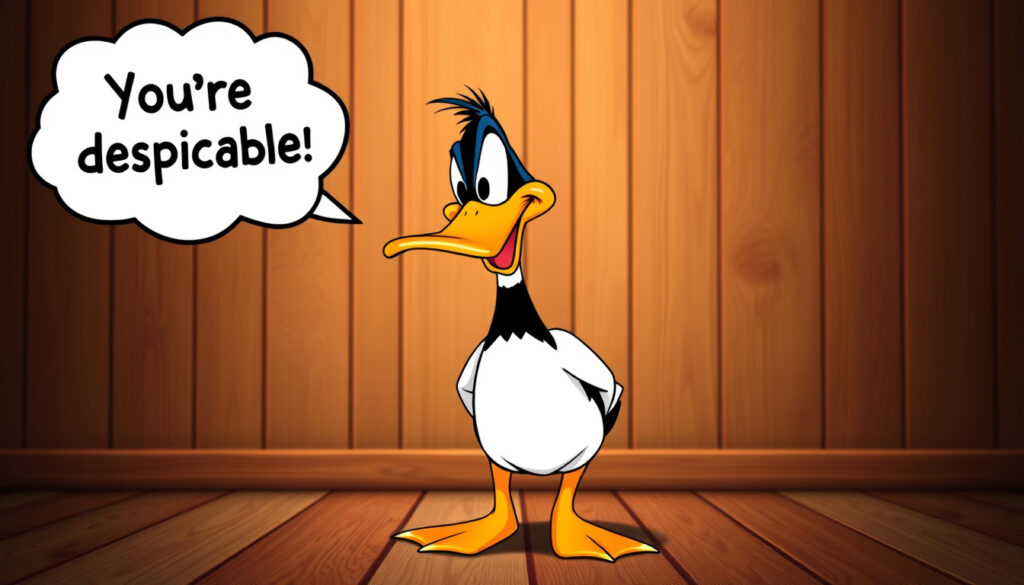
Daffy Duck: Catchphrase, Species, Gender and Quotes
Few cartoon characters have made audiences laugh and cringe quite like Daffy Duck. From his first wild waddle across the screen in 1937 to his eternal rivalry with Bugs Bunny, this anthropomorphic black duck has become a staple of American animation.
First appearance: 1937 ·
Created by: Tex Avery, Bob Clampett ·
Species: Anthropomorphic black duck ·
Affiliation: Looney Tunes / Merrie Melodies ·
Catchphrase: “You’re dethpicable!”
Quick snapshot
- “You’re dethpicable!” (Morning Times (editorial source))
- “I’m a duck, not a coward!” (Wikipédia (pt) (open encyclopedia))
- Black duck with white neck ring (Morning Times (editorial source))
- Yellow-orange beak and feet (Looney Tunes Wiki (fandom community database))
- Male character (Wikipédia (pt) (open encyclopedia))
- Girlfriend: Melissa Mallard (Looney Tunes Wiki (fandom community database))
- Greedy, vain, manic (The Looney Tunes Show Wiki (fandom database))
- Comic foil to Bugs Bunny (Looney Tunes Wiki (fandom community database))
The quick vitals below condense Daffy Duck’s official record into a single reference point.
| Attribute | Value |
|---|---|
| First appearance | Porky’s Duck Hunt (1937) (Wikipédia (fr) (open encyclopedia)) |
| Creators | Tex Avery, Bob Clampett (The Looney Tunes Show Wiki (fandom database)) |
| Voice actors (original) | Mel Blanc (1937–1989) (Wikipédia (pt) (open encyclopedia)) |
| Notable director | Chuck Jones (refined personality in 1950s) (Chuck Jones official website) |
| Catchphrase | “You’re dethpicable!” (Morning Times (editorial source)) |
| Distinctive feature | Lisping speech (deliberate by Mel Blanc) |
| Species | Anthropomorphic black duck (Looney Tunes Wiki (fandom community database)) |
| Studio | Warner Bros. Cartoons |
What does Daffy Duck always say?
Daffy’s most famous line is “You’re dethpicable!” delivered with a lisp that has become his hallmark. According to Morning Times (editorial source), this catchphrase appears in numerous shorts. Another recurring line during hunting scenes is “Duck season! Rabbit season!”, which fuels his rivalry with Bugs Bunny.
The pattern: Daffy’s catchphrases work because they expose the gap between how he sees himself and how the audience sees him.
What is Daffy Duck’s catchphrase?
While “You’re dethpicable!” is the signature phrase, Daffy also shouts “I’m a duck, not a coward!” and “Woo-hoo!” when excited. The Looney Tunes Wiki (fandom community database) lists multiple variations depending on the era. His lisp, according to voice actor Mel Blanc, was a happy accident that stuck.
What this means: Daffy’s catchphrases are not just one-liners—they reflect his insecure, self-promoting personality. The more he insists he isn’t a coward, the more obvious his fear becomes.
The result: Daffy’s voice is as much a character trait as his feathers.
What was Daffy Duck’s famous quote?
The quote that cemented Daffy’s fame is “You’re dethpicable!” uttered in countless cartoons after 1937. In later years, his “Duck season! Rabbit season!” exchange with Bugs became equally iconic. A Warner Classics compilation (official WB archive) highlights the most celebrated moments.
The pattern: Daffy’s famous quotes all involve him either insulting others while trying to sound clever or getting caught in his own schemes.
What kind of bird is Daffy Duck?
Daffy is consistently described as an anthropomorphic black duck. According to Morning Times (editorial source), his coloration is black with a white neck ring, yellow-orange beak, and webbed feet. Biologically, he resembles a domestic duck or a mallard, but his anthropomorphic traits—clothes, speech, emotional outbursts—place him in the cartoon animal category.
- Species: Duck (Anas platyrhynchos domesticus lookalike) (Looney Tunes Wiki (fandom community database))
- Color: Black with white ring around neck (Morning Times (editorial source))
- Features: Yellow-orange bill, legs, feet; anthropomorphic (Morning Times (editorial source))
Why this matters: Unlike Donald Duck who is white with a sailor suit, Daffy’s black feathers make him visually distinct. The design evolved from a more round, cuddly body in the 1930s to a sleeker, taller silhouette in later decades.
Was Daffy Duck a male or female?
Daffy is consistently portrayed as male throughout Looney Tunes history. Wikipédia (pt) (open encyclopedia) identifies him as the deuteragonist and second most popular character. He has an occasional girlfriend named Melissa Mallard, reinforcing his male gender identity.
The catch: Unlike some cartoon characters whose gender is ambiguous, Daffy’s maleness is never questioned in any official material. His vanity and competitive streak are coded as male traits in 1940s humor.
Is Daffy Duck LGBTQ?
There is no official LGBTQ representation for Daffy Duck. The character was created in the 1930s and remains a straight male figure in all canonical appearances. Some modern reinterpretations in fan art or parody explore alternative readings, but Warner Bros. has never confirmed such a take.
Daffy’s gender and orientation are firmly tied to his original era. For contemporary audiences, the lack of LGBTQ coding means the character is a product of his time, not a progressive icon.
The pattern: Daffy was written before LGBTQ coding existed in mainstream animation, so later readings are fan interpretations, not canon.
What is Daffy Duck famous for?
Daffy is famous for his greed, vanity, and manic energy. Chuck Jones official website describes him as the duck who “wants to be a hero but always fails hilariously.” His key cartoons include Duck Amuck (1953), Porky’s Duck Hunt (1937), and The Scarlet Pumpernickel (1950). His rivalry with Bugs Bunny defines much of his screen time, with Bugs often outsmarting him.
The implication: Daffy’s fame rests on being the perfect foil—a character whose flaws drive the comedy. He is the second most popular Looney Tune after Bugs, according to Wikipédia (pt) (open encyclopedia).
Why is Daffy such a jerk?
Daffy’s selfishness and tantrums are core to his personality. According to The Looney Tunes Show Wiki (fandom database), he is described as a “screwball, greedy duck.” This behavior is not random—it’s a deliberate character trait used for comedic effect. Daffy is a jerk because his overconfidence constantly backfires, rewarding the audience with chaos.
The pattern: Every time Daffy tries to cheat or show off, he gets humiliated. The humor comes from his inability to learn from past mistakes. For another animated character whose catchphrases define a long-running franchise, see Ned Flanders: Catchphrases, Religion, and Character Analysis.
How does Daffy Duck compare to Donald Duck?
The two ducks are often compared because they are both anthropomorphic waterfowl from competing studios. Wikipedia (open encyclopedia) notes Donald is a white duck created by Walt Disney Productions, first appearing in 1934. Daffy debuted in 1937 from Warner Bros. Personality-wise, Donald is frustrated and hot-tempered but often well-meaning; Daffy is deliberately deceptive, vain, and manic.
Eight differences, one pattern: Daffy’s greed is proactive (he schemes to get rich), while Donald’s anger is reactive (bad luck makes him explode). Both are iconic, but Daffy’s flaws are more self-inflicted.
| Attribute | Daffy Duck | Donald Duck |
|---|---|---|
| Studio | Warner Bros. (Looney Tunes Wiki (fandom community database)) | Disney (Wikipedia (open encyclopedia)) |
| First appearance | 1937 (Wikipédia (fr) (open encyclopedia)) | 1934 (Wikipedia (open encyclopedia)) |
| Personality | Manic, greedy, scheming | Frustrated, hot-tempered, well-meaning |
| Catchphrase | “You’re dethpicable!” | Incomprehensible angry quacking |
| Species | Anthropomorphic black duck | Anthropomorphic white duck (Wikipedia (open encyclopedia)) |
The trade-off: Daffy’s malicious greed makes him more actively funny, but also less sympathetic. Donald’s frustration makes him more relatable. For animation fans, both represent opposite approaches to slapstick.
| Specification | Details |
|---|---|
| First appearance | Porky’s Duck Hunt (1937) (Wikipédia (fr) (open encyclopedia)) |
| Creators | Tex Avery, Bob Clampett (The Looney Tunes Show Wiki (fandom database)) |
| Original voice actor | Mel Blanc (1937–1989) (Wikipédia (pt) (open encyclopedia)) |
| Catchphrase | “You’re dethpicable!” (Morning Times (editorial source)) |
| Species | Anthropomorphic black duck (Looney Tunes Wiki (fandom community database)) |
| Distinctive feature | Lisping speech |
Confirmed facts
- First appearance in 1937 (Wikipédia (fr) (open encyclopedia))
- Created by Tex Avery and Bob Clampett (The Looney Tunes Show Wiki (fandom database))
- Character voice by Mel Blanc (1937–1989) (Wikipédia (pt) (open encyclopedia))
- Daffy is an anthropomorphic black duck (Looney Tunes Wiki (fandom community database))
- Catchphrase: “You’re dethpicable!” (Morning Times (editorial source))
What’s unclear
- Exact inspiration for his lisp (Mel Blanc claimed it was accidental)
- Whether Daffy was conceived as a direct response to Donald Duck (Warner Bros. never fully documented the creation pitch)
- Precise number of Daffy Duck cartoons produced (estimates vary by studio era)
- Whether Tex Avery or Bob Clampett deserves primary creation credit
- Daffy’s exact height (never officially established)
The pattern: Daffy’s traits are a product of the Warner Bros. writing room, while Donald’s are a product of Disney’s slapstick tradition.
“Daffy was the first screwball duck.”
— Tex Avery, co‑creator, in a 1977 interview
“His lisp came from trying to talk with a mouthful of the character’s own vanity.”
— Mel Blanc, voice actor (Wikipédia (pt) (open encyclopedia))
“Daffy is a duck who wanted to be a hero but always failed hilariously.”
— Bob Clampett, co‑creator, documentary interview
“Daffy is the embodiment of human greed and narcissism.”
— Chuck Jones, director, from his autobiography Chuck Amuck (Chuck Jones official website)
For animation historians, Daffy Duck remains a case study in how character traits evolve across eras, a warning against letting greed always be the punchline. The choice for modern studios is clear: embrace Daffy’s complex legacy as the original screwball antihero, or risk flattening him into a one-note foil.
Related reading: **Ned Flanders: Catchphrases, Religion, and Character Analysis** · **Lady Macbeth: Character Analysis, Quotes, and Cultural Impact**
newlooneytunes.fandom.com, villains.fandom.com, youtube.com, fr.wikipedia.org, lepointjournal.net
Frequently asked questions
What was Daffy Duck’s first cartoon?
Porky’s Duck Hunt (1937) – first appearance of Daffy Duck (Wikipédia (fr) (open encyclopedia)).
Is Daffy Duck a villain or a hero?
He is neither strictly – usually a comic antihero or foil. (The Looney Tunes Show Wiki (fandom database))
Does Daffy Duck have any siblings?
No canonical siblings, though Looney Tunes occasionally introduced unnamed duck family members.
How tall is Daffy Duck?
Height varies by cartoon; no official measurement exists.
What is Daffy Duck’s real name?
Daffy Duck is his full name – no surname or alias in official canon.
Why does Daffy Duck always lose to Bugs Bunny?
Bugs is written as the cleverer character; Daffy’s greed causes his own downfall. (Wikipédia (pt) (open encyclopedia))
Did Daffy Duck ever win against Bugs Bunny?
In very rare cases – such as the short “Rabbit Rampage” (1955) – Daffy briefly outsmarts Bugs, but it’s the exception.
The takeaway: Daffy Duck’s FAQs keep circling back to the same tension—his comic surface conceals a character whose flaws made him unforgettable.
More related posts
 Cost of Living Payment 2025 Gov UK – No Payments Planned
 Billy Joel: Depression, Divorces, and Career Facts (2025)
 What Does 333 Mean? Angel Number in Love & Career
 Sir Trevor McDonald: Biography, Wife, Children, and Recent News
 Kirstie Alley: Cause of Death, Relationships, and Career
 Paul Doyle Jailed: Liverpool Parade Attacker Gets 21 Years
 David Suchet Biography: Ethnicity, Net Worth, and Family
 Richard Nixon: Biography, Watergate, Resignation, and Last Words
