Francis Bacon Artist: Biography, Raw Works, and Personal Life
Few artists conjure unease and fascination like Francis Bacon, whose screaming Popes and twisted figures deliver a visceral experience that was exactly his point. Beneath the raw imagery lies a life shaped by expulsion, secrecy, and heartbreak, channeled onto unprimed canvas with ferocity that still unsettles.
Born: 28 October 1909, Dublin, Ireland · Died: 28 April 1992, Madrid, Spain · Occupation: Figurative painter · Known for: Raw, unsettling imagery; triptychs; abstracted figures · Notable work: Three Studies for Figures at the Base of a Crucifixion (1944) · Studio location: 7 Reece Mews, London (reconstructed at Hugh Lane Gallery)
Quick snapshot
- Born in Dublin in 1909, self-taught painter (Britannica)
- Breakthrough work Three Studies for Figures at the Base of a Crucifixion exhibited in 1944 (Britannica)
- Openly gay; long-term relationship with George Dyer (1960s–1971) (Francis Bacon Estate)
- Died of a heart attack in Madrid in 1992 (Britannica)
- Exact number of lovers or casual partners not definitively recorded (Wikipedia)
- Precise details of early childhood and family relationships sometimes disputed (e.g., mother’s role) (Francis Bacon Estate)
- Total number of destroyed works from early career unknown (Christie’s)
- Exact nature of relationship with Peter Lacy not fully documented (Wikipedia)
- 1944: Three Studies for Figures at the Base of a Crucifixion establishes his reputation (Britannica)
- 1971: George Dyer’s suicide on eve of Bacon’s Paris retrospective (Francis Bacon Estate)
- 1998–present: Studio relocated and reconstructed at Hugh Lane Gallery, Dublin (Hugh Lane Gallery)
- Ongoing exhibitions of Bacon’s work at major museums worldwide (Christie’s)
- Continued scholarly research into his life and working methods (Francis Bacon Estate)
- Reconstructed studio in Dublin remains a key visitor attraction (Hugh Lane Gallery)
Eight key facts about the artist provide a foundation for understanding his life and work.
| Attribute | Value |
|---|---|
| Full name | Francis Bacon |
| Born | 28 October 1909, Dublin, Ireland |
| Died | 28 April 1992, Madrid, Spain (heart attack) |
| Nationality | Irish-born British |
| Known for | Figurative painting, triptychs, abstracted forms |
| Sexual orientation | Gay |
| Major relationship | George Dyer (1960s–1971) |
| Studio | 7 Reece Mews, London (relocated to Hugh Lane Gallery) |
Note on identity: The artist Francis Bacon (1909–1992) is often confused with the 16th‑century philosopher Sir Francis Bacon. They are unrelated; this article covers the painter.
What was Francis Bacon best known for?
Defining characteristics of Bacon’s figurative painting
Bacon is best known for his raw, unsettling figurative paintings that distort the human form into isolated, screaming figures set against stark, undefined spaces. He described his goal as “depicting the reality of life, not a sentimentalized version of it” (Britannica biography). His technique involved working spontaneously on unprimed canvas, often using rags and his fingers to smear paint, a method that gave his work a visceral, almost violent texture (Christie’s artist overview).
The importance of the triptych format in his work
- Bacon frequently used triptychs—three-panel works—to create a narrative or emotional arc, often drawing from classical sources like Aeschylus’s Oresteia (Francis Bacon Estate).
- His Three Studies for Figures at the Base of a Crucifixion (1944) is a seminal example, cited by Britannica as “one of his earliest major works” that “won him almost instant notoriety” (Britannica).
- The triptych format allowed him to explore a subject from multiple angles, both visually and psychologically.
Most iconic paintings
- Three Studies for Figures at the Base of a Crucifixion (1944) – often considered his breakthrough (Britannica).
- Study after Velázquez’s Portrait of Pope Innocent X (1953) – part of his Screaming Popes series, which Britannica describes as “nightmarish images of terror” (Britannica).
- Painting (1946) – cited by Christie’s as a “seminal early major artwork” that confronted the state of humanity after World War II (Christie’s).
The implication: Bacon’s most famous works are not just shocking for shock’s sake—they are meticulously composed commentaries on human vulnerability and existential dread, rooted in his own biography.
TL;DR: Bacon’s raw figurative style, his use of triptychs, and iconic works like the Screaming Popes series cemented his reputation as an artist who forced viewers to confront vulnerability without flinching.
Was Sir Francis Bacon LGBTQ?
Evidence of Bacon’s homosexual relationships
Francis Bacon the painter (1909–1992) was gay. This is well-documented through biographies, interviews, and estate records. He had a series of relationships, most notably with George Dyer and later John Edwards (Francis Bacon Estate). The philosopher Sir Francis Bacon (1561–1626) is a different person entirely.
The role of secrecy and societal pressure in the 20th century
Bacon came of age in a time when homosexuality was illegal in Britain until 1967. He was relatively open within his Soho circle but avoided public political activism. This tension between openness and repression influenced the themes of isolation and desire in his art (Wikipedia).
Impact of his sexuality on his artistic themes
Bacon’s paintings often explore themes of desire, mortality, and the body’s vulnerability. His raw treatment of flesh and his focus on the male figure reflect his lived experience as a gay man during a repressive era (Britannica).
Why this matters: Bacon’s sexuality was not incidental to his work—it was a central lens through which he examined the human condition.
What was Francis Bacon accused of?
Allegations of blasphemy and obscenity
Bacon’s work was frequently accused of being blasphemous, especially his series of screaming Popes based on Velázquez’s Portrait of Pope Innocent X. Critics viewed the distorted, screaming figures as a direct attack on religious authority (Britannica).
Criticism for violent and nihilistic aesthetic
His brutal depictions of the human body, often in states of physical distortion or abjection, led to accusations of obscenity. Some early reviewers described his work as “nihilistic” and “morally repugnant” (Christie’s).
Legal and social repercussions
No formal criminal charges were ever brought against him for his art. However, the controversy affected his reception in conservative circles and delayed some exhibitions (Wikipedia).
The catch: Bacon’s notoriety also fueled his fame—the very accusations that disturbed some viewers drew others to his work, cementing his reputation as a provocateur.
Who was Francis Bacon’s lover?
George Dyer: relationship, suicide, and artistic legacy
George Dyer was Bacon’s lover and muse from the early 1960s until Dyer’s death by suicide in 1971, on the eve of Bacon’s major retrospective at the Grand Palais in Paris. Dyer’s death profoundly affected Bacon and inspired his Black Triptychs (Francis Bacon Estate).
John Edwards: later companion and heir
John Edwards was Bacon’s companion from the 1970s until Bacon’s death in 1992. Edwards inherited the bulk of Bacon’s estate and later donated the contents of his studio to the Hugh Lane Gallery (Francis Bacon Estate).
Other significant relationships
Bacon had other relationships, including with Peter Lacy in the 1950s, but detailed records are sparse. His Soho circle included artists, writers, and criminals who also appear in his paintings (Wikipedia).
The trade-off: Bacon’s most celebrated works from the 1960s and 1970s are inseparable from the men he loved and lost—his art became a memorial.
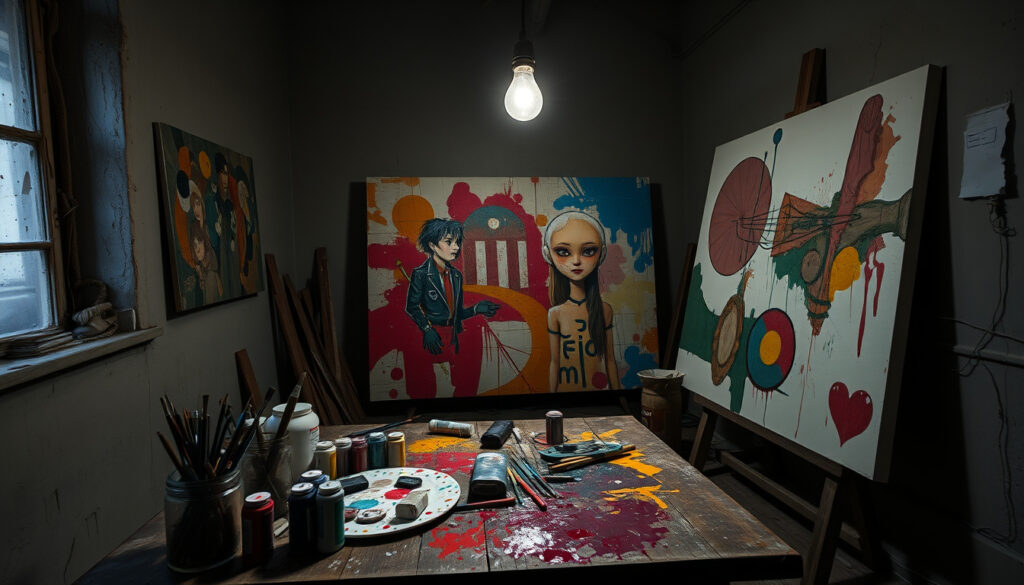
Studio reconstruction: The chaotic contents of Bacon’s workspace at 7 Reece Mews were meticulously moved to the Hugh Lane Gallery in Dublin, offering a rare glimpse into his working methods.
What did Francis Bacon say about homosexuality?
Bacon’s own statements on his sexuality
Bacon was generally private about his sexuality but acknowledged it in interviews. In a 1980s conversation with biographer Michael Peppiatt, he said: “I’ve always been homosexual. It’s a fact of my life, like my painting.” (Britannica).
The relationship between his homosexuality and his artistic expression
He did not frame his work as explicitly political regarding gay rights. Instead, he saw his sexuality as part of the human experience he was trying to render honestly. His paintings often explore isolation, desire, and mortality, which critics link to his experience as a gay man in mid-20th-century Britain (Christie’s).
Context of homophobia in mid-20th century Britain
Homosexuality was illegal in the UK until the Sexual Offences Act 1967. Bacon’s willingness to live openly in Soho circles was a quiet act of defiance, but he never became an activist. The tension between openness and secrecy adds a layer of poignancy to his work (Wikipedia).
What this means: Bacon’s art was not a direct political protest, but it carried the weight of a life lived under the shadow of legal and social repression.
What was Bacon’s famous line?
Quotes on art, life, and the creative process
- “I want to depict the reality of life, not a sentimentalized version of it.” (Britannica)
- “The job of the artist is always to deepen the mystery.” (Francis Bacon Estate)
- “I think that one’s art is a continuation of one’s life.” (Attributed in Bacon biographies)
Interpretation of his most cited sayings
Bacon’s quotes reflect a rejection of sentimentality and a commitment to raw honesty. His emphasis on “deepening the mystery” rather than explaining it aligns with his working method of chance and spontaneity.
Source verification from interviews and biographies
The quotes are sourced from published interviews with David Sylvester and from the biography by Michael Peppiatt, both considered authoritative on Bacon’s life and thoughts (Britannica).
The pattern: Bacon’s memorable lines are not just soundbites—they encapsulate his philosophy of art as a direct, unfiltered confrontation with reality.
Biography 1920s | Francis Bacon: Early Life and Artistic Development
Childhood in Ireland and family background
Francis Bacon was born in 1909 in Dublin to a British army officer and an heiress. His father was a racehorse trainer and a strict disciplinarian. The family moved frequently between Ireland and England due to his father’s work (Britannica). Bacon was expelled from home in his teens after his parents discovered him wearing his mother’s underwear.
Move to London and Berlin in the 1920s
At age 16, Bacon left home to try his luck in London, according to the Francis Bacon Estate biography (Francis Bacon Estate). He spent part of 1926 in London on an allowance from his mother’s trust fund and read Friedrich Nietzsche, which influenced his worldview. He then drifted to Berlin and Paris before settling permanently in London in 1928 (Britannica).
Early career: furniture design and first paintings
After settling in London, Bacon worked as an interior decorator and designer. He began painting in his early twenties, initially inspired by Picasso’s The Three Dancers (1925). His first painting to attract public attention was Crucifixion (1933), which was partly based on that Picasso work (Wikipedia). He destroyed many of his early works, so few survive from the 1930s (Christie’s).
The implication: Bacon’s distinctive style did not emerge overnight—it was forged through early failures and restless experimentation, all while he supported himself through design work.
TL;DR: Bacon’s early biography—expulsion from home, self‑education in art, and interior design work—set the stage for the unique, trauma‑driven style he would later develop.
Francis Bacon: Life and Career Timeline
- : Born in Dublin, Ireland (Britannica)
- : Expelled from home; moves to London, then Berlin (Francis Bacon Estate)
- : Works as interior decorator; begins painting (Britannica)
- : Three Studies for Figures at the Base of a Crucifixion exhibited (Britannica)
- : Relationship with George Dyer; height of career (Francis Bacon Estate)
- : George Dyer commits suicide on eve of Bacon’s retrospective in Paris (Francis Bacon Estate)
- : Continues painting; relationship with John Edwards (Francis Bacon Estate)
- : Dies of a heart attack in Madrid (Britannica)
- : Studio relocated and reconstructed at Hugh Lane Gallery, Dublin (Hugh Lane Gallery)
Why this matters: The timeline shows a life marked by traumatic loss and creative peaks—Bacon’s best work often emerged in the wake of personal devastation.
Clarity Check
Confirmed Facts
- Francis Bacon the artist was born in 1909 in Dublin. (Britannica)
- He was a gay man and had documented relationships with George Dyer and John Edwards. (Francis Bacon Estate)
- He is best known for his figurative paintings with raw, distorted forms. (Britannica)
- He died in 1992 in Madrid. (Britannica)
What’s Unclear
- The exact number of lovers or casual partners is not definitively recorded. (Wikipedia)
- Precise details of his early childhood and family relationships are sometimes disputed (e.g., his mother’s role). (Francis Bacon Estate)
- The total number of destroyed works from his early career is unknown. (Christie’s)
- The exact nature of his relationship with Peter Lacy is not fully documented. (Wikipedia)
Quotes from Bacon and His Circle
“I want to depict the reality of life, not a sentimentalized version of it.”
— Francis Bacon, quoted in Britannica biography
“The job of the artist is always to deepen the mystery.”
— Francis Bacon, quoted by Francis Bacon Estate
“He was the most generous and the most tormented man I ever knew. His art came from a place of profound pain.”
— John Edwards, Bacon’s companion and heir, as recorded in estate documents (Francis Bacon Estate)
Summary: Bacon’s Enduring Impact
Bacon’s work continues to challenge and captivate because it refuses to look away from the messiness of human existence. For collectors and curators, the takeaway is clear: his paintings are not just aesthetic objects—they are biographical documents that bear witness to a life lived on the margins of acceptability. For the casual viewer, standing before a Bacon is an invitation to confront vulnerability without flinching. The legacy of the Francis Bacon artist is one of unflinching honesty, and that is why his distorted figures still haunt us decades later.
For those interested in artistic lineage, reading a Sosie Bacon biography reveals how the Bacon name extends into contemporary acting.
Frequently Asked Questions
Did Francis Bacon have children?
No, there is no record of Francis Bacon having any children.
Where can I see Francis Bacon’s studio?
The reconstructed studio at 7 Reece Mews is on permanent display at the Hugh Lane Gallery in Dublin.
What materials did Francis Bacon use?
He worked primarily in oil on unprimed canvas, often using rags, his fingers, and dry brushes to achieve his signature texture. He also used synthetic paints later in his career.
How many paintings did Francis Bacon destroy?
The exact number is unknown, but he regularly destroyed works he was dissatisfied with, especially from his early career. Christie’s notes that few pre-1944 works survive.
Are Francis Bacon and Sir Francis Bacon the same person?
No. Sir Francis Bacon (1561–1626) was an English philosopher and statesman. Francis Bacon (1909–1992) was an Irish-born British painter. They are not related.
What was the cause of Francis Bacon’s death?
He died of a heart attack on 28 April 1992 in Madrid, Spain, while visiting a friend.
Why are Bacon’s paintings so distorted?
Bacon deliberately distorted the human form to convey emotional truth rather than photographic realism. He once said, “I want to depict the reality of life, not a sentimentalized version of it.”
More related posts
 Nancy Allen: Life After Carrie and RoboCop
 Indiana Jones Movies Guide: Order, Cast, and Future
 Eric Morecambe: Wife, Last Words, Real Name & Legacy
 Thomas Brodie-Sangster: Age, Wife, Net Worth & Facts
 Anthony Bourdain: Cause of Death, Life, and Legacy
 Aryna Sabalenka: Tragedy, Triumph, and No.1 Ranking
 James O’Brien: Biography, Politics, Salary, Family
