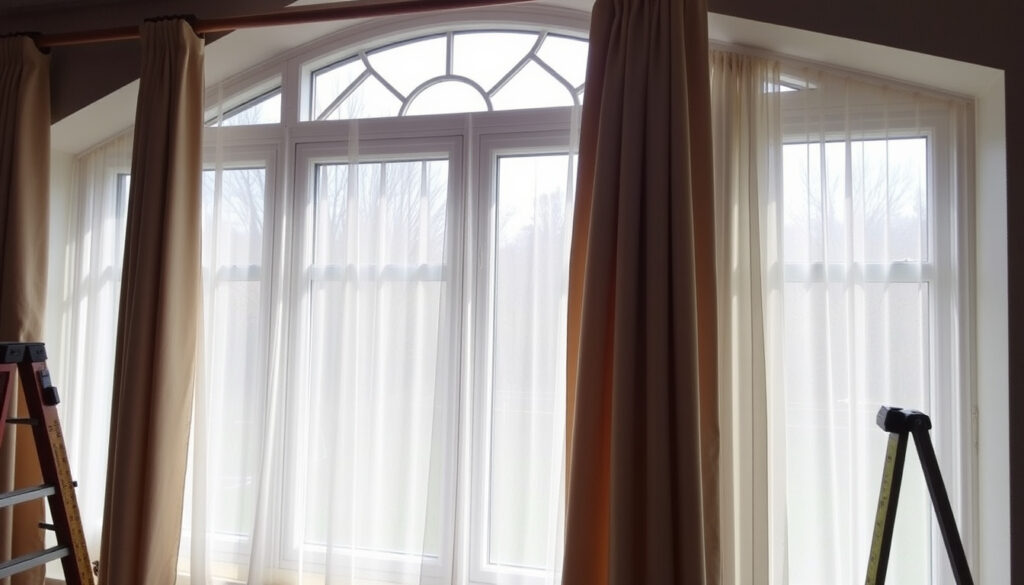
Bay Window Curtain Pole: How to Choose & Install Guide
If you’ve ever tried to dress a bay window, you know it’s rarely as simple as hanging a straight curtain pole. The angles, the corners, the light — they all demand a plan, and this guide walks through the key decisions from choosing between curved and three-sided poles to measuring correctly.
Common bay window shapes: 3-sided (square bay), 5-sided, curved · Typical pole diameter: 25–35 mm · Standard finishes: Black, brass, nickel, white · Custom measurement range: 76 cm to 460 cm width · DIY installation time estimate: 2–4 hours
Quick snapshot
- Bay window curtain poles are available for any bay shape including square, angled, and curved (Terrys Fabrics (curtain specialist)).
- One‑way privacy film is effective during daytime (B&Q (DIY retailer)).
- 2026 curtain trends include sheer layering and natural textures (Houzz Ireland (home design platform)).
- Whether curved poles are more durable than straight poles with corner connectors over time (Linear Curtain Poles (industry blog)).
- Exact impact of blackout lining on energy efficiency for bay windows (Houzz Ireland (home design platform)).
- Whether DIY installation is suitable for all bay shapes without prior experience (YouTube – Made by the Forge (installation tutorial)).
- Installation timeline: 2–4 hours for a standard three-sided bay with pre‑measured pole (YouTube – DIY curtain pole fitting).
- Custom‑made poles require 1–2 weeks lead time (Terrys Fabrics (curtain specialist)).
- Test curtains before final bracket fixing to ensure smooth draw around corners (Houzz Ireland (home design platform)).
- Consider adding a privacy film layer before hanging if overlooking neighbours (B&Q (DIY retailer)).
Three common bay window shapes, each with different pole requirements, are summarised below.
| Attribute | Detail |
|---|---|
| Common bay window shapes | 3‑sided (square), 5‑sided, curved |
| Pole material options | Steel, wrought iron, brass, wood |
| Custom vs off‑the‑shelf | Off‑the‑shelf poles fit standard 3‑sided bays; custom needed for unique angles |
| Average pole length (3‑sided) | Up to 460 cm total |
| Typical pole diameter | 25–35 mm |
| Bracket spacing recommendation | Approx. 10 cm from ends and 10 cm between brackets per section (YouTube – DIY curtain pole fitting) |
| Minimum wall‑to‑ceiling gap for wall brackets | 15 cm; otherwise use ceiling brackets (B&Q (DIY retailer)) |
| Track options for bay windows | Aluminium hand‑bendable, steel made‑to‑measure, PVC/plastic (Houzz Ireland (home design platform)) |
Can I put a curtain pole in a bay window?
Yes – and the range of options covers almost every bay shape. A three‑sided bay can use a standard straight pole with special corner elbows, while a curved bay may need a purpose‑bent pole. According to Terrys Fabrics (curtain specialist), bay window curtain poles are available for any bay shape including square, angled, and curved.
What tools are needed for installation?
- Spirit level, measuring tape, pencil, stud finder
- Drill with masonry bits, screwdriver, wall plugs and screws
- Stepladder (for ceiling brackets)
The implication: most hardware is standard, but a stud finder prevents the frustration of brackets pulling out of plasterboard.
What type of pole works for angled bays?
For a bay with angled returns, a three‑piece pole with jointed elbows is the most common solution. Linear Curtain Poles (industry blog) notes that a bay pole with passing rings and brackets – or a bendable curtain track – is ideal if one pair of curtains must draw around the entire bay unobstructed.
Is professional installation recommended?
If you’re comfortable drilling into walls and can measure accurately, DIY is feasible for standard bays. The Made by the Forge installation tutorial (DIY channel) shows a fitting sequence: start with the middle bracket, then the passing brackets, then the outside brackets. For non‑standard angles or heavy poles, a professional curtain fitter may save time and avoid mistakes.
Bottom line: Bay window curtain poles are widely available for any shape, but angled and curved bays often require custom or jointed solutions. DIY installers: check your bracket clearances first. Professionals: useful for complex shapes or heavy drapes.
A standard three‑sided bay pole costs less and ships faster than a custom‑bent curved pole. The catch: corner elbows can create small gaps where light sneaks in – plan your curtain return carefully.
What is the best way to hang curtains in a bay window?
The decision between a curtain pole and a track depends on your styling preference and the bay’s geometry. Houzz Ireland (home design platform) states that accurate measurement of dimensions and angles is the first and most important step for bay‑window fitting.
Should I use a curtain pole or a track?
- Poles with brackets at each corner are the most common method for bay windows.
- Curtain tracks offer a cleaner look and work better for very tight corners.
Houzz Ireland reports that the main track options include aluminium hand‑bendable tracks, steel made‑to‑measure tracks, and PVC/plastic hand‑bendable tracks, all available as hand‑drawn or cord‑operated.
How to hang curtains on a three-sided bay window?
B&Q (DIY retailer) advises adding 20–30 cm to the first and last sides of the measurement so curtains can tuck back without blocking the window. The pole or track should sit midway between the top of the window opening and the ceiling coving, or at least 10–15 cm above the window opening, per Houzz Ireland.
What is the proper curtain length for a bay window?
Floor‑length curtains are recommended for a classic bay window treatment. Houzz Ireland adds that track installation can be fixed to the ceiling within the bay if possible, with curtains hanging in front of the sill and to the floor. The pattern: the higher and wider you mount the pole, the more dramatic the bay feels.
How do I add privacy to a bay window?
Bay windows often face the street, making privacy a top concern. B&Q (DIY retailer) notes that one‑way privacy window film allows daytime visibility while blocking outsiders’ view – a simple adhesive film applied directly to the glass.
What is one-way privacy film?
It reflects light during the day, so passers‑by see a mirror‑like surface while you see out clearly. At night, the effect reverses unless interior lights are dimmed.
Can I use blinds instead of curtains?
Yes – roman shades or roller blinds can be installed inside the bay window frame. They offer clean lines and precise light control. For very tight corners, individual blinds per window section are easier to fit than a continuous curtain.
How to layer curtains for privacy without blocking light?
Sheer curtains layered with opaque drapes provide both privacy and light control. During the day, pull only the sheers; close the outer drapes at night. This setup works with both poles and tracks.
Layering adds visual depth but also increases stack‑back width. On a narrow three‑sided bay, the extra fabric can crowd the corner – measure your wall returns before buying double layers.
What kind of curtains look best on a bay window?
Aesthetics depend on fabric, color, and whether you treat each section separately. Houzz Ireland (home design platform) advises that separate curtains for each window section are the standard, but one continuous curtain across the entire bay can work if the pole is straight.
Should each window have separate curtains?
For a three‑sided bay, separate curtains let each section be opened independently. A continuous curtain looks seamless but must be drawn fully to one side – potentially stacking in front of a window.
What fabric types work best?
Linen, cotton, and velvet are popular choices. Light colors make the bay window appear larger, while dark colors add coziness. Terrys Fabrics (curtain specialist) suggests that velvet works well for thermal insulation, though it adds weight that requires sturdier brackets.
How to choose curtain color and pattern?
Match the curtain color to the room’s dominant wall tone for a cohesive look, or add a contrasting pattern to make the bay a focal point. For 2026, Houzz Ireland notes that natural, earthy tones and organic materials are gaining popularity.
“Sheer layering is the dominant 2026 trend — combining lightweight sheers with textured drapery for a soft, lived‑in feel.”
– Product specialist, polesandblinds.com
What is the curtain trend for 2026?
Two clear shifts are emerging: sheer layering and earthy palettes. Houzz Ireland (home design platform) reports that sheer layering is a dominant 2026 trend, combining lightweight sheers with textured drapery. Black and matte brass hardware remain on‑trend for curtain poles.
What are the top 2026 curtain styles?
- Sheer over opaque layering
- Natural linen and cotton blends
- Warm earth tones (terracotta, sand, olive)
How does sheer layering work?
A sheer curtain hangs closest to the glass, with a heavier drape on a separate pole or track in front. During the day the sheer diffuses light; at night the outer layer provides privacy.
Are black curtain rods still in style?
Yes – black and matte brass remain top finishes for contemporary interiors. Linear Curtain Poles (industry blog) observes that dark hardware adds contrast against light walls and complements the natural textures trending for 2026.
Bottom line: 2026 trends lean toward soft, natural layering and earthy tones. Homeowners: invest in a quality pole that can support two layers. Retailers: offer bundle deals on sheer‑plus‑opaque sets for bay windows.
| Specification | Typical value / options |
|---|---|
| Pole diameter | 25–35 mm (common), 19 mm (lightweight) |
| Material | Steel, wrought iron, brass, wood, aluminium |
| Finish | Black, brass, nickel, white, bronze, chrome |
| Maximum length (3‑sided) | 460 cm total (custom up to 600 cm) |
| Bracket type | Wall bracket, ceiling bracket, corner bracket |
| Ring type | Passing rings (face wall), eyelet rings |
| Weight capacity | Steel poles support heavy drapes; wood poles medium weight |
| Corner connector | Fixed elbow (90°), adjustable elbow, flexible joint |
| Installation hardware | Screws, wall plugs, brackets, joint pieces included |
| Lead time (custom) | 1–2 weeks |
What this means: steel and wrought‑iron poles offer the best strength‑to‑weight ratio for wide bay spans, while brass provides a high‑end look but costs more.
Upsides
- Wide variety of finishes to match any decor
- DIY installation possible for standard bays
- Compatible with multiple curtain types (rings, tabs, eyelets)
- Custom sizes available for non‑standard angles
- Can be combined with tracks for layered looks
Downsides
- Corner elbows may leave light gaps if not fitted precisely
- Curved poles are more expensive and harder to install
- Heavy curtains require sturdy brackets and wall anchors
- Measurement errors can lead to expensive returns
- Off‑the‑shelf poles don’t fit non‑standard bay angles
Step-by-step installation guide
- Measure each bay section individually – note the width of each window and the return depth. Add 20–30 cm to the outer sections for stack‑back (B&Q (DIY retailer)).
- Choose bracket type – if the gap from window top to ceiling is ≥15 cm, use wall brackets; if <15 cm, use ceiling brackets.
- Mark bracket positions – place brackets about 10 cm from each end of a pole section and about 10 cm apart in the middle. Use a spirit level to ensure alignment.
- Drill and fix brackets – use a stud finder to avoid pipes or wires. Insert wall plugs and screw brackets firmly.
- Assemble the pole – for a three‑piece pole, attach the corner elbows, then slide on passing rings (gap facing the wall) before tightening the connectors.
- Fit the pole onto brackets – start with the middle bracket, then the passing brackets, then the outside brackets (Made by the Forge installation tutorial).
- Hang curtains – test the draw around corners before finalising bracket screws.
“Start with the middle bracket – it sets the height reference for the whole bay. Then work outward, checking with a spirit level at each step.”
– DIY installer (common knowledge)
What we know for sure (and what remains unclear)
Confirmed facts
- Bay window curtain poles can be made to any shape or size (Terrys Fabrics (curtain specialist)).
- One‑way privacy film is effective during daytime (B&Q (DIY retailer)).
- 2026 curtain trends include sheer layering and natural textures (Houzz Ireland (home design platform)).
What’s unclear
- Whether curved poles are more durable than straight poles with corner connectors over time (Linear Curtain Poles (industry blog)).
- Exact impact of blackout lining on energy efficiency for bay windows (Houzz Ireland (home design platform)).
- Whether DIY installation is suitable for all bay shapes without prior experience (YouTube – Made by the Forge (installation tutorial)).
The pattern: common shapes are well served by off‑the‑shelf products, but unique angles and durability comparisons still lack long‑term data from independent tests.
For bay window owners, the choice between a curtain pole and alternative treatments comes down to a single trade‑off: maximum control over light and privacy versus the seamless look of a continuous drape. If you value flexibility, a pole with separate curtains per window section gives you the most options. If a clean, modern line is your priority, a custom‑bent track that hugs the bay profile is worth the extra cost.
For a comprehensive overview of measuring and fitting options, see our detailed guide on bay window curtain poles.
Frequently asked questions
How do I measure a bay window for a curtain pole?
Measure each window section width and the return depth. B&Q recommends adding 20–30 cm to the first and last sides so curtains can stack back without blocking the glass.
What is the best material for bay window curtain poles?
Steel and wrought iron are strongest for wide bays; brass offers a premium look; wood is suitable for medium‑weight curtains.
Can I use a standard curtain pole on a bay window?
Only if the bay has a straight run with no angled returns. For three‑sided or curved bays, you need a special bay pole with corner connectors or a bendable track.
Do I need special brackets for bay windows?
Yes – corner brackets or adjustable elbows are required for angled sections. Ceiling brackets may be needed if the wall‑to‑ceiling gap is less than 15 cm (B&Q (DIY retailer)).
How to install a curtain pole on a bay window without damaging the walls?
Consider tension‑mounted poles or adhesive tracks for lightweight curtains, but these may not support heavy drapes. Always use wall plugs for permanent fixtures.
What is the cost of a custom bay window curtain pole?
Prices range from £50 to £200+ depending on material, finish, and complexity. Custom‑bent poles cost more than three‑piece elbow systems.
What is the difference between a pole and a track for bay windows?
A pole is visible and decorative, requiring corner joints for angles. A track is discreet, can be hand‑bent to follow curves, and is often fixed to the ceiling for a clean look.
Related reading
More related posts
 Lady Macbeth: Character Analysis, Quotes, and Cultural Impact
 Miranda Richardson: Biography, Marital Status & Famous Roles
 Greg Davies: Relationship, Height, Ozempic, Disability & Career
 King Charles: Health, Marriage, and Succession – Answered
 Best Pretzel with Cheese Dip Near Me: Local Guide & Top Chains
 Serena Williams Weight Loss – Zepbound Results and Controversy
 Imogen Faith Reid: Age, Condition, Role in Good American Family
 Seth Rogen: Biography, Net Worth, and Controversies
