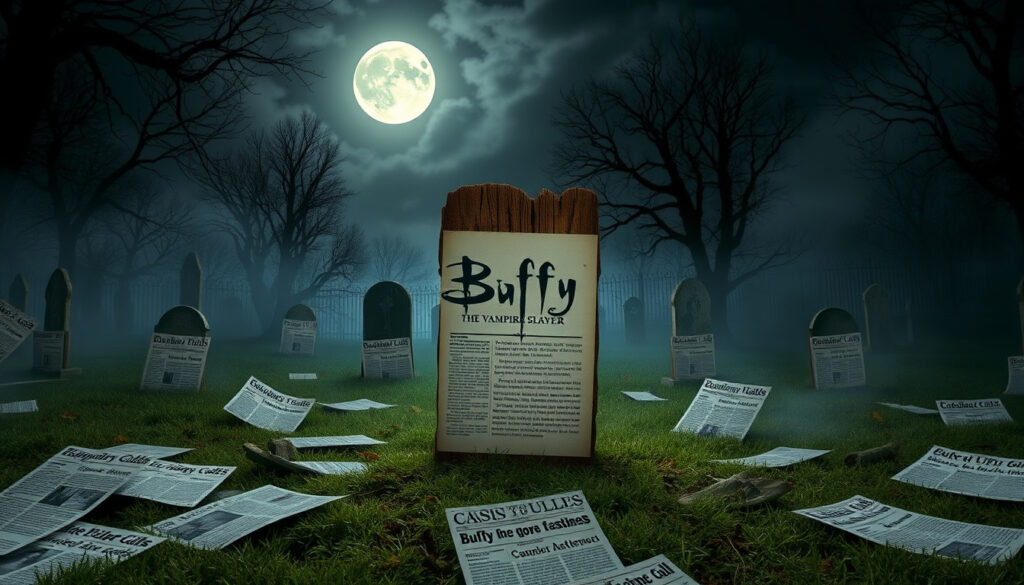
Buffy the Vampire Slayer: Controversies, Reboot & Cast
Sarah Michelle Gellar made the Buffy role her own for seven seasons, but the show’s legacy extends far beyond demon-slaying. Behind the cameras, there were banned episodes, casting shake-ups, and a reboot that’s finally inching toward reality after years of false starts. Some of it reads like drama even the show’s writers couldn’t have scripted.
Seasons: 7 · Episodes: 144 · Creator: Joss Whedon · Original Run: 1997–2003 · Based On: 1992 film
Quick snapshot
- Two Season 3 episodes were pulled from air after the Columbine massacre on April 20, 1999
- Ryan Kiera Armstrong cast as the new Slayer, announced May 2025 (ELLE)
- Whether Sarah Michelle Gellar and Alyson Hannigan had ongoing tensions off-screen remains unverified, per fan community discussions
- Exact details on which original cast members confirmed their return beyond speculation, per YouTube cast reports
Why was Buffy episode Earshot banned?
In spring 1999, two Buffy episodes met a fate no script could predict. The Columbine High School massacre on April 20, 1999 sent shockwaves through American schools—and through television boardrooms. Warner Bros. pulled both episodes from their original air dates over fears that Buffy content might be blamed if copycat violence erupted elsewhere.
The first casualty was “Earshot” (Season 3, Episode 18). The plot had Buffy literally hearing the thoughts of Jonathan, a lonely student who brings a gun to the school clock tower. ScreenRant notes that onlookers mistook Jonathan for a mass shooter—he was actually suicidal. In the aftermath of Columbine, any storyline involving a student with a weapon became radioactive.
The second was “Graduation Day Part 2” (Season 3, Episode 22), which featured a full-scale school battle and an explosion. CBR reports that WB executive Brad Turell worried that if any graduation ceremony anywhere resulted in violence, every news outlet would run Buffy clips. “If anything [violent] had happened at any graduation anywhere, every news organization would’ve run Buffy clips,” Turell recalled.
Other controversial episodes
Beyond Earshot, Buffy accumulated episodes that aged awkwardly or courted controversy. The Things notes that Season 6’s “Seeing Red” featured Spike’s attempted sexual assault on Buffy—a scene considered too disturbing to air by today’s standards. The episode did air, but rewatching it now feels different.
ScreenRant catalogs other episodes that raised eyebrows: “The Pack” (students possessed by hyenas), “I Only Have Eyes for You” (a ghost and student exchange bodies), and “Beauty and the Beast” (a literal prisoner-beast relationship). Whether these warrant banning or reflect the era’s creative boldness remains debated.
Buffy’s approach to school violence, sexuality, and trauma aged faster than its demon mythology. The Earshot delay set a precedent that echoes in today’s debates about media responsibility versus creative freedom.
What was Pedro Pascal in Buffy?
Long before he was the Mandalorian or the Last of Us, Pedro Pascal showed up on Sunnydale. IMDb records Pascal’s Buffy credit as Eddie, a relatively minor role that fans now scour episode guides to find. His appearance came during the show’s early seasons, before Pascal became a household name.
The same pattern holds for Nathan Fillion, who appeared in the Season 4 episode “The House in the City of Death.” IMDb confirms Fillion’s guest role predated his breakthrough on Firefly and Castle. These guest spots have become collector’s items for fans tracing the careers of actors who later became stars.
The reboot, meanwhile, has cast Chase Sui Wonders as a vampire named Shirley—announced August 11, 2025, per ELLE. Whether her character has roots in Pascal-style guest spots or represents a larger ensemble role remains to be seen.
What is considered the worst episode of Buffy the Vampire Slayer?
Fan forums and critics have spent years compiling worst-of lists. IMDb’s community ratings consistently rank certain episodes at the bottom: Season 1’s “The Phantom Menace”-referencing plots and early pacing issues drag down certain entries. “The Gift” and “Once More, with Feeling” dominate the top spots, which means the bottom contains episodes viewers skip on rewatches.
Season 6’s experimental episodes—”The Liquidifier” and similar plotting—draw particular criticism for tone shifts that alienated viewers who came for horror-comedy. Giant Freakin Robot reports that Gellar herself called Season Six the low point of her tenure. “Sarah Michelle Gellar hated Season Six,” the outlet notes, citing the dark tone and production stress.
Critics and fans agree: the “worst” Buffy episodes tend to be the ones that took the biggest creative swings. Safe episodes fade into forgettability; ambitious failures generate the most discussion.
Did Sarah Michelle Gellar and Alyson Hannigan get along?
Public appearances suggest genuine friendship. On talk shows, Gellar and Hannigan trade banter about their on-set dynamic, and Instagram interactions occasionally surface. However, YouTube discussions on cast secrets note rumors of tension behind the scenes—unverified claims that circulated in fan circles but never appeared in formal interviews.
Production secrets and cast drama remain difficult to verify independently. Most claims trace back to anonymous forum posts or secondhand reports. What’s documented: both actors pursued successful post-Buffy careers, suggesting any on-set friction didn’t permanently damage their professional trajectories.
For the reboot, ELLE reports that Gellar’s involvement is primarily as executive producer and recurring presence, not full-time cast. Hannigan’s participation remains unannounced. Whether they share screen time in the new series—or whether old tensions resurface—stays an open question.
Why was the Buffy Revival cancelled?
Calling it “cancelled” oversimplifies what actually happened. A Buffy revival has been in development for years, but multiple attempts stalled before gaining traction. The difference now: TV Guide reports that Hulu moved the project closer to pilot order as of February 2025, with Gellar in final talks for a recurring role.
The previous delays trace partly to rights complexity (original producers Fran and Kaz Kuzui hold significant stakes) and partly to finding the right creative direction. Father Roderick’s podcast notes that the reboot intends to focus on a new Slayer with an ensemble cast, signaling a deliberate departure from the single-hero model.
Joss Whedon, the original creator, has no involvement. TV Guide confirms this stems from 2021 allegations of a toxic work environment that effectively ended his Hollywood position. The reboot’s writers are Nora and Lila Zuckerman, with Chloé Zhao attached to direct.
A reboot without Whedon raises questions about tonal continuity. His vision defined the original—its quips, its darkness, its mythology. The new creative team inherits that legacy while deliberately rebuilding from scratch.
Timeline
Buffy’s history tracks from theatrical origins through television dominance to resurrection attempts.
| Date | Event |
|---|---|
| 1992 | Original Buffy film released |
| April 20, 1999 | Columbine massacre triggers episode delays |
| September 21, 1999 | “Earshot” airs after postponement |
| 2003 | Series concludes after seven seasons |
| 2021 | Whedon exits Hollywood amid allegations |
| February 3, 2025 | Variety reports Gellar in revival talks |
| August 2025 | Ryan Kiera Armstrong cast as new Slayer |
| August 1, 2025 | Gellar training video surfaces on Instagram |
| August 11, 2025 | Chase Sui Wonders cast announcement |
The pattern shows Whedon’s exit creating space for a revival that Gellar controls while deliberately cutting the creator who defined the original’s voice.
Confirmed vs Unclear
Certain facts anchor the Buffy narrative; others remain unresolved.
Confirmed
- Series ran 1997–2003 on The WB and UPN
- Created and showrun by Joss Whedon
- Two episodes delayed after Columbine (Earshot, Graduation Day Part 2)
- Hulu developing reboot as of August 2025
- Gellar confirmed as executive producer and recurring talent
- Ryan Kiera Armstrong cast August 2025, Chase Sui Wonders August 11, 2025
Unclear
- Exact air date for “Graduation Day Part 2” post-delay
- Whether Willow will be recast (Alyson Hannigan’s involvement unannounced)
- Full cast beyond initial announcements
- Reboot release date or episode count
- Nature of cast feuds—verified details remain scarce
Gellar described the revival process: “I wish there was a better word than overwhelming… heartwarming and exciting and also incredibly nerve-wracking.” — TV Guide
“From the moment I saw Ryan’s audition, I knew there was only one girl that I wanted by my side.” — Sarah Michelle Gellar
The contrast between Gellar’s enthusiasm for Armstrong and her distancing from Whedon defines the reboot’s complicated inheritance. Her reduced role signals a passing-of-the-torch story rather than a direct continuation.
For viewers who grew up with Buffy in syndication and fans discovering it through streaming, the reboot represents both opportunity and risk. Gellar’s involvement lends legitimacy, but her reduced role signals this is a passing-of-the-torch story rather than a direct continuation. Whedon’s absence—controversial as it is—opens space for fresh voices while cutting the creative thread that defined the original.
The show’s controversies (banned episodes, difficult seasons, behind-the-scenes tensions) haven’t stopped Buffy from remaining culturally relevant. The Things notes that even critics acknowledge the show’s willingness to tackle difficult topics—the Earshot delay was about external pressure, not internal cowardice.
For loyal fans watching from the sidelines, the question isn’t whether Buffy returns. It’s whether the reboot captures what made the original worth revisiting—or whether it’s a nostalgia vehicle that misses the point.
Related reading: Stranger Things Season 4 Cast
While reboot rumors spotlight new talents like Ryan Kiera Armstrong, fans continue grappling with cast deaths and career updates that have marked the original Buffy legacy.
Frequently asked questions
When was Nathan Fillion on Buffy?
Nathan Fillion appeared in Season 4 as a guest star in an episode that aired during the show’s transition from The WB to UPN. His Buffy credit predates his more famous roles on Firefly and Castle.
Is Buffy LGBTQ?
The show broke ground with its depiction of Willow’s relationship with Tara, one of television’s first sustained, positive portrayals of a gay relationship. The reboot’s “ensemble cast for diversity and fresh energy” suggests these themes will continue, per Father Roderick’s reporting on production notes.
Why did they replace Willow on Buffy?
Alyson Hannigan played Willow Rosenberg throughout the original run and was not replaced mid-series. Any recasting in the reboot would be a creative choice for the new iteration, not a continuation of the original cast.
How would Buffy have been different with Riff Regan as Willow?
Riff Regan reportedly auditioned for the Willow role before Hannigan was cast. Speculating on alternate casting paths belongs to the “what-if” territory that fan forums explore endlessly—but Hannigan’s seven-season tenure suggests the production made the right call.
What feud rumors exist between Gellar and Hannigan?
Unverified rumors of off-screen tension circulate in fan communities, but no documented interviews or credible sources have confirmed ongoing conflict. Their joint talk show appearances and occasional social media interactions suggest at least functional professional chemistry.
What happened to Nicholas Brendon?
Nicholas Brendon (Xander Harris) left the show after Season 7 and faced personal challenges afterward. Fan discussions note his departure as a notable cast change, but specific details remain outside verified fact territory.
Who are the executive producers of the reboot?
Executive producers include Sarah Michelle Gellar, Gail Berman, Fran Kuzui, Kaz Kuzui, and Dolly Parton. Notably, Joss Whedon is excluded from the production due to 2021 allegations.
More related posts
 Storm Huntley: Husband, Net Worth, and Career Facts
 Richard Kiel: The Gentle Giant’s Height, Health, and Family
 Nancy Allen: Life After Carrie and RoboCop
 Curtis Pritchard: biography, relationships, and TV career
 Cristiano Ronaldo: Net Worth, Retirement, Messi Comparison (2025)
 Harry Potter Questions Answered: Movies, Trivia, Plot Mysteries
 Greg Davies: Relationship, Height, Ozempic, Disability & Career
 Peter Rabbit: Story, Film Backlash, and 50p Coin Value
