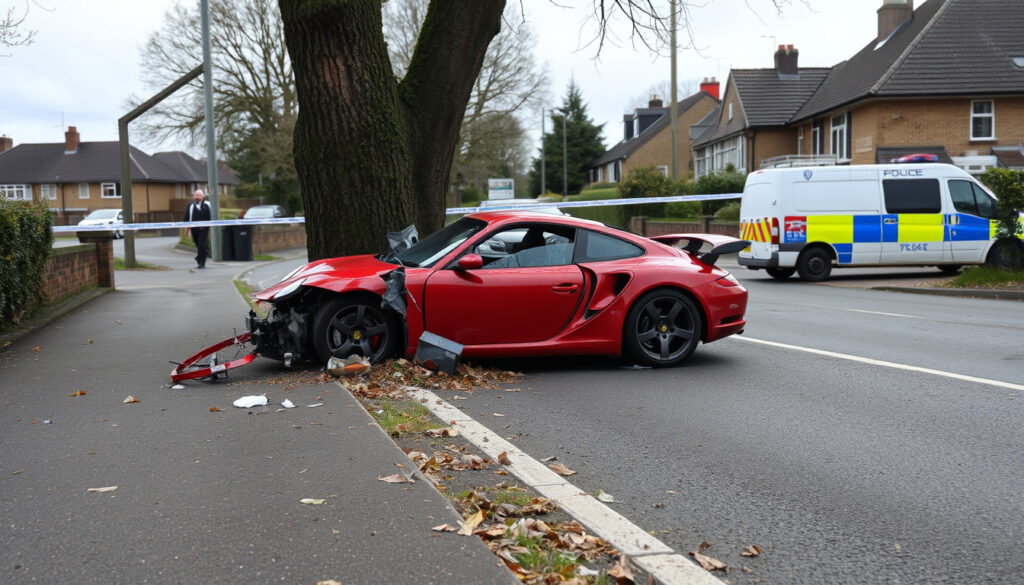
Paul Walker Death: Crash Cause, Speed, and Aftermath
Most people remember exactly where they were when the news broke that Paul Walker had died — the Fast & Furious star was a passenger in a 2005 Porsche Carrera GT driven by his friend Roger Rodas when the car crashed and caught fire in Santa Clarita, California, on November 30, 2013. More than a decade later, the official investigation still answers the big questions — and leaves a few human ones permanently open.
Date of crash: November 30, 2013 · Location: Santa Clarita, California · Vehicle: 2005 Porsche Carrera GT · Driver: Roger Rodas · Passenger: Paul Walker · Coroner’s cause of death: Traumatic and thermal injuries
Quick snapshot
- Walker was a passenger in a 2005 Porsche Carrera GT driven by Roger Rodas (CBS News (network reporting))
- Speed, not drugs, racing, or mechanical failure, was the primary factor (CNN (investigation coverage))
- Coroner’s cause of death: traumatic and thermal injuries (Reuters (wire service))
- The exact speed at impact was never pinned to a single number; estimates ranged from roughly 80 mph to as high as 100 mph (Reuters (wire service))
- Whether Walker felt pain after impact cannot be answered by autopsy evidence (Reuters (coroner reporting)) (Reuters (wire service))
- The private moment Vin Diesel learned the news was not independently documented (E! Online (entertainment news))
- November 30, 2013 — the single-car crash in Santa Clarita (Los Angeles Times (California newspaper))
- March 2014 — official findings attribute the crash to speed (BBC News (broadcaster))
- 2016 — the $10.1 million settlement surfaced publicly (BBC News (broadcaster))
- The civil case closed with a $10.1 million settlement for Meadow Walker (WCNC (NBC affiliate))
- Reach Out Worldwide, Walker’s relief organization, continued after his death (WCNC (NBC affiliate)) (WCNC (NBC affiliate))
- Furious 7, released in 2015, delivered the franchise’s tribute (E! Online (entertainment news)) (WCNC (NBC affiliate))
Seven facts, one pattern: the public record is narrower than the rumor mill, and every confirmed detail traces back to two official investigations — the sheriff’s crash probe and the coroner’s exam.
| Field | Value |
|---|---|
| Full name | Paul William Walker IV |
| Born | September 12, 1973 |
| Died | November 30, 2013 |
| Known for | The Fast & Furious films, Into the Blue |
| Crash vehicle | 2005 Porsche Carrera GT |
| Driver | Roger Rodas |
| Official cause of death | Traumatic and thermal injuries |
What is the reason Paul Walker died?
Walker died because the 2005 Porsche Carrera GT he was riding in went out of control at high speed and hit trees and a light pole on Hercules Street, then caught fire. The Los Angeles County Sheriff’s Department identified unsafe speed as the primary collision factor, and the coroner separately listed Walker’s cause of death as traumatic and thermal injuries.
What caused the crash?
- The car struck trees and a concrete light pole on Hercules Street in Santa Clarita (Los Angeles Times)
- Investigators found no problems with the brakes, throttle, fuel system, steering, suspension, or electrical systems (BBC News)
- The vehicle was a 2005 Carrera GT, the model later named in court filings over the crash (CNN (lawsuit reporting))
In plain terms, the sequence went from fast to fatal: the Porsche struck fixed objects on Hercules Street and caught fire. The investigation found nothing wrong with the car itself, which is why the official record keeps returning to speed as the explanation.
Mechanical failure is the favorite internet theory, but the sheriff’s investigators traced the wreck to speed, not a faulty part. The car that crashed was functioning — the situation wasn’t.
Who was the driver?
- Roger Rodas, a close friend of Walker, was driving; Walker was in the passenger seat (CBS News)
- Rodas also died in the crash; the coroner attributed his death to multiple traumatic injuries (Reuters)
- The settlement between Meadow Walker and Rodas’s estate later made Rodas’s role part of the legal record (WCNC)
The confusion matters because a lot of the online conversation credits or blames Walker for “his” crash. He was a passenger that day, and the official record treats both men’s deaths as one event.
Who was Paul Walker’s best friend in real life?
- Roger Rodas was one of Walker’s closest friends and the man beside him when the crash happened (CBS News)
- Walker’s Fast & Furious co-stars described him as family, but Rodas was the friend at his side in his off-screen life (E! Online)
Their friendship was rooted in a shared love of high-performance cars and the Southern California car scene. Rodas and Walker’s relationship explains why the crash landed so hard on Walker’s inner circle: the friend driving the car was also the friend lost. The official record keeps them together, too — same crash, same force, two fatal injury lists (Reuters).
The implication: the cause of death has a clear official answer — high speed turned an ordinary drive into a fireball. Everything else is rumor layered on top of a record that was already closed by March 2014.
The pattern: both investigations reached the same conclusion, and no later legal filing overturned it.
How fast was Paul driving when he died?
He wasn’t driving — Roger Rodas was. That’s the first correction the record requires. The speed question still matters, though, because speed is what investigators blamed for the loss of control.
- The sheriff’s investigation estimated the Porsche was traveling between roughly 80 and 93 mph before impact (Reuters)
- A widely cited police statement put the car at about 94 mph in a 45 mph zone when it hit a light pole (BBC News)
- The coroner’s earlier estimate ran as high as 100 mph (CNN (lawsuit coverage))
The numbers differ because they came from different stages of the investigation. The coroner’s figure was a first look; the sheriff’s range was the product of a full reconstruction. Either way, every number points to the same conclusion: the Carrera GT was moving at roughly twice the posted speed limit on a commercial street.
Was the Porsche mechanically sound?
- Investigators found no defects in the car’s brakes, throttle, fuel system, steering, suspension, or electrical systems (BBC News)
- No evidence of mechanical failure emerged from the crash reconstruction (BBC News)
- Settlement documents later described speed, road conditions, and the car’s age and tires as key factors (WCNC)
The mechanical record is unambiguous: as far as investigators could determine, the Porsche was functioning properly when it crashed. The settlement reporting added nuance — the Carrera GT was an older supercar, on a public road, at a speed the street wasn’t designed for (WCNC).
The range matters more than any single headline number. Whether the car was doing 80 mph or 94 mph, it was traveling at roughly twice the speed limit — and that gap already explains the outcome.
The pattern: every number in the public record points the same direction — a high-performance car at high speed on a street built for 45 mph. The exact figure matters less than the ratio.
The implication: 80 mph or 94 mph, the crash energy was already beyond what the street or the car’s safety systems could absorb.
Was Paul Walker wearing a seatbelt when he died?
Yes — according to the sheriff’s investigation. Both Walker and Rodas were wearing seat belts, and both airbags deployed (Reuters). The finding surprises people because it undercuts the assumption that a belt would have saved him.
Does a seatbelt guarantee survival in a high-speed crash?
- Both men’s seat belts were found in use (Reuters)
- Both the driver and passenger airbags deployed (Reuters)
- The impact was followed by fire, which compounded the injuries (Los Angeles Times)
A seat belt keeps you inside the car; it doesn’t change the kinetic energy of a 90 mph impact into a fixed object. In round numbers, that’s four times the crash energy of a 45 mph collision — before factoring in the fire. The seatbelt finding and the speed finding tell the same story: the systems worked, and the forces were still overwhelming.
The trade-off: safety systems reduce risk, they don’t remove it. A belt and an airbag did their job on November 30, 2013, and the crash was still fatal — which tells you how violent the impact was.
Could Paul Walker have survived?
This is the question the record can’t fully answer, because investigators never released a formal “would have survived if” calculation. What the record does provide is the injury list, and it reads as fatal on its own.
What injuries did the autopsy report list?
- Walker’s cause of death: traumatic and thermal injuries (Reuters)
- Rodas’s cause of death: multiple traumatic injuries (Reuters)
- The car burned after impact, adding fire to the collision sequence (Los Angeles Times)
The coroner’s listing matters: “traumatic and thermal” means the impact itself was fatal and the fire compounded it. That combination is why survival theories have no official footing — no injury list like that leaves room for the “he could have been pulled out” scenarios that circulate online.
Did rescue crews reach Walker in time?
- Witnesses heard the crash and saw flames; the Porsche was burning when emergency crews arrived (Los Angeles Times)
Officials never issued a response-time analysis tied to the survival question, and no public witness account describes a rescue that reached either man before the fire. Whether a faster response would have changed the outcome is a counterfactual, not a finding. The people closest to the wreck reported fire, not a rescue that got there in time. The combination of impact injuries and fire means the survivability question is medical speculation, not investigative fact.
Celebrity-death rumors love a “he could have been saved” angle, but the coroner’s injury list doesn’t support it. Both men died from the crash itself; the fire shaped the aftermath, not the outcome.
The judgment: survival talk is understandable — nobody wants a beloved actor’s story to end at a light pole. But the evidence says the trajectory was already fatal before the flames started.
What were Paul Walker’s last words before he died?
No one knows, and anyone who claims otherwise is repeating fiction. No confirmed recording, no witness account, and no official document places Walker’s final words on the public record. The BBC’s summary of the crash report, for example, details the wreck sequence — not a single word from Walker.
Was Paul Walker in pain when he died?
- Pain cannot be measured after death; the autopsy documents injuries, not sensation (Reuters)
- Walker’s fatal injuries were traumatic and thermal (Reuters)
This is the hardest question in the thread. The medical record says what killed him; it cannot say what he felt. Any account of his experience in the final moments is speculation, not finding. That distinction is the whole answer: the autopsy settles the cause, and it is silent on suffering.
What did witnesses see after the crash?
- Witnesses reported hearing the crash and seeing flames (Los Angeles Times)
- The scene involved trees and a concrete light pole on Hercules Street (Los Angeles Times)
The witness record is about the fire, not the conversation inside the car. No public witness account includes a documented final statement from Walker. That silence is the finding. Everything online that claims to quote Walker’s last words is invented, because nothing in the official record quotes him at all.
The upshot: “last words” searches return fan fiction because the factual record is empty. The dignified answer is the same one investigators gave: not documented.
Who inherited Paul Walker’s money?
Walker’s daughter, Meadow Walker, was the primary beneficiary of his estate. Because she was a minor at the time of her father’s death, the inheritance was handled through a trust structure rather than a direct payout (Los Angeles Times).
Who is Meadow Walker?
- Meadow was a minor when her father died, which is why the estate moved through a trust (Los Angeles Times)
- She reached a $10.1 million settlement with Roger Rodas’s estate over the crash (WCNC)
The legal picture took shape over years. The settlement was agreed in 2014 and became public in 2016 (E! Online). The Los Angeles Times reported that more than $7.2 million of the settlement was placed in a trust for Meadow.
Her public tributes have kept her father’s memory visible since his death. Public estimates at the time put Walker’s net worth near $25 million, but the probate reporting focused on the trust structure rather than a full accounting (Los Angeles Times).
Did Paul Walker have a will?
- The will’s full terms were never made public; the trust outcome is what the record establishes (Los Angeles Times)
- The estate’s direction is clear: Meadow was the beneficiary and the trust was the mechanism (Los Angeles Times)
- The civil settlement closed the largest claim tied to the crash (WCNC)
Whether a formal will existed, the estate’s direction is clear: Meadow was the beneficiary, the trust was the mechanism, and the settlement closed the biggest legal question tied to the crash.
The catch: the estate numbers that circulate online are estimates, not audited figures. The probate reporting confirms the structure — a trust for Meadow, anchored by the $7.2 million settlement portion — not a precise final accounting.
The pattern: the estate’s public footprint ends at the trust — the rest of the accounting stayed private.
How did Vin Diesel find out Paul Walker died?
The public side is documented: the death was confirmed on November 30, 2013, and the news broke worldwide within hours. The private side — who called Diesel, when, and what was said — was never independently documented (E! Online).
What did Vin Diesel say after Paul Walker died?
- Diesel posted a public social media tribute after the news broke (E! Online)
- He spoke of Walker in the brotherly terms that defined their Fast & Furious bond (E! Online)
- Production on Furious 7 paused after the crash; the film was later completed and released with a tribute to Walker (E! Online)
The tributes were part of the story from the first day. Diesel’s posts, and Dwayne Johnson’s alongside them, gave the public a way to grieve a franchise that had become a family narrative. For Furious 7, that meant finishing the film with Walker’s remaining footage, visual effects, and body doubles — a production decision that turned the movie into a memorial.
What did Dwayne Johnson say about Paul Walker’s death?
- Johnson, Walker’s Fast & Furious co-star, also made a public statement honoring him (E! Online)
The cast’s responses became a global news story in the days after the crash. Johnson’s message ran through the same themes as Diesel’s: sudden loss, a bond built over years of filming, and gratitude for having known Walker. The exact private moment Diesel learned the news, though, belongs to him alone — and no public account has ever documented it.
What this means: the cast’s public grief became the lasting public memory, but the record ends at the news alert. The “how did he find out” question has a documented public answer and an undocumented private one — and conflating the two is how rumors start.
The upshot: what the cast said publicly is documented; what happened privately is not — and that line is where the reliable record ends.
Timeline of the Crash and Its Aftermath
- — Walker creates the disaster-relief organization Reach Out Worldwide (WCNC)
- — Walker and Rodas die in a single-car crash in Santa Clarita (CBS News)
- — Official findings attribute the crash to speed, not mechanical failure (CNN)
- — Furious 7 is released with a tribute to Walker (E! Online)
- — The $10.1 million settlement becomes public (Los Angeles Times)
Why the timeline matters: the official findings came fast, the legal aftermath took years, and the cultural tribute never really ended. Each stage added a layer to the record — and none of them changed the central conclusion from March 2014.
Confirmed Facts vs. Open Questions
Confirmed facts
- Walker and Rodas died in a single-car crash in Santa Clarita on November 30, 2013 (CBS News)
- Rodas was driving the 2005 Porsche Carrera GT; Walker was the passenger (CBS News)
- Speed was the primary factor, not drugs, racing, or mechanical failure (CNN)
- Walker’s cause of death was traumatic and thermal injuries (Reuters)
- Meadow Walker was the primary beneficiary of the estate (Los Angeles Times)
What’s unclear
- Walker’s exact last words are not in the public record (BBC News)
- Whether Walker felt pain after the crash cannot be determined from autopsy evidence (Reuters)
- The private moment Vin Diesel learned the news is not independently documented (E! Online)
- The exact speed at impact was never nailed to a single number; estimates ranged from 80 mph to roughly 100 mph (Reuters)
- Whether a faster response or a different vehicle would have changed the outcome was never established (BBC News)
The pattern: the confirmed list is built on official documents, while the open questions all hinge on private experience that no document can capture.
The Crash in the Official Record
“The primary collision factor was unsafe speed.”
Los Angeles County Sheriff’s Department, cited in CNN (investigation coverage)
“Walker died from traumatic and thermal injuries; Rodas died from multiple traumatic injuries.”
Los Angeles County coroner’s office, cited in Reuters (coroner reporting)
“Rodas was not executing particularly hazardous maneuvers when the car lost control, but was still partially accountable.”
Court materials, cited in E! Online (entertainment news)
Together, those three statements frame the whole case: a speed-based crash, an unsurvivable injury pattern, and a legal settlement that assigned partial responsibility to the driver’s estate.
The Takeaway
Paul Walker’s death is one of those celebrity stories that keeps generating new rumors because the human questions — last words, pain, private phone calls — were never answered. The official record is narrower and older: a friend driving too fast, a car hitting a pole and catching fire, and a coroner’s report that ended the debate about cause. For the fans who made Walker a star, the choice is clear: honor the verified record — a friend driving too fast on a public road — and stop feeding the rumors the investigation already closed.
Frequently asked questions
How old was Paul Walker when he died?
Walker was 40. He was born on September 12, 1973, and died on November 30, 2013 (CBS News).
Was alcohol or drugs a factor in Paul Walker’s crash?
No. The sheriff’s department ruled out alcohol and drugs as factors; the primary collision factor was unsafe speed (CNN).
Did Paul Walker have any children?
Yes — one daughter, Meadow Walker, who was the primary beneficiary of his estate (Los Angeles Times).
How did Fast & Furious 7 handle Paul Walker’s death?
Production paused after the crash, then the film was completed using Walker’s remaining footage, visual effects, and body doubles. It was released in 2015 with a tribute to him (E! Online).
What was Paul Walker’s net worth when he died?
Public estimates at the time put his net worth near $25 million, but the estate’s exact accounting stayed private (Los Angeles Times).
What happened to Paul Walker’s charity Reach Out Worldwide?
The disaster-relief organization Walker founded continued after his death and remains part of his public legacy (WCNC).
Related reading
- Philip Seymour Hoffman Death: Cause, Relapse & Legacy
- JFK Jr. Plane Crash: What Happened and Unanswered Questions
Both of those deaths left the same shape behind: a closed official record and an open field for speculation.
More related posts
 Pain in Lower Left Abdomen: Causes, Red Flags & When to Worry
 Thomas Brodie-Sangster: Age, Wife, Net Worth & Facts
 Funny Jokes: Best Collections for Adults & Friends
 Dustin Diamond: Death, Conviction, Net Worth, and Final Years
 St. Vincent: Biography, Relationships, and Music Career
 UK Cold Weather Warning: Current Alerts, Forecasts & Records
 Jeffrey Dean Morgan: Actor Biography, Age, Wife, and Kids
 Victoria Coren Mitchell: Children, Net Worth & Poker
