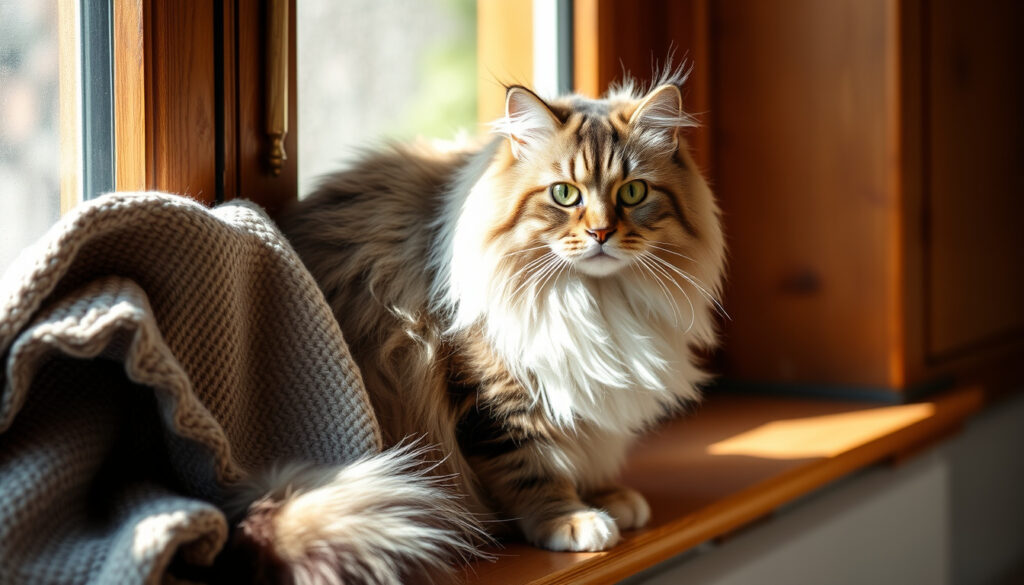
Siberian Cat: Guide to Temperament, Size, and Allergies
There’s something quietly fascinating about a cat breed that carries a thousand years of natural evolution in its fur: the Siberian cat, a landrace breed from the forests of Russia and Ukraine, manages to be both a living piece of history and a surprisingly practical choice for modern homes, especially for those navigating allergies. This guide walks through what makes them special, how they compare to the Maine Coon, and what it actually means to own one in Ireland.
Origin: Russia and Ukraine (landrace breed) · Average Weight (Female): 12–20 pounds (5.4–9.1 kg) · Full Maturity Age: 5 years · Coat Type: Triple-layer, water-resistant coat · Hypoallergenic Claim: Lower levels of Fel d1 protein reported
Quick snapshot
- Originated in Russia and Ukraine as a natural landrace breed (Wikipedia (encyclopedia))
- Triple-layer water-resistant coat requires regular grooming (Cat Fanciers’ Association (breed registry))
- Full maturity reached at 5 years (The International Cat Association (breed registry))
- Exact level of Fel d1 protein reduction compared with other breeds (Royal Canin (pet nutrition company))
- Precise number of active breeders in Ireland (Civic Post (lifestyle publication))
- Lifespan range — commonly cited as 12–15 years but not confirmed by primary sources (Royal Canin (pet nutrition company))
- Exact weight range — sources vary (Petful cites 8–12 lbs for females, while others say 12–20 lbs) (Petful (pet care guide))
- Recorded history since around 1000 AD (Cat Fanciers’ Association (breed registry))
- Slow growth — full size achieved at 5 years (The International Cat Association (breed registry))
- First documented in cat shows in the 1800s (Cat Fanciers’ Association (breed registry))
- Growing interest in Ireland — few breeders currently active (Civic Post (consumer guide))
- TICA and CFA registration increasingly accessible (Civic Post (consumer guide))
- More allergy-focused research needed on Fel d1 levels (Civic Post (consumer guide))
Five facts, one pattern: the Siberian cat is a breed where ancient origins meet modern allergy science, but the evidence is still catching up with the claims.
| Attribute | Detail |
|---|---|
| Origin | Russia and Ukraine (landrace breed) (Wikipedia (encyclopedia)) |
| Average Weight (Female) | 12–20 pounds (5.4–9.1 kg) (Royal Canin (pet nutrition company)) |
| Full Maturity Age | 5 years (TICA (breed registry)) |
| Coat Type | Triple-layer, water-resistant coat (CFA (breed registry)) |
| Hypoallergenic Claim | Lower levels of Fel d1 protein reported (TICA (breed registry)) |
Are Siberian cats a good pet?
For most households, yes — with a few important caveats. Four years of kittenhood, a triple coat that demands attention, and a personality that’s part-dog, part-cat make them a rewarding but not hands-off pet.
What are the downsides of Siberian cats?
- High grooming needs — 2–3 brushings per week, daily during seasonal sheds (Petrebels (pet care guide))
- Slow to mature — kitten-like energy lasts 3–4 years (TICA (breed registry))
- Not truly hypoallergenic — some people still react (Royal Canin (pet nutrition company))
- Strong prey drive — not ideal for homes with small rodents (Tvaryny (breed database))
- Expensive in Ireland — kittens range €300–€950 (Civic Post (consumer guide))
Do Siberian cats like to be held?
Most do. Owners and breeders consistently describe them as “dog-like” in their affection — they follow you from room to room, greet you at the door, and many enjoy being held or draped over a shoulder (Petrebels (pet care guide)). That said, individual temperament varies, and some cats prefer to stay planted on the couch rather than your lap.
Females weigh on average between 12–20 lbs and full maturity is reached at 5 years.
Can Siberian cats be left alone for 8 hours?
They handle solitude better than many breeds, but they are social animals. A Siberian left alone for a full workday will likely be fine if they have toys, a scratching post, and a window to watch (Wikipedia (encyclopedia)). For longer absences, a second cat is recommended — Siberians generally get along well with other pets.
What is so special about Siberian cats?
Three things set them apart: their ancient lineage, their unique coat, and their potential to be easier on allergy sufferers than most other breeds.
Siberian cat hypoallergenic traits
- The International Cat Association (TICA) (breed registry) states they are considered a hypo-allergenic breed due to reduced Fel d1 protein levels
- Chewy (pet retailer guide) notes they naturally produce lower Fel d1 levels
- Royal Canin (pet nutrition company) warns no cat can be considered truly hypoallergenic
Origin and history
Siberian cats first appeared in recorded history around the year 1000.
The Cat Fanciers’ Association (CFA) (breed registry) describes recorded history reaching back to around 1000 AD. They were a natural landrace breed — meaning they evolved without much human interference — in the forests of Russia and Ukraine. Their heavy coat and sturdy build developed in response to harsh winters.
Coat and physical characteristics
The triple-layer coat is water-resistant, a relic of their forest origins. It sheds seasonally (heavily), and requires regular brushing to prevent matting. The CFA describes them as “medium to medium-large, strong triple-coated” cats with “surprising heft for their size” (Cat Fanciers’ Association (breed registry)).
TICA calls them hypoallergenic; Royal Canin says no cat truly is. An Irish buyer relying on the hypoallergenic claim alone may face disappointment — personal testing is the only real proof.
The paradox underscores the need for personal testing before committing.
Is a Siberian cat a Maine Coon?
No — they are separate breeds with distinct standards, though they are often confused because both are large, fluffy, and friendly.
Differences in size and build
Two breeds, one clear size gap. Maine Coons are the heavyweights, with males reaching up to 25 pounds. Siberian females average 12–20 pounds (Petful (pet care guide)). The CFA notes that Maine Coons have a “square muzzle” and a “shaggy” coat, while Siberians have a “round head” and a “triple coat” (Cat Fanciers’ Association (breed registry)).
Differences in coat and color patterns
- Siberian: triple-layer, water-resistant, all colour patterns accepted
- Maine Coon: shaggy, less dense coat, more limited colour range per standard
- Siberian: distinct ruff around neck and tufted paws (CFA (breed registry))
Differences in temperament
Both are friendly and dog-like, but with different flavours. Siberians are described as even-tempered, playful, and adventurous — somewhere between a Maine Coon’s laid-back royalty and a Bengal’s energy (Wikipedia (encyclopedia)). They tend to be more independent than Maine Coons, though still deeply loyal.
The pattern: if you want a bigger, more laid-back cat, go Maine Coon. If you want a more moderate size with higher energy and a lower-shedding coat, go Siberian.
Which is bigger, Maine Coon or Siberian?
Maine Coons are larger by a clear margin — but both breeds have wide weight ranges depending on sex and individual genetics.
An Irish family comparing the two faces a concrete trade-off: Maine Coon means more cat (and more food bills), but Siberian means slower growth and more years of kitten-like play.
Size comparison: weight and length
Four data points, one clear ranking. Weenect Ireland (pet tracker guide) lists Siberian males at 15–20 pounds and up to 12 inches tall. Royal Canin (pet nutrition company) gives 6–9 kg for males and 4–6 kg for females. Maine Coon males reach up to 25 pounds.
Growth rate differences
TICA (breed registry) notes that Siberians are “slow to mature” and reach full maturity at 5 years. Maine Coons reach full size around 3–4 years, meaning Siberian owners sign up for a longer kitten phase.
Male vs female sizes
- Siberian male: 15–20 pounds (Weenect Ireland (pet tracker guide))
- Siberian female: 12–20 pounds (Petful (pet care guide))
- Maine Coon male: up to 25 pounds
| Breed | Male Weight | Female Weight | Full Maturity | Average Lifespan |
|---|---|---|---|---|
| Siberian | 15–20 lbs (Weenect Ireland (pet tracker guide)) | 12–20 lbs (Petful (pet care guide)) | 5 years (TICA (breed registry)) | 12–15 years (commonly cited) |
| Maine Coon | up to 25 lbs | 12–18 lbs | 3–4 years | 12–15 years (commonly cited) |
The trade-off is clear: Maine Coon buyers get a bigger cat faster; Siberian buyers wait longer but get a more moderate-sized companion with a longer playful window.
Are Siberian cats available in Ireland?
They are — but the market is small. A handful of breeders operate around the country, and kittens are often booked in advance.
Breeders and adoption in Ireland
The number of active Siberian breeders in Ireland is uncertain. Some cats are registered with TICA (breed registry) and CFA (breed registry), while others come through import. Adoption from rescues is rare — the breed is still uncommon enough that most available cats are kittens from breeders. For information on other breeds, see our guide on Cane Corso: Breed Facts, Legal Status & Temperament Guide.
Price range for Siberian kittens
Classified ads typically list kittens between €300 and €950 (Civic Post (consumer guide)). The wide range reflects differences in pedigree, registration, and breeder reputation.
Import considerations
- Some Irish buyers import from UK or EU breeders
- Post-Brexit import rules apply for UK-registered cats
- Health certificates and vaccinations required for entry
An Irish buyer who finds a Siberian kitten for under €300 should ask serious questions about health testing and registration — the breed’s rarity means low prices often signal backyard breeding or unregistered crosses.
Due diligence is essential when purchasing a rare breed in Ireland.
Upsides and downsides
Upsides
- Affectionate and playful — good with families and other pets (Petrebels (pet care guide))
- Lower Fel d1 protein — potentially better for allergy sufferers (TICA (breed registry))
- Stunning triple coat with seasonal colour variation (CFA (breed registry))
- Independent but loyal — dog-like personality (Tvaryny (breed database))
- Slow to mature — longer kitten phase for owners who enjoy it
Downsides
- High grooming commitment — 2–3 times per week (Petrebels (pet care guide))
- Not truly hypoallergenic — some people still react (Royal Canin (pet nutrition company))
- Expensive in Ireland — €300–€950 (Civic Post (consumer guide))
- Kitten energy lasts 3–4 years — not for households seeking a calm cat immediately
- Strong prey drive — bird and rodent owners beware (Tvaryny (breed database))
nationalreport.uk, chewy.com, eveningledger.uk, zubairkhalid.com, cats.fandom.com, petrebels.com, tvaryny.com
Frequently asked questions
Do Siberian cats like to be held?
Most do — they are known for their dog-like affection and often enjoy being carried or draped over a shoulder (Petrebels (pet care guide)). Individual temperament varies, so early socialisation matters.
What are the downsides of Siberian cats?
High grooming needs (2–3 brushings per week), slow maturity (kitten energy for 3–4 years), not truly hypoallergenic, strong prey drive, and a high price tag in Ireland (€300–€950) (Royal Canin (pet nutrition company)).
Can Siberian cats be left alone for 8 hours?
Yes, with proper enrichment — toys, scratching posts, and a window view. They handle solitude better than many breeds but do best with a companion cat (Wikipedia (encyclopedia)).
Do Siberian cats pick one person?
They form strong bonds with their primary caregiver but are generally friendly to all household members. Some owners report a preference for one person, similar to a dog’s loyalty (Tvaryny (breed database)).
Are male or female Siberian cats better?
Males tend to be larger (15–20 lbs) and more affectionate (Weenect Ireland (pet tracker guide)). Females are smaller (12–20 lbs) and often more independent. Neither is “better” — it depends on household dynamics.
Do Siberian cats sit on your lap?
Many do, but not all. They are affectionate and enjoy close contact, but some prefer to sit beside you rather than on you. Breeders note individual variation (Petrebels (pet care guide)).
What age do Siberian cats calm down?
They typically mature around 4–5 years. Until then, they maintain a playful, kitten-like energy (TICA (breed registry)). After full maturity, they become more laid-back but remain active.
For an Irish household considering a Siberian, the choice is clear: invest the time in grooming and early socialisation, and you’ll gain a loyal, playful companion that stands apart from the common breeds. Skip the grooming or underestimate the cost, and you’ll face a decade of frustration. The breed rewards preparation.
More related posts
 Funny Jokes: Best Collections for Adults & Friends
 Xi Jinping: Biography, Power, and Key Questions Answered
 Karren Brady: Net Worth, Weight Loss, and 2026 West Ham Exit
 Puff Daddy: Name Changes, Current Status & Peer Views
 Kirsten Farage: Age, Nationality, Job, Marriage to Nigel Farage
 Erika Kirk: Biography, CEO of Turning Point USA
 Richard Blackwood: Career, EastEnders, and Current Projects
 Michael Jackson Cause of Death: Propofol Overdose and Final Hours
