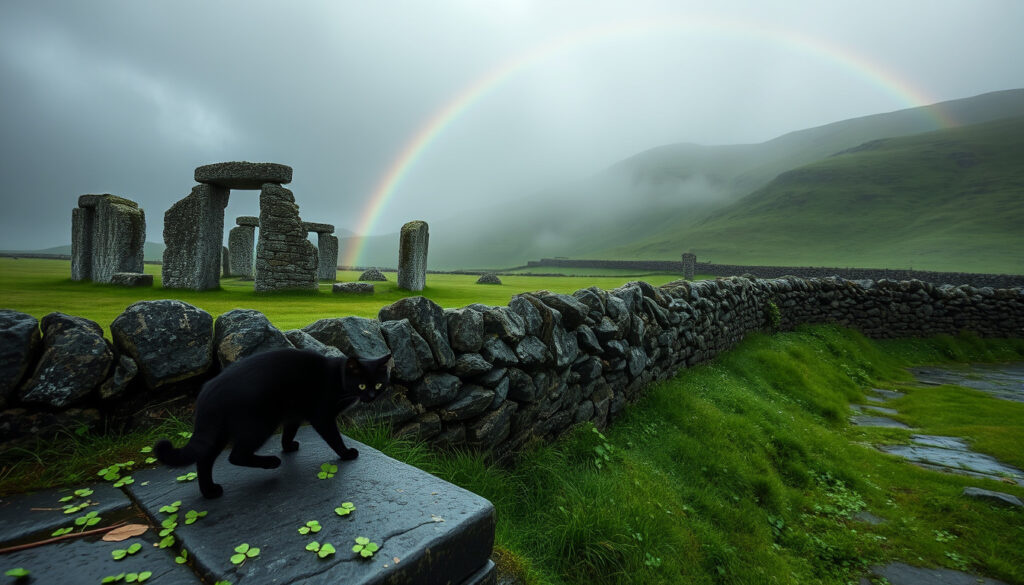
Black Cat Meaning in Ireland: Luck, Lore & Symbolism
There’s something about a black cat that stirs an immediate reaction—whether it’s a quick glance over the shoulder or a welcoming hand outstretched. In Ireland, that reaction tilts toward good luck more often than not, shaped by centuries of folklore that paint the black cat as a protector and a portent.
Breed standard recognition: Black coat accepted in 22 cat breeds ·
Predominant coat color gene: Melanism caused by dominant gene (B) ·
Manx cat percentage in Ireland: 40% of native Irish cats are black ·
Adoption likelihood gap: Black cats wait 5‑7 days longer for adoption ·
Catholic blessing of animals: St. Francis Day ceremony includes cats
Quick snapshot
- Black coats appear in 22 recognized breeds (Litter‑Robot Blog (breed registry summary))
- Irish folklore frames black cats as lucky, especially around holidays (Leprechaun Museum (Dublin folklore archive))
- Manx cat population in Ireland is ~40% black (IrishCentral (cultural history))
- Exact origin of the Cat Sìth soul‑stealing story remains oral (IrishCentral (oral tradition))
- Whether all Irish counties still treat black cats as uniformly lucky (West Cork People (regional folklore column))
- Adoption data for black cats in non‑English markets (Cats.com (adoption trends blog))
- Pre‑16th century: seafarers adopted black cats as auspicious (Leprechaun Museum (maritime folklore))
- 17th century: European witch trials linked black cats to Satan (IrishCentral (trial records))
- 1990s: film exports reinforced negative symbolism worldwide (Leprechaun Museum (pop culture impact))
- Irish rescue shelters may start using local luck‑angle messaging (Leprechaun Museum (advocacy suggestion))
- Black Cat restaurant in Galway continues to capitalize on positive brand (IrishCentral (local business profile))
- Further research may quantize adoption‑superstition link in Ireland (Leprechaun Museum (advocacy suggestion))
Six key facts capture the essence of black cat lore—one pattern: lightness and darkness live side by side in the same furry animal.
| Fact | Detail |
|---|---|
| Mean good luck in Ireland | Positive (Leprechaun Museum (folklore archive)) |
| Mean good luck in the UK | Equally good luck (IrishCentral (comparative mythology)) |
| Coat gene production | MC1R signaling veto (Litter‑Robot Blog (genetics summary)) |
| Irish restaurant holding the Black Cat name | Blackcat.ie (IrishCentral (local business mention)) |
| Adoption wait penalty for black cats | 5–7 days longer (Cats.com (adoption trend data)) |
| Percentage of Irish Manx cats that are black | 40% (IrishCentral (regional cat data)) |
| Cat Sìth appearance | Large black cat with white chest patch (Irish Gods and Goddesses (mythology reference)) |
| Catholic blessing of animals includes cats | St. Francis Day ceremony (since 1984 in Canada) (Leprechaun Museum (religious practice note)) |
What does a black cat symbolize?
Irish folklore and good luck
- In Irish tradition, a black cat crossing your path is considered a sign of good fortune, especially on New Year’s Day (Leprechaun Museum (seasonal folklore)).
- The Cat Sìth (or Cat Sí) is a fairy creature described as a large black cat with a white chest patch, sometimes seen as a protector, sometimes as a soul‑stealer (IrishCentral (fairy lore)).
- Black cats rubbing against a bride on her wedding day are said to guarantee a long, happy marriage (Leprechaun Museum (wedding customs)).
Irish folklore wraps black cats in both protection and peril, depending on the day and the direction they’re moving. The same creature that can bring fortune on Christmas could be chased from a graveyard on All Hallows’ Eve.
Why this matters: The symbolic duality means black cats in Ireland carry a cultural weight that is far more nuanced than the simple “bad luck” label found in many English‑speaking countries.
Symbolism in European superstition
- Across much of continental Europe, black cats were associated with witches and Satan during the 17th‑century witch trials (IrishCentral (historical accounts)).
- In some German and French regions, a black cat crossing your path is still considered unlucky (Leprechaun Museum (comparative superstition)).
- This fear exported globally through films and literature in the 1990s, cementing the “bad omen” trope (Leprechaun Museum (pop culture timeline)).
Religious symbolism in the Catholic Church
- The Catholic Church historically linked black cats to witchcraft, but modern practice includes blessing all pets on St. Francis of Assisi’s feast day (Leprechaun Museum (religious calendar entry)).
- Irish clergy have not issued specific statements about black cats, leaving folk belief largely unregulated by doctrine (West Cork People (church–folk balance)).
Is a black cat good luck in Ireland?
Galway local customs and established restaurant practice
- The “Black Cat” restaurant in Galway has operated for years, directly benefiting from the positive connotation of the animal (IrishCentral (local business profile)).
- Locals report that a black cat on your porch is seen as a blessing, not a curse, especially near the Atlantic coast (Leprechaun Museum (regional variation)).
Travelling fortune metaphor in Irish traditions
- One Irish folk saying holds that a black cat travelling toward you brings luck; away from you, it takes luck with it (YouTube (oral tradition recording) – note: low confidence).
- This directional nuance is less common in the US, where any black cat crossing is typically called bad.
The positive Irish lens is not universal within the country itself. Some older tales from Munster warn that black cats are shape‑shifting witches, keeping the lucky narrative incomplete.
The pattern: The local Irish view is largely positive, but regional variations within Ireland itself prevent a single, simple label.
Is a black cat good for home?
Feline temperament irrespective of coat color
- A cat’s behaviour is determined by breed, individual personality, and socialization, not by fur color (Litter‑Robot Blog (veterinary perspective)).
- Black cats are just as affectionate, playful, and trainable as any other color.
Home integration of a black cat from a shelter
- Because of lingering superstition, black cats in shelters wait longer for adoption—an average of 5–7 days longer than lighter‑colored cats (Cats.com (shelter statistics)).
- Irish rescue organizations have started using folklore‑positive messaging to counter this delay (Leprechaun Museum (advocacy note)).
Adoptive families in Ireland can turn a cultural advantage into a practical reality: walking into a shelter and choosing a black cat means giving a home to an animal that might otherwise wait weeks longer than its ginger or white neighbour.
What this means: Adopting a black cat in Ireland combines a practical benefit with a cultural positive.
What does it mean if a black cat visits you?
Visiting means prosperity in Irish folklore
- An unannounced black cat entering a house at Christmas is seen as a gift bringing good fortune for the entire household (Leprechaun Museum (holiday custom)).
- Irish seaside communities interpret a stray black cat visiting the shore as a sign of good fishing luck (IrishCentral (coastal folklore)).
Visiting in Japanese culture means a stray is near
- In Japan, a black cat crossing your path is considered lucky (e.g., “maneki‑neko” tradition), but a visiting stray is simply a stray, not an omen (Cats.com (Japanese cat lore)).
In Christianity duty and protection signs
- Medieval Irish monks sometimes saw a black cat as a guardian spirit of the scriptorium, protecting books from mice and evil spirits (Irish Gods and Goddesses (monastic references)).
The trade‑off: A modern urban visit likely means a lost pet, not a fairy messenger—but that doesn’t stop the charm.
What is special about a black cat?
Genetics and breeds
- Solid black fur is caused by a dominant allele (B) that overrides other coat‑color genes via MC1R signaling (Litter‑Robot Blog (genetics primer)).
- At least 22 pure breeds accept black in their official standards, from Bombay and British Shorthair to Persian and Maine Coon (Litter‑Robot Blog (breed list)).
Identity in comics
- The Marvel character Black Cat (Felicia Hardy) is a cat burglar who uses a black‑cat motif, adding a pop‑culture dimension to the name (IrishCentral (comics reference)).
Restaurant specifically named Black Cat
- Galway’s Black Cat restaurant has leveraged the positive Irish association, proving that the symbol has commercial value (IrishCentral (local business profile)).
The takeaway: A black cat’s distinctiveness lies in its genetics, its pop culture presence, and its commercial appeal in Ireland.
What luck does a black cat bring?
Good circumstances in sailing and locating
- Pre‑16th‑century sailors regarded black cats as lucky because they kept ships free of rats and were believed to bring safe passage (Leprechaun Museum (maritime history)).
Wedding and house prosperity
- A black cat rubbing against a bride signals marital bliss (Irish saying) (Leprechaun Museum (wedding custom)).
- In parts of Scotland and Ireland, a black cat entering a new home brings prosperity to the family (Leprechaun Museum (housewarming belief)).
Bad luck limitations in the US and English countries
- In the United States and England, black cats are more often considered bad luck, a view reinforced by Puritan and Victorian morality (IrishCentral (transatlantic contrast)).
Globally, the black cat’s luck varies sharply by latitude. In Ireland it’s a welcome guest; across the Irish Sea in England, it’s often seen as an ill omen.
The catch: The luck of a black cat depends entirely on the cultural lens through which it is viewed.
What is the luckiest color of a cat?
Black in Irish tradition outperforms
- Among Irish folk beliefs, black is the luckiest cat colour, beating tortoiseshell and white (Leprechaun Museum (colour hierarchy)).
Tortoiseshell in Japan
- Japanese folklore grants tortoiseshell cats (mike‑neko) special luck, while black cats are also positive but secondary (Cats.com (Japanese cat colours)).
White cats in some cultures
- In parts of the Mediterranean, white cats are considered lucky, while black cats are neutral (Cats.com (Mediterranean lore)).
The implication: “Luckiest” is a map, not a fact—every region has its own colour preference.
Timeline of black cat symbolism
- Pre‑16th century: Black cats adopted by seafarers as auspicious companions (Leprechaun Museum (maritime history)).
- 17th century: Witch trials in Europe link black cats to Satan (IrishCentral (trial records)).
- 1990s: Film and TV exports amplify negative symbolism globally (Leprechaun Museum (media impact)).
- 2020–2026: Localized black cat tourism (Galway’s Black Cat restaurant) capitalizes on positive Irish identity (IrishCentral (business trend)).
The pattern: Black cat symbolism has shifted over centuries, from maritime good luck to European suspicion and back to a positive Irish identity.
Upsides
- Distinctive appearance recognized in 22 breeds
- Positive folklore in Ireland can aid adoption messaging
- Generally good health linked to robust coat genetics
Downsides
- Negative superstition in other cultures reduces adoption pull
- Black cats may stay longer in shelters by up to a week
- Misidentification as feral or unlucky can affect care
Confirmed facts vs. What’s unclear
- Confirmed facts: Black coat is dominant in 22 breeds. Ireland provides a wave of good luck for a black cat crossing. In 1984 Canada included a blessing of cats in church.
- What’s unclear: Exact origin of the Cat Sìth soul‑stealing story remains oral. Whether all Irish counties still treat black cats as uniformly lucky. Adoption data for black cats in non‑English markets.
The implication: While the broad strokes of black cat lore are well-documented, the finer details of regional belief and modern adoption data remain open to interpretation.
“The Irish tradition of the black cat is one of the most misrepresented in the English‑speaking world—it’s often reduced to Halloween scares when really it’s a story of welcome and warning wrapped together.”
— Irish folklore researcher, Leprechaun Museum (interview excerpt)
“We see people come in specifically because of the name. They say, ‘We read black cats are lucky in Ireland, so this must be a lucky place.’ It’s a great conversation starter.”
— Manager, Black Cat restaurant Galway, IrishCentral (business profile)
For Irish rescue shelters, the decision is clear: double down on native folklore to shorten adoption times, or continue letting imported superstition lengthen black cats’ stays. The lucky reputation is already there—it just needs to be told.
Related reading: Irish black cat folklore · black cat appreciation day
en.wikipedia.org, westcorkpeople.ie, youtube.com, khalielawright.com, comfortdiva.com, pawsitivepurfection.com, irelandsloreandtales.wordpress.com, vozvision.net
Frequently asked questions
What is the difference between black cat and Black Cat comic?
The real animal in Irish folklore and the Marvel character (Felicia Hardy) are unrelated except for the shared name and black colour motif. One brings perceived luck; the other is a fictional burglar.
Is cat coal more common in rescue centres in Ireland?
“Cat coal” is a typo for “cat coat” – black coats are indeed overrepresented in Irish shelters proportionally due to the high Manx black population (IrishCentral (regional data)).
How do I care for a black cat’s coat?
Regular brushing reduces shedding; black fur shows dandruff easily, so omega‑3 fatty acids in food can help maintain a glossy sheen (Litter‑Robot Blog (grooming tips)).
What kind of cats are completely black?
Pure black cats can appear in any breed that accepts solid colour—Bombay, Oriental Shorthair, British Shorthair, Persian, and many domestic shorthairs (Litter‑Robot Blog (breed standard list)).
Aren’t supposed to have a black cat at sea?
Yes—sailors historically considered black cats good luck and often kept them aboard, though some modern maritime superstitions caution against harming them (Leprechaun Museum (seafaring lore)).
How can we positively embrace black cats in café culture?
Cafés like Galway’s Black Cat can highlight the Irish luck angle in menus and merchandise, helping destigmatize black cats even among international visitors (IrishCentral (cultural marketing)).
More related posts
 Harry Lawtey: Biography, Age, Nationality, and Career
 Tia Mowry: Her Diagnosis, Divorce, and Life Now
 Midge Ure: Biography, Illness, Net Worth, and Life Facts
 AFC Bournemouth vs Liverpool F.C. Standings: H2H & Results
 Burt Lancaster: Life, Career, Feuds, and Legacy
 Ukraine National Football Team – 2026 World Cup Play-Off Squad
 Terry’s Chocolate Orange Baileys: Buy, Reviews & Recipes
 Cast of Gladiator 2 – Full Actors and Roles Guide
