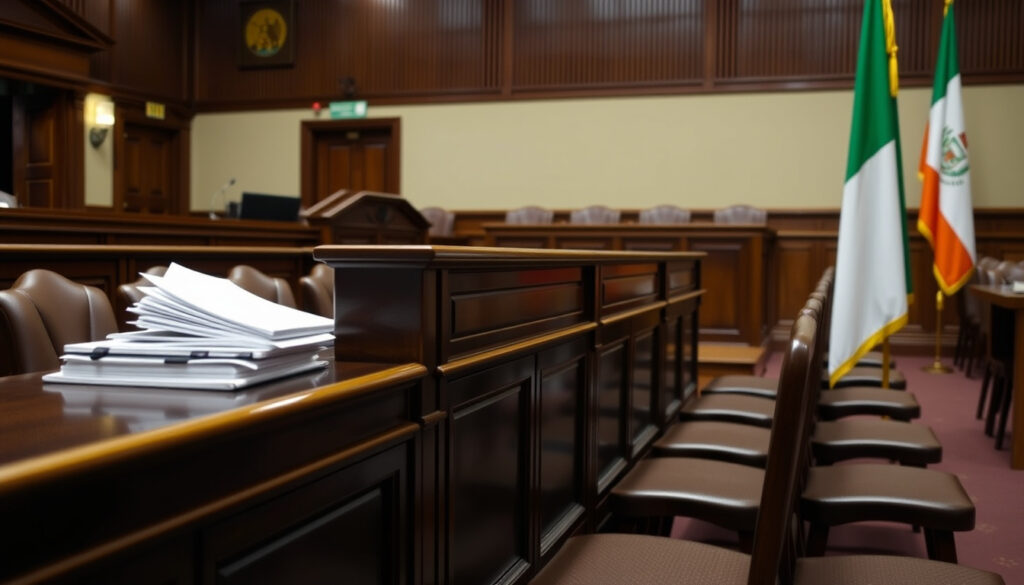
Jury Service in Ireland: Pay, Excuses, Attire & What to Expect
That envelope from the Courts Service can feel a bit heavy, but jury service in Ireland is simpler than you might expect once you know what’s waiting. Whether you’re wondering about pay, valid excuses, or the best way to dress, this guide covers every practical detail — including what happens if you nod off in court.
Typical jury service duration: 5 to 10 days ·
Daily payment (first 10 days): €35 per day ·
Daily payment (after 10 days): €70 per day ·
Age requirement: 18 to 70 years ·
Number of jurors in a criminal trial: 12
Quick snapshot
- Age: 18–70 (Citizens Information)
- Duration: 5–10 days typical (Citizens Information)
- Pay: €35/day (€70 after 10 days) (Courts Service of Ireland)
- Excuses allowed: illness, student, caring duties (Courts Service of Ireland)
- Valid: medical cert, full-time student, carer (Courts Service of Ireland)
- Invalid: personal inconvenience, dislike of court (Courts Service of Ireland)
- Employer refusal not a valid excuse (Courts Service of Ireland)
- Arrive by 9:30 AM
- Dress smartly
- Bring your summons letter and ID
- Expect waiting time before assignment
- Sleeping: contempt of court – fine or imprisonment (Citizens Information)
- Phone use: removal from jury (Citizens Information)
- Missing duty: fine up to €2,500 (Citizens Information)
Six parameters define your jury service obligations: age, allowance, and the potential cost of non-attendance. Here’s the breakdown.
| Item | Value |
|---|---|
| Minimum age for jury service | 18 |
| Maximum age for jury service | 70 |
| Daily allowance (days 1–10) | €35 |
| Daily allowance (day 11+) | €70 |
| Number of jurors in criminal trials | 12 |
| Fine for not attending | Up to €2,500 |
Can I refuse jury duty in Ireland?
Technically, no. Jury service is compulsory for eligible citizens. Refusing to attend without a valid excuse can lead to a fine — up to €2,500 according to the Courts Service of Ireland (official court authority). But there are lawful ways to be excused or deferred.
What are valid excuses for jury duty in Ireland?
- Serious illness or disability (medical certificate required) (Courts Service of Ireland guidance)
- Full-time student status
- Being a full-time carer or a new parent with no alternative childcare
- Self-employed persons facing serious business harm (Courts Service of Ireland)
Who is exempt from jury duty in Ireland?
- People over 65 (the summons age stops at 70, but those 65+ can be excused automatically) (Courts Service of Ireland)
- Full-time students, certain teaching staff with principal certification
- Practising doctors, dentists, nurses, midwives, vets, pharmacists
- Religious ministers or members of religious orders
- Certain Oireachtas and State office holders
How to get dismissed or excused from jury duty
You must respond to your summons — either online via the Courts Service jury response system (official online portal) or by post. Attach copies of supporting documents. You cannot request excusal by phone. Another person (including an employer) cannot apply on your behalf except in exceptional cases like illness or incapacity (Courts Service of Ireland).
Personal inconvenience, dislike of courts, or an employer’s refusal are not valid excuses. The judge has final discretion, so expect to provide solid proof.
The implication: if you lack documented proof of a recognized excuse, your options for excusal are limited.
Do you get paid for jury service in Ireland?
Jurors receive a daily allowance, but there’s nuance around self-employment and employer obligations.
How much do you get paid for jury duty in Ireland?
- Days 1–10: €35 per day (Courts Service of Ireland (employment rights guide))
- Day 11 onward: €70 per day
- Lunch is provided on trial days (Citizens Information (official public advice))
Are travel expenses covered?
Travel expenses are reimbursed at public transport rates, and a subsistence allowance may also be paid (Citizens Information).
Does my employer have to pay me during jury service?
The Juries Act 1976 protects employees — your employer must continue to pay you during jury service (Courts Service of Ireland). However, there is no statutory compensation for self-employed people. If you are self-employed and jury service would seriously harm your business, you can apply for excusal (Courts Service of Ireland).
Self-employed individuals face a trade-off: no compensation unless they prove serious business harm. The Courts Service of Ireland notes this gaps in the 1976 Act — plan accordingly.
The pattern: the legal framework protects employees but leaves self-employed jurors to bear the financial burden of civic duty.
What should I wear for jury duty in Ireland?
Dress codes exist to maintain the dignity of the courtroom. The Courts Service of Ireland (official court administration) recommends smart, respectful attire — business casual works well.
Is there a dress code for jury duty in Ireland?
- Smart trousers or skirt with a collared shirt or blouse
- Jacket or blazer optional but fine
- Closed-toe shoes
What not to wear to court
- Jeans, shorts, t-shirts with slogans
- Hats (unless required for religious reasons)
- Overly casual footwear like flip-flops
The catch: dressing too casually can undermine the courtroom’s authority and may draw a judge’s reprimand.
What is serving on a jury like?
The process from summons to verdict is structured. Here’s what happens at each stage.
How are jurors selected?
Names are randomly drawn from the electoral register. You receive a summons letter with a date and instructions to respond online. On arrival, you join a panel; the judge and barristers question potential jurors to select the final 12 for a criminal trial (Citizens Information).
What happens in the courtroom during a trial?
- Opening statements from prosecution and defence
- Presentation of evidence (witnesses, documents, exhibits)
- Closing arguments
- Judge’s legal instructions to the jury
- Jury deliberation in private to reach a unanimous or majority verdict
What does a typical day look like?
Arrive around 9:30 AM. After selection, you listen to evidence and arguments. The trial may break for lunch (provided on trial days). Afternoon sessions continue until the judge adjourns. Deliberations can extend into the evening. The Supreme Court of Ireland (highest court) launched an online platform in 2022 to simplify the process for jurors.
What if I fall asleep during jury duty?
Falling asleep during proceedings is taken seriously. It’s considered contempt of court, which can carry a fine or even imprisonment (Citizens Information).
What happens when a juror sleeps in court?
The judge may dismiss the juror and replace them with an alternate. If a juror repeatedly fails to stay awake, the trial could be delayed or a mistrial declared.
Can a sleeping juror be removed?
Yes. The judge has the authority to remove a juror who is not paying attention, ensuring the integrity of the trial.
What are the legal consequences of not paying attention?
Beyond contempt, the juror may be ordered to pay costs for any delay or retrial. The Courts Service of Ireland emphasizes that attentive participation is a legal duty.
Step-by-Step Guide to Jury Service in Ireland
- Receive your summons — The letter arrives by post with a date and a unique reference number.
- Respond online — Use the Courts Service jury response portal (official online system) to confirm attendance, request excusal, or defer.
- Prepare documents — If applying for excusal, gather medical certificates, student enrolment, or proof of caring responsibilities.
- Arrive on time — Check the courthouse location, parking options, and aim to arrive by 9:30 AM. Bring your summons and photo ID.
- Dress appropriately — Smart, respectful clothing; avoid casual wear.
- Participate attentively — Listen to evidence, take notes if allowed, and follow the judge’s instructions.
- Deliberate and reach a verdict — Discuss the case with fellow jurors in private, and aim for a unanimous decision (majority may be accepted in some cases).
The pattern: the process from summons to verdict requires careful attention at every stage, with failure to respond being the most common pitfall.
Confirmed Facts vs. What’s Unclear
Confirmed facts
- Jurors receive a daily allowance as specified by the Courts Service of Ireland (Courts Service of Ireland).
- You may be excused for medical, student, or care reasons (Courts Service of Ireland).
- Falling asleep in court is considered contempt of court with potential fines (Citizens Information).
What’s unclear
- The exact amount employers must pay varies by contract; the law protects employment but does not set a minimum payment level.
- Whether a specific excuse will be accepted depends on the judge’s discretion — there is no guaranteed outcome.
- Self-employed compensation is not provided, and the definition of “serious business harm” can be subjective.
- The online response system is the official method, but whether it works without issues in all cases or how technical problems are handled is not fully specified.
What the Courts Say
“Jury service is an important civic duty that ensures the right to a fair trial.”
Courts Service of Ireland (official court authority)
“If you are summoned for jury service, you must attend unless excused by the county registrar or trial judge.”
Citizens Information (official public advice body)
“The online platform for jury service makes it easier for citizens to respond and access information.”
The message is consistent: attend promptly, respond formally, and participate attentively. For employees in Ireland, the choice to serve is clear: your job is protected, but you must treat the duty with the seriousness it deserves. The trade-off for self-employed individuals is steeper — no compensation unless you can demonstrate exceptional harm.
ww2.courts.ie, courts.ie, courts.ie, courts.ie, civicpost.co.uk, circulars.gov.ie, jury.courts.ie, sdworx.ie, storyly.nl
Frequently asked questions
How long does jury service usually last in Ireland?
Most trials last between 5 and 10 days, though complex cases can extend considerably.
Can I bring my mobile phone into the courtroom?
You may bring a phone, but use during proceedings (including texting, browsing, or photos) can lead to contempt of court and removal from the jury.
What happens on the first day of jury service?
You check in, are assigned to a panel, and may face voir dire questioning. Unselected jurors may be released or called again later.
Do I need to take time off work for jury duty?
Yes, you are required to attend during working hours. Your employer must allow time off and pay you as per the Juries Act 1976.
Can I be called for jury duty more than once?
Yes, but if you have served within the previous 3 years, you can ask to be excused (Courts Service of Ireland).
What if I have a holiday booked during my summons period?
You can request a deferral through the online system. Supporting documents like flight itineraries are recommended.
Is there parking available at the courthouse?
Parking varies by courthouse. Check the specific court’s website or plan to use public transport.
For anyone called to serve, the choice is clear: respond promptly, prepare thoroughly, and participate attentively — or face legal consequences that can go far beyond a fine. The recent case of Paul Doyle and the Reena Virk fact-check remind us how seriously courts treat proceedings.
More related posts
 Thomas Doherty: Age, Height, Relationships, and Career Updates
 Alan Osmond: Health, Career, and Death of an Osmond Brother
 Lela Loren: Ethnicity, Power Role, and Current Life
 Best Pretzel with Cheese Dip Near Me: Local Guide & Top Chains
 Train to Paris from London – Fares, Times and Booking Guide
 Vodafone Free Number 0800 Customer Service 24/7 Ireland
 Post Malone: Wife, Children, Health, Net Worth & More
 Jim Curtis: Age, Career, and Jennifer Aniston Relationship
